


21st Century Printing: Not Just Ink on a Page
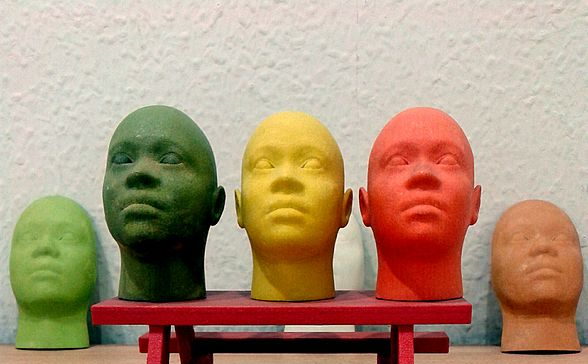
Full color objects created using 3D printing techniques in July, 2012. Image from Wikimedia Commons.
In 2013, printing no longer just means the passive production of a sheet of paper covered in ink. Rapid technological advances have made the reproduction of 3D objects possible and increasingly economical. This, however, has sparked widespread concern over issues ranging from copyright infringement to gun regulation.
Charles Hull built the first version of a 3D printer, which he called a “stereolithography apparatus,” in 1984. Hull patented the original machine in 1986, and after roughly two years of experimentation and modification released the first commercially available version in 1988. Around the same time, employees at DTM (now part of B.F. Goodrich) were developing their own 3D printing technology called Selective Laser Sintering, and Scott Crump, founder of Stratasys, was developing Fused Deposition Modeling. The early 3D printers were used for rapid prototyping, meaning that an engineer would design an object as a computer aided design (CAD) file and use one of the above methods to see what the object would like in actual physical form. The problem with the aforementioned processes was durability; the materials used produced flimsy physical models useful for nothing more than getting an idea of an object's three-dimensional appearance.
In 1992, 3D Systems created the first true 3D printer. 3D printers deposit one layer of powder at a time (be it plastic, metal, or various other substances), and a laser heats and fuses this layer to the one beneath it. The object is then built from the ground up, much like a brick wall, except on the molecular or atomic level. 3D Systems’ development of new nanocomposites, blends of powdered plastic and powdered metals, allowed 3D printers to produce sturdy, usable parts. The development of nanocomposites opened up 3D printing to a new range of potential uses, from medicine to industrial manufacturing, which universities and corporations started experimenting with by the end of the 1990s.
While still largely relegated to motivated hobbyists and design shops, 3D printers are beginning to enter the mass consumer market. What used to be the sole domain of factories and manufacturers are now seen as the next gadget for the tech-savvy home. This popularization has mainly been caused by the printers’ falling prices: what used to cost $6,000 can now be had for $600. In addition, the push to have a 3D printer in regular homes has led to shrinking and simplifying the complicated machinery into something that can be used by the average person. As the printers follow the inevitable course towards affordability and ease of use, they will be found in more homes and used in wider capacities.
Beyond the advent of novel and more affordable 3D printers, there has also been a change in how people relate with the digital and physical aspects of their environment. The burgeoning “maker movement,” inspired by start-up MakerBot Industries, has taken the long-exiting passion for programming and designing in the digital domain and brought it into creating tangible products. These almost evangelical builders and hackers spread designs for innumerable products online, which are then plugged into a printer to create everything from spare parts to board games. The reduced need for resources, shipping, and energy has also caused 3D printers to win the favor of those interested in sustainable living.
With the accelerating proliferation of 3D printers to homes around the world, many are beginning to question the legal implications of printing name brand products straight from home. Some are comparing the coming legal battle to that between the music and film industries and their fans after the introduction of illegal downloads. However, a crucial difference lies in what laws dictate the protection of products that might be printed. Unlike music and film, which are protected under copyright laws, other intellectual property and patent laws protect manufactured materials. Patent laws are generally much less strict than copyright laws. For example, patents typically only last up to twenty years so anything older is free to copy. Additionally, patent laws only protect full products; so creating a replacement part (as opposed to an entire product) is likely legal. The only time manufactured products are protected directly under copyright laws is when they are protecting specific artistic designs. The totality of these laws actually seem to favor the amateur, but as 3D printing takes off, many interests are looking to make it harder for the average person to make 3D printed products. Chief among those is the American Chamber of Congress, the largest lobby group in the country. They are looking to strengthen IP and patent laws to protect their manufacturing interests.
More than just intellectual property law, the proliferation of 3D printing has the potential to drastically affect other areas as well. One set of policies that are under threat are gun regulations. With 3D printing, anybody can print out different parts to a gun and therefore create a weapon without leaving their home. Currently, however, creating a homemade weapon is not against the law in the United States. With arguments for gun control experiencing a resurgence in popularity, 3D printers could be seen as an obstacle to successful implementation of gun control policies. The question then is how to regulate a new industry in order to protect both American commerce as well as individuals against potential dangers. It will inevitably be up to the federal government to decide how to proceed.
Further Reading:
Gun Printing
Copyright Issues
Matt Baron, Ben Mandel, and Alexi Stocker contributed