


The Chinese Dream
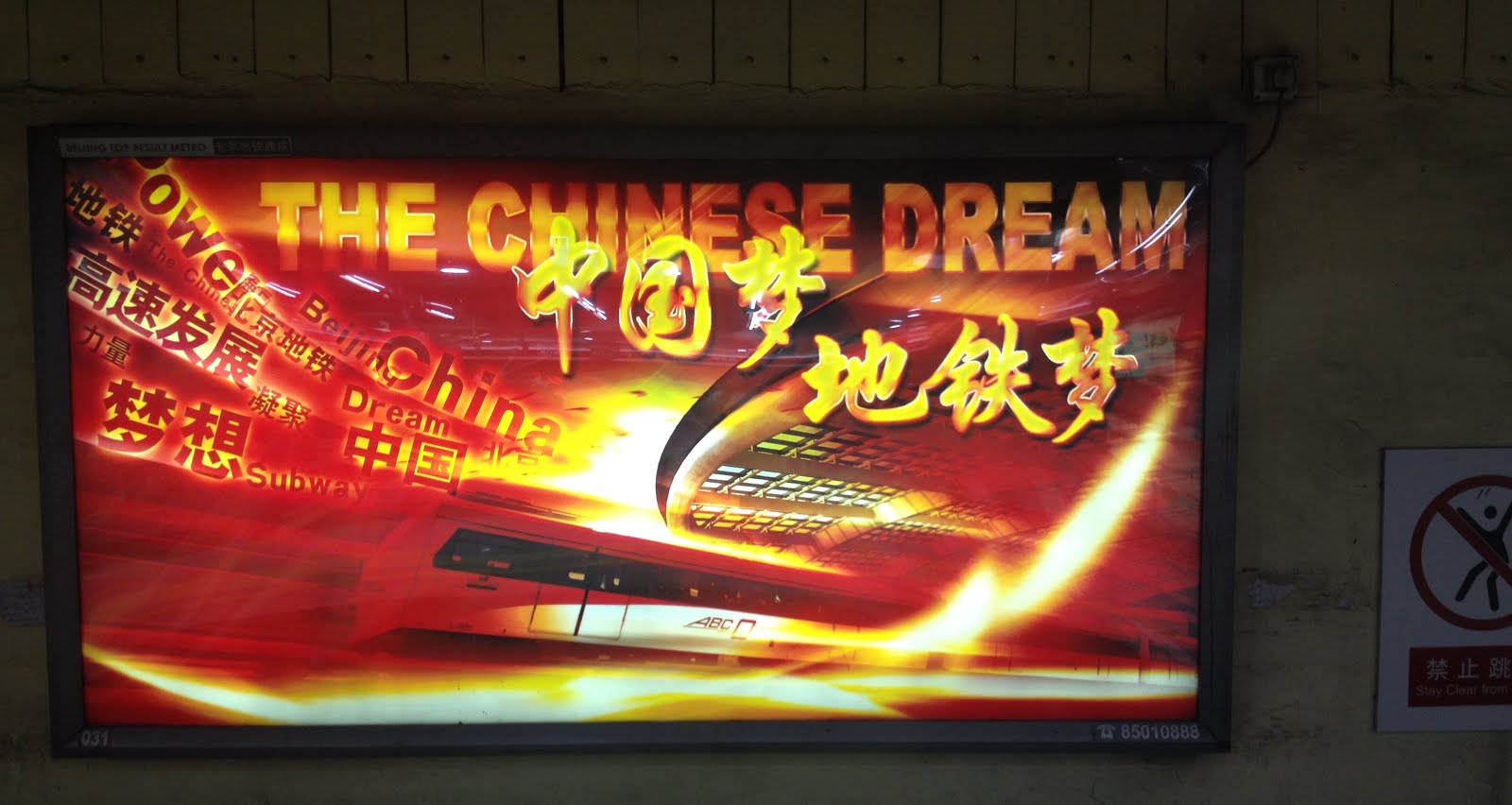 July 4, 2026 Ryan Kenney, A subway advertisement for the Chinese Dream.
By Ryan Kenney
August 11, 2026
To overlook it, one would have to actively avoid it. As pictured, posters line Beijing’s subway stations with it, new editions of Chinese textbooks now explain it, businessmen have been trained in it, and popular songs and other media are saturated with it.
The Chinese Dream is President Xi Jinping’s medicine for a country in need of purpose and vision.
Deng Xiaoping’s program of “opening and reform” ushered China into its era of galloping economic development. Since then, popular belief in economic growth as China’s guiding principle has steadily eroded and replaced the Communist ideology that once firmly undergirded the strategy and legitimacy of the ruling party. Following Deng’s lead, paramount leaders Jiang Zemin and Hu Jintao offered China their strategic visions: the “three represents” and “scientific development,” respectively. For the past few decades, the CCP has maintained neither a coherent ideological vision nor legal or ideological justifications for retaining control of the world’s most populous country. The Chinese Dream is the most recent iteration of unsuccessful official attempts to fill China’s ideological void.
As much as it falls in step with its opaque predecessors, the Chinese Dream seems to be marching to it’s own beat in some respects. Many commentators have highlighted differences in the current slogan, specifically its emotional nature. Moreover, Mr. Xi’s decision to unveil his Chinese Dream on a visit to the “Road to Renewal” exhibit at the National Museum of China is telling. The exhibit details the revival of the Chinese nation from oppression under foreign powers to salvation and prosperity under party rule, a trajectory to which Mr. Xi apparently intends to hitch his mantra. However, the key issue remains: the Chinese Dream does little to patch the ideological hole or satisfy the Chinese people.
Since the 1980s, many Chinese citizens have also sought clarity and confidence beyond the state’s offerings, specifically in religion. For some, religion has provided the guidance and clarity many Chinese people thirst for, but for most, it has not.
It is difficult to ascertain the extent to which the Chinese Dream’s lack of traction can be attributed to an inadequate public relations effort by the government, popular apathy, or a combination of factors. It is hard to believe that the government truly considers posters in the subway and similarly superficial propaganda to be the best avenues into the hearts and minds of the Chinese people, but many indicators suggest that Mr. Xi is genuinely throwing significant weight behind this idea. Whatever the cause, the Chinese Dream does not seem to be catching on, and the void remains.
The United States has little reason to be concerned with the slogan itself, but rather should be very concerned about the possibility of China not living up to its new ideological foundations. That is, any significant reduction or reversal in China’s economic growth or a large-scale national political crisis would throw the world’s second largest economy into a tailspin with only a bankrupt ideology on which to fall back. Simply put, the CCP has tied its own fate to its performance at the helm of the Chinese economy, and only time will tell if it will gain the credibility and staying power it needs to survive. The stakes are high.