


Is Fast Paced Growth Over in China?
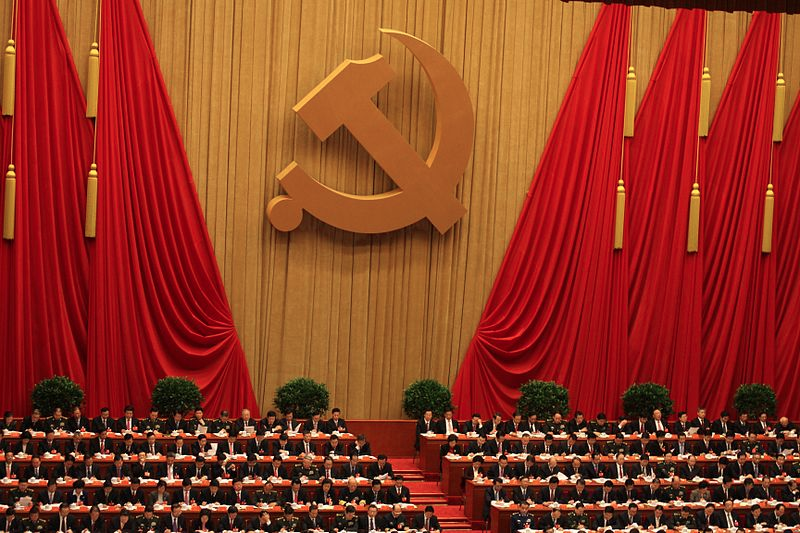
The 18th National Congress of the Communist Party of China. Photo courtesy of wikimedia commons
February 5, 2026
The recent release of China’s GDP growth numbers for the fourth quarter of 2013, as well as the numbers for the full year, have given mixed signals on the state of the Chinese economy. China’s GDP grew by 7.7% in 2013, slightly less than the 7.8% growth it experienced in 2012 according to the World Bank. This number is significantly less than the double digit growth that China experienced for much of the past three decades, and has led some analysts to wonder whether China’s days of fast paced growth might be coming to an end.
Traditionally, China’s leaders have viewed 7% growth in GDP as the absolute minimum required in order to maintain social stability. This idea originated in the early 1990’s when the Chinese government radically opened trade and reformed the orientation of China’s economy. In 1992 China’s leader Deng Xiaoping toured the south of the country and began policies that would result in Special Economic Zones where huge export growth was birthed. Simultaneously to these changes in its economic make up, however, China’s political system remained rigid and authoritarian. Thus, it was believed that a high level of economic growth would be able to provide strong enough improvements in standard of livings to make changes in political structure unnecessary; 7% was deemed the threshold.
Through the 1990’s and 2000’s growth rarely came close to falling near 7%, and was usually above 10%. The primary sources of this growth were a massive increase in exports, huge amounts of government investment in large-scale infrastructure projects, and Foreign Direct Investment (FDI) in manufacturing. The Chinese economy had lacked outside investment for much of the latter half of the 20th century, and so it responded extremely well to the influx of investment. Many Chinese saw large improvements in their standard of living, and per capita GDP increased from $419 in 1992 to $6,764 (est.) in 2013 according to the China Statistical Yearbook.
As the growth rate has cooled in the past few years, dipping into the single digits and landing at 7.7% in 2013, there has been concern that perhaps China’s miraculous economic development is coming to a standstill. Yet this reading does not take into account changing views on growth from the Chinese leadership. At a meeting of top CCP officials discussing the economy this past December, guidelines were agreed upon calling for China to focus on more sustainable growth. Rather than focusing on GDP numbers, the meeting produced guidelines of “Safe Growth” accounting for food security, “Balanced Growth” involving structural changes to what drives economic growth, “Inclusive Growth” focusing on standards of living, and “Green Growth” concentrating on environmentally sensible growth.
These guidelines represent a realization amongst the Chinese leadership that China’s economy must undergo structural transformations to ensure its long-term stability. In other words, huge amounts of investment can only drive economic growth for a limited time, and are not sustainable in the long term. Rather, a transition to domestic consumption as a driver of growth is a more stable model to strive for at this point in the Chinese economy’s development. As this adjustment occurs, the Chinese economy’s growth will slow, and could even fall below 7%. But in the long term these structural adjustments will allow for more permanent and organic economic growth.
For part one of our weekly series click here. Click here for part 2.