


Gaza Blockade Breaks into the Public Conscious...Again
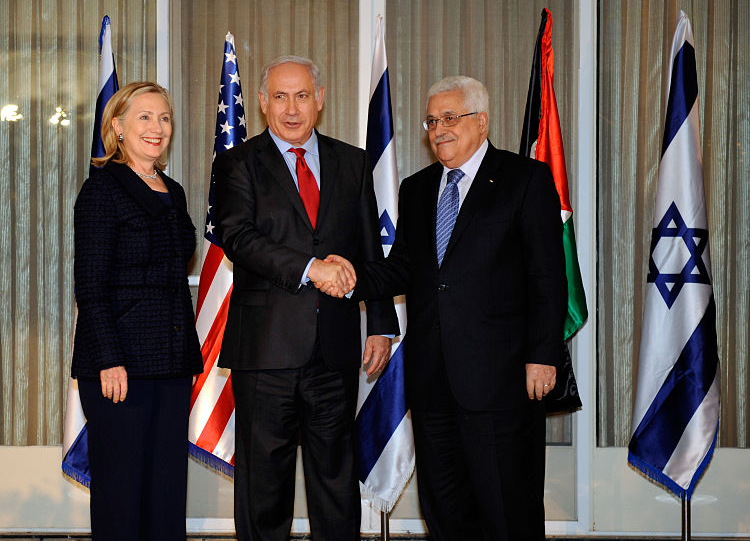
A 2010 meeting in Jerusalem between Hillary Clinton, Benjamin Netanyahu, and Mahmoud Abbas. Courtesy of wikimediacommons.org.
The ongoing blockade of Gaza (seven years and counting) has sprung back into the news recently because it remains a crucial policy central to any efforts at broader Middle East reconciliation, ranging from Israel’s relations with its neighbors to any potential peace deal between Israel and the Palestinians.
In January of 2006, Hamas won a decisive majority in the Palestinian Parliament, defeating the European and American supported Fatah party, prompting the United States and European Union to cut off financial aid to the new government under Hamas. In 2007, tensions erupted in the Battle of Gaza, in which Hamas seized control of the Gaza Strip and the party’s officials were expelled from the West Bank. With the West Bank under Fatah control, and the Gaza strip firmly under Hamas rule, the Israeli government imposed a full-scale economic blockade on the territory. Supported by former Egyptian President Hosni Mubarak, the blockade cut off Gaza by land, sea, and air. Hamas rocket attacks on Israel in 2008 prompted stricter enforcement of the blockade; the Israeli Army prevented fuel, food, and other basic necessities from entering Gaza.
In 2008, Hamas destroyed part of the barrier between Gaza and Egypt. Due to the severe humanitarian crisis in Gaza, Mubarak allowed hundreds of thousands of Palestinians, seeking food, fuel, and medical supplies, into Egypt. After numerous rocket exchanges, Israel allowed minimal food, medical supplies, and fuel into Gaza, hoping to ease tensions. In December 2008, tensions erupted into the Gaza War, which lasted 22 days and killed roughly 1400 Palestinians and 13 Israelis. The war also had massive humanitarian effects, leaving tens of thousands of Palestinians without power, water, or shelter.
Following the Gaza War, Israel allowed medical supplies and humanitarian aid into Gaza. In 2010, after pressure from the Arab League and the European Union, Israel opened the border to civilian goods, and Egypt allowed the movement of people, but not supplies, into and out of Gaza. Despite calls from the United Nations in 2011 to dismantle the blockade, Israel has done little to further ease restrictions on movement in and out of the territory. Egypt, on the other hand, has done more to open its borders to Gaza since late May 2011, following the resignation of former President Hosni Mubarak.
Recently, the Gaza blockade has found its way back into the news. Although the Egyptian government has tried to put an end to smuggling between Gaza and Egypt, reports have surfaced about a new operation run by smugglers that has KFC being delivered to Gazans at their convenience. This somewhat comical story is a reminder of the porousness of the Gaza blockade and the thriving black market that it has created. More seriously, the International Criminal Court has begun a probe into the botched Israeli Gaza flotilla raid that killed nine civilians in 2010. ICC prosecutor Fatou Bensouda has begun the fact-finding process, which is a required step before she can request a full investigation from the ICC judges. There are numerous ICC probes every year, including ones in Afghanistan, Colombia, and Nigeria that are currently open.
Whether Ms. Bensouda’s probe becomes a full-blown investigation (and potentially even a trial) remains to be seen, though the repercussions of the botched raid continue to haunt the Israeli government. As part of the reconciliation deal to be made for killing eight Turkish nationals (the other activist was American), Turkish Prime Minister Recep Erdogan demanded an end to the blockade. Turkey—once seen as a key player in peace process talks— refused to come to the table until it received an official apology, compensation for the families of victims, and the end to the blockade. Only in the last month have the two countries begun to reach a rapprochement under American urging. However, the recent agreement between Israel and Turkey, which Erdogan has acknowledged will lead to much-improved relations between the states, fell far short of a major opening of borders. This is in line with much of the rhetoric of Middle Eastern and Central Asian nations towards Palestine-- unceasing vocal support paired with exceedingly rare economic or diplomatic aid.
One exception to this trend in relation to the blockade came from Egypt after the fall of Hosni Mubarak, a strongman supported in many ways by the US and Israel. Mubarak claimed that opening the Rafah border between Egypt and Gaza would amount to a recognition of Hamas control over the region and a subsequent undermining of the Palestinian National Authority. In contrast to the closed borders, tunnels burrowed between Egypt and Gaza have been open, allowing for a variety of smuggled goods. After the Muslim Brotherhood took power in 2011, the Rafah border was opened permanently, enabling more people to cross into Gaza. This has had limited real effects on the shipping of goods, however, with strict limits on both sides of the border still placed on admitted supplies. Egypt still receives hundreds of millions of dollars worth of aid from the US, which will likely keep the Muslim Brotherhood from unilaterally ending the blockade any time soon. With its restrictions, the blockade remains contentious. While Israel reiterates that the border needs to be largely closed to ensure no weapons come in, it remains deeply controversial.
Further Reading:
Matt Baron, Ben Mandel, and Alexi Stocker contributed