


Introducing India’s BJP- the Largest Political Party in the World
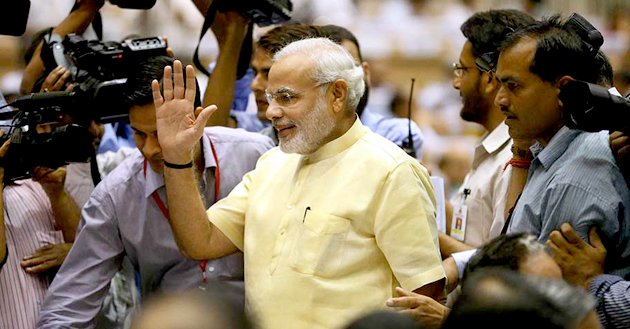
Indian Prime Minister Narendra Modi in 2013. Accessed on Wikimedia Commons, July 7 2015.
By Ali Pelczar
July 5, 2026
UDAIPUR, India-- In spring 2014, after nine months of voting, the world's largest democratic election in history saw the Bharatiya Janata Party (BJP) emerge victorious.
In contrast to America’s two-party system, India has hundreds of political parties to reflect its great religious, social, linguistic, and geographic diversity. What made the BJP's victory - 282 seats out of 543, with 31 percent of the popular vote - so notable was that it was the first time since 1984 that a single party, without the support of a coalition, won a majority of seats. The divisive but charismatic Narendra Modi was appointed prime minister.
With 100 million registered members, the BJP is the largest political party in the world. It was established as a political party in 1980, although it arose from the ideologically identical Bharatiya Jana Singh, which was founded in 1951. One of the Jana Singh's first leaders, Deendayal Upadhyaya, developed its still-standing philosophy of integral humanism, which strikes a balance between the individualism of the West and the East's tradition of communalism.
The BJP has also held a position of Hindu nationalism since its origins as the Jana Singh. Although India is, according to its 2001 census, 80.5 percent Hindu, this position can alienate the 13 percent of the population, or 38 million people, that is Muslim. In 1992, a pogrom destroyed the Babri mosque in Ayodhya. The site is believed to be the birthplace of the Hindu god Rama and the presence of the mosque had long been a source of tension. The BJP had supported the campaign opposing the mosque, and some BJP leaders were blamed for urging on the mob. BJP leaders were again implicated in inciting violence in 2002 when widespread anti-Muslim violence broke out in Gujarat. Among those implicated was Modi, who was the Gujarat chief minister at the time. The United States denied him a visa to enter the country in 2005 due to this.
The BJP's economic policy advocates less government involvement. Modi hopes to reduce government subsidies on major commodities and increase direct foreign investment. In his first year in office, he has tackled high inflation and a sluggish bureaucracy in which projects were wont to disappear.
The future of the party's power, however, is unclear. The BJP's opposing coalition, the United Democratic Alliance, won an overwhelming majority of seats in the Delhi elections last month. This may be a manifestation of India's strong anti-incumbency sentiment and frustration over Modi's slow pace of change. Since the BJP holds a majority in the national legislature on its own, it does not need to rely on a coalition with more moderate parties. The Delhi elections may be a sign Modi cannot remain so firm in his far-right stance. How he chooses to respond will play out over the coming months.