


Is Myanmar Obama’s Foreign Policy Success Story?
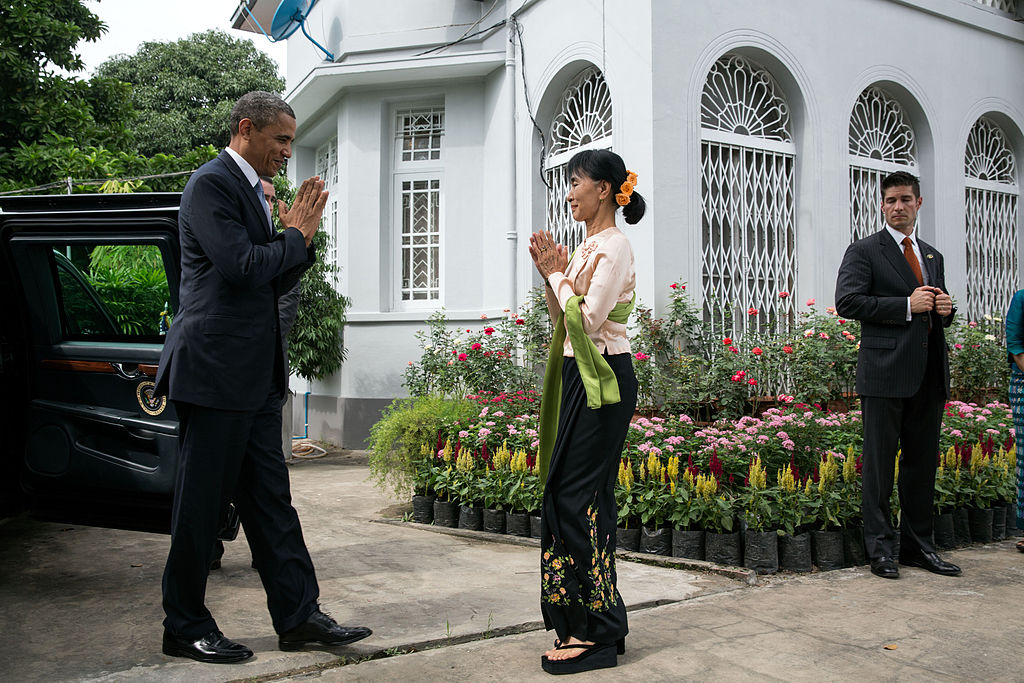 November 19, 2025 Pete Souza, The opposition leader of Myanmar, Aung San Suu Kyi, inviting President Barack Obama into her home.
By Arkar Hein
August 21, 2026
Last week, U.S. Secretary of State John Kerry visited Myanmar and pushed for more democratic reforms while rejecting calls for a harsher stance toward the country’s slow reformism. Mr. Kerry’s remarks come amid backsliding on media freedom, sectarian violence, and allowing the opposition leader Aung San Suu Kyi to become a president in next year’s general election. Yet, such a stance is not entirely surprising.
Messy situations in Syria, Iraq and Ukraine have opened President Obama’s foreign policy to scathing critiques and left his legacy on the global stage in doubt. In Myanmar, Obama has taken credit for ongoing democratic reforms enacted since 2010. He even singled out the transition in Myanmar as U.S. foreign policy victory in his speech to the West Point cadets in May, mentioning that if Myanmar succeeds “we will have gained a new partner without having fired a shot”, as the country had emerged from decades of military rule and turned toward the West
Since 1962, Myanmar, also known as Burma, was ruled by secretive and repressive military regimes. The United States imposed stiff economic sanctions after the military junta brutally killed thousands during a student uprising in 1988. By 2010, the Obama administration began to see signs that Burmese generals were looking to open up the country and move away from their close ties with China and North Korea. The current government led by the army general-turned-President Thein Sein has set out a series of political and economic reforms, including the release of Aung San Suu Kyi, who had won the 1991 Nobel Peace Prize for her pro-democracy struggle, from the house arrest. Since then, the Obama administration has celebrated Myanmar’s transition from a brutal and debilitating military rule to a quasi-civilian government, welcoming to Washington not just President Thein Sein but also Aung San Suu Kyi. In 2011, Obama became the first U.S. President to visit Myanmar. At the same time, the State Department began a policy of matching “action for action” by rewarding the Burmese government’s reforms with a gradual easing of sanctions. Critics argue, however, that Obama has gone all in too soon on a questionable hand.
Here is a reality check. The Burmese government has recently cracked down on the media while the opposition leader Aung San Suu Kyi remains constitutionally barred from becoming a president as the country aims towards the pivotal election next year. Also, the country’s transition has become more complicated by the rise of anti-Muslim movement led by Buddhist ultranationalists, who become freer to propagate their views in the less repressive environment. The situation is perhaps most dire in the western part of Myanmar where more than 100,000 Rohingya Muslims are living under apartheid with little access to health care and food since the outbreak of sectarian violence between Muslims and Rakhine Buddhists in 2012.
With President Obama’s foreign policy facing a 58 percent disapproval rate according to a recent poll, Obama may need a “success story” from abroad. Myanmar perhaps could be his best bet. But claiming credit for the transition towards a flawed democracy and restraining judgment of ongoing human rights violations probably won’t sit well with skeptics who may point out that the reforms still remain far from a success story and that the military and its former generals still control much of the country’s political and economic structures.