


The Obama Administration Takes on the War on Drugs
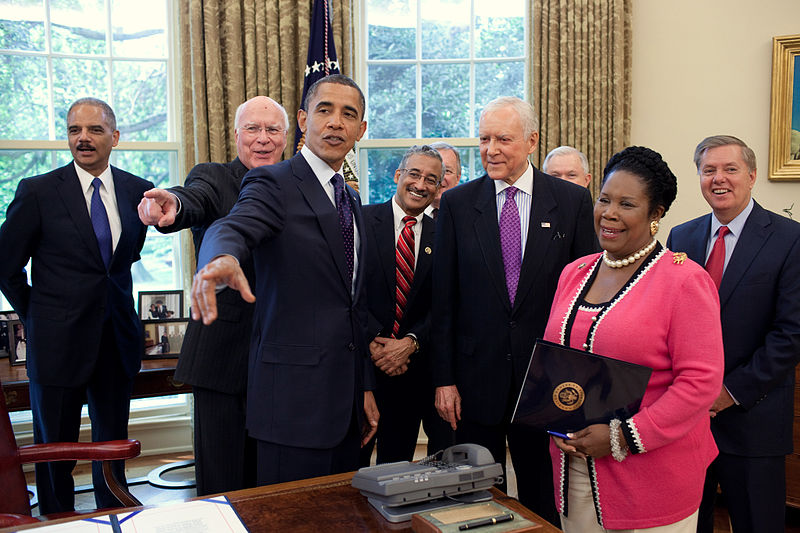
Celebrating the signing of the Fair Sentencing Act. Photo Courtesy of Wikimedia Commons.
May 5, 2026
Since the presidency of Richard Nixon, when the phrase “war on drugs” was popularized, the US has had a strict policy against illicit drugs. Despite the four decades of this harsh policy, however, there has been little to show for it other than various problems it has created. Currently, the US government spends $51 billion a year to keep millions of people in prison, incarcerated for petty nonviolent drug charges. This strict policy has not only been ineffective, it has been costly and unfairly impacted certain segments of US society.
There are multiple indicators that suggest the war on drugs has been unsuccessful. Though the policy established longer and more inflexible punishments for drug offenses, drug usage in the US rose by 2,800% since the policy began in 1971. This has resulted in the US having the highest incarceration rate in the world. The policy has been especially harmful for African-American men, with a disproportionate number of them jailed for petty drug offenses.
According to the Sentencing Project, only 12% of drug users are African-American men, but 40% of people jailed for drug offenses are African-American. Even without considering the racially disproportionate arrest and incarceration rates, more people today are in prison for drug offenses than there were total in 1980 for all other crimes combined. The strict policy carries a 5-10 year jail sentence, even for first-time offenses. This is extremely harsh punishment compared to other Western nations. The Sentencing Project also notes that almost 80% of the rise in arrests in the 1990s are due to marijuana laws. Marijuana laws have proven significant components of the drug policy straining the American jail system. By 2010, 46% of all drug arrests were for marijuana possession, according to information from the FBI’s Uniform Crime Reporting Program Data. The same data shows that marijuana possession laws also disproportionately affect African-Americans. Arrest rates for marijuana possession for African-Americans are greater than double the rates for white Americans, often much, much, greater.
In August 2013, U.S. Attorney General Eric Holder ordered federal prosecutors to stop listing the quantities of illegal drugs in indictments for low-level, nonviolent drug offenses. Such an order sounds rather odd, and to one unfamiliar with the U.S. federal drug laws, perhaps meaningless. But Holder’s order was the first step in what many lawmakers deem the “right direction” for sensible reform of drug policy. The order allows judges to sidestep mandatory minimum sentencing laws, which are based on the quantities of illegal drugs seized during an arrest or search. Although Holder’s order was a step in the right direction, granting judges the freedom to give lighter sentences, likely reducing the federal prison population in the long run, it affects only a small fraction of drug offenders, namely those who are actually handled by the federal judicial system. Holder’s order has no effect on state or local prosecutors, meaning that judges at those levels are still bound by local mandatory minimum sentencing laws. The August 2013 order also did nothing to change federal mandatory minimum sentencing laws; the laws still exist, and Holder’s order will end with the Obama administration. Moreover, the order had no effect on all of the nonviolent drug offenders already behind bars, serving out sentences dictated by mandatory minimum sentencing laws.
That is where the Obama administration’s second major reform comes in. In January, White House officials announced that defense lawyers would start recommending non-violent drug offenders for clemency. On Monday, April 21, the Justice Department announced that President Obama would start using his pardon to grant clemency to potentially thousands of non-violent drug offenders serving lengthy sentences in federal prisons. Although no action has yet been taken, advocates for smarter drug policy greeted the announcement with enthusiasm.
Despite Attorney General Eric Holder and President Barack Obama’s recent orders and actions, the central problems of drug policy remain unchanged. The Smarter Sentencing Act, which would reduce mandatory minimums and restrict their use, passed the Senate Judiciary Committee in January 2014. The bill recently gained more Republican co-sponsors in the House, but the bill would face an uphill battle in both houses even if it moved to the Senate and House floors. Until Congress changes federal drug policy, the Obama administration’s recent actions are little more than temporary fixes to a massive, institutional problem. Although the Obama administration’s reforms sound appealing, they will do little until the national and state legislatures act to change the law.
Further Reading:
August Reforms
Limitations of Obama’s Directives
Contributions by Monika Hur and Alexi Stocker