


A Relationship on the Rocks?
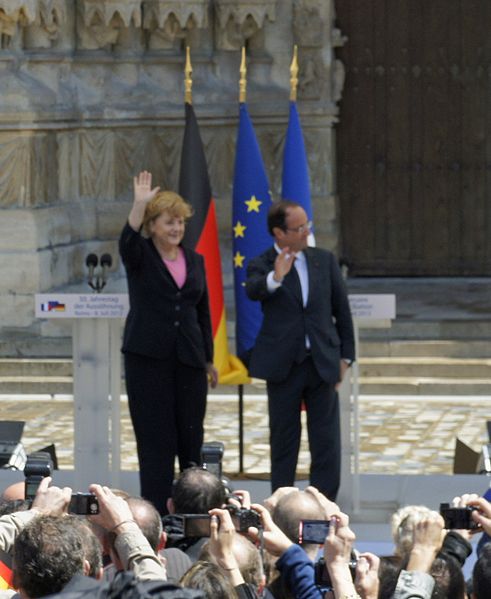
8 July 2026 Garitan, Merkel and Hollande greet a crowd.
October 3, 2026
The Franco-German relationship is an ever-changing one, best demonstrated by the interaction between the two countries’ respective leadership positions: the German Chancellorship and the French Presidency. The dynamic duo, Giscard-Schmidt, succeeded by the considerably less amicable pair, Kohl-Mitterand, demonstrates how the Franco-German relationship oscillates between political harmony and discord. With each new pair of leaders, the decisions and framework of Franco-German relations changes, and thus the composition of Europe changes as well. The European community is left wondering what will characterize the Merkel-Hollande relationship since it seems that there is more room for ideological discord than harmonious, practical cooperation.
Merkel is riding the wave of her third victory as chancellor, one that is deemed a personal victory. She is the director of the most economically successful country in the wake of a wide-spread economic crisis. The German public like her, they like her style, and they like her politics. She was deemed by Forbes as the most powerful woman in the world.
Meanwhile, President Hollande is often portrayed by the French media as weak and silly. His politically meek personality is in stark contrast to Sarkozy’s strong and suave demeanor – Hollande’s reputation precedes him and thus shoots him in the foot.
While Merkel is a stable leader, something that Germans value highly, who puts an emphasis on responding to the will of the public (to the detriment of her own original views); three of her recent political decisions reveal the future of German foreign relations – and its possible adverse repercussions.
The first decision is Merkel’s unwillingness to engage in geopolitical affairs. This is demonstrated by Germany’s non-involvement in the Libyan, Malian, and Syrian conflicts. Secondly is her resolve to save the euro and then build the necessary infrastructure to ensure its survival and growth. Thirdly, she shares David Cameron’s preference for inter-governmentalism, as opposed to the EU’s historic focus on the community method and “enlargement.”
Merkel believes that the EU should serve primarily as an economic institution. This assumes that politics and economics can be divided and it redefines the purpose of the EU from a focus on integration, community, and empowerment to personal economic gain. It reverses the decisions put forth by the Maastricht Treaty under Kohl and Mitterrand and creates a fundamentally different, less substantial union.
A large part of the European Union’s usefulness lies in its normative political role. Without a focus on integration and the transcendence of national sovereignty in the name of cooperation and support, the EU will not have the legitimacy it needs to effectively play that role.
One could argue that the seeds for the establishment of EU were sown through economic processes, (with a focus on a common market in the European Coal and Steel Community agreement) and that a return to a solely economy-focused union would be returning to the roots of an initial European commitment. However, the first treaty that established a European community, the Treaty of Paris (1951), was not meant to be a stopping point. It was meant to mark the beginning of a long journey toward European supranationalism.
The point is, historically, France and Germany have acted as a checks and balances system for one another. If one wasn’t satisfied with the other’s actions, concessions were made in the name of maintaining amicable relations and upholding the prestigious record of international cooperation. However, it seems Hollande is too powerless to have any impact on the Chancellor’s opinions in regards to possible European political disintegration.
A strong Germany is a rather uneventful one politically, a prosperous one in public opinion, a safety net for the eurozone, and a potentially pernicious influence on the future of the European union. If the Hollande-Merkel relationship continues to be a one-sided power struggle in favor of the Germans, and the EU begins to falter, Hollande might become what the media declares him to be: “un échec.”