


Ukraine at a Crossroads
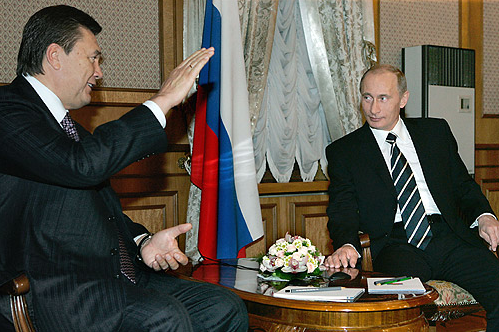
Viktor Yanukovych meeting with Vladimir Putin in 2006. Courtesy of Wikimedia Commons.
Ukraine’s recent moves to enter into a trade agreement with the European Union have attracted the ire of the Kremlin, leading to a cooling of already icy relations between the two former states of the Soviet Union. European integration seems to be one of the few things that Ukraine, led by President Viktor Yanukovych, and its politicians agree upon, and the nation can already look to other former Soviet-bloc states like Poland for precedents when it comes to shifting alliances. Meanwhile, Russian officials have made it clear that Ukraine will need to make a choice between whether it wants to be connected with Moscow or Brussels, and has warned of Ukraine’s financial and potentially political collapse if it goes ahead with the planned EU deal.
Russia has already shown its willingness to hit Ukraine economically as a result of Ukraine’s increasing tilt towards the EU. It has restricted imports on a range of Ukrainian products, from steel to chocolate, and more recently added stricter customs, resulting in costly shipment delays. Ironically, this has led the EU to show more willingness to allow Ukraine’s entry into the union than otherwise might have been the case. Historically European leaders have looked warily at Ukraine’s corruption scandals and human rights abuses, including Yanukovych’s continued detainment of former prime minister Yulia Tymoshenko, which analysts believe to be politically motivated. But with Russia’s recent posturing, the EU has felt a greater need to soften its pressure on the Ukraine in the hopes of convincing it to play a greater role in the bloc. As Oleksiy Haran, a Ukrainian political analyst has noted, “Russia's threats has made both Ukraine and Europe more serious about integration. It’s now a matter of principle.”
As for the Ukrainians themselves, Petro Poroshenko, former trade minister of Ukraine, has claimed that its people are willing to pursue a course of EU integration, stating “For the first time in our history more than 50% of people support European integration, and less than 30% of the people support closer ties with Russia.” The potential benefits of membership into the EU, along with a the establishment of a Free Trade Zone, are not insubstantial, especially with regards Ukraine’s processed agricultural products. For years the Soviet Union’s breadbasket, the UN Food and Agriculture Organization estimates that Ukraine has the potential to boast the highest percentage increase in domestic agricultural production in the world by the year 2020, and some Ukrainian observers go so far as to say that the country could become the second largest grain exporter in the world as soon as this year, trailing behind only the US. As such, the country’s potential is enormous, something both Brussels and Moscow have duly noted.
Ukraine now finds itself in the position faced by numerous other former Eastern bloc countries following the dissolution of the Soviet Union. They could, like the Baltic states and Poland, link up with the western European system, or they could go the route of Belarus, existing within the Russian sphere of influence. The states that have joined the European Union, even taking into account the ongoing issues facing the monetary union, seem to have benefited from closer economic and political ties to countries such as Germany and France. Indeed, Poland’s relatively large population has garnered it significant influence in the EU’s supranational institutions.
A major issue facing Ukraine is its political heritage. While it is not currently seeking membership to the EU, closer relations with the bloc often requires democratic political reforms. Ukraine cannot be considered a true democracy, as power is overly concentrated in the office of the President, and current leader Viktor Yanukovych and his cabinet essentially rule Ukraine as a kleptocracy. The 2010 Presidential elections further underscore the basic political issues Ukraine would face if it chooses the EU over Russia, or vice versa. The country essentially split in half during the election, with those living in the East (affiliating more with pro-Russian stances) voting for one party and those in the west voting for the opposing major candidate. Indeed, the loser of that election, and the ostensible leader of the opposition, Yulia Tymoshenko, has been in jail on sketchy charges.
Though the current debates over trade pacts and gas lines are important, they portend an even greater issue that Ukraine will be forced to face in the near future. Will they shift west and align with the EU, or will they embrace their historical roots to the east?
Further Reading:
Vilnius meeting on trade union
Mohamad Akef and Aaron Levine contributed