


The Victory of Laurent Lopez and the Future of France
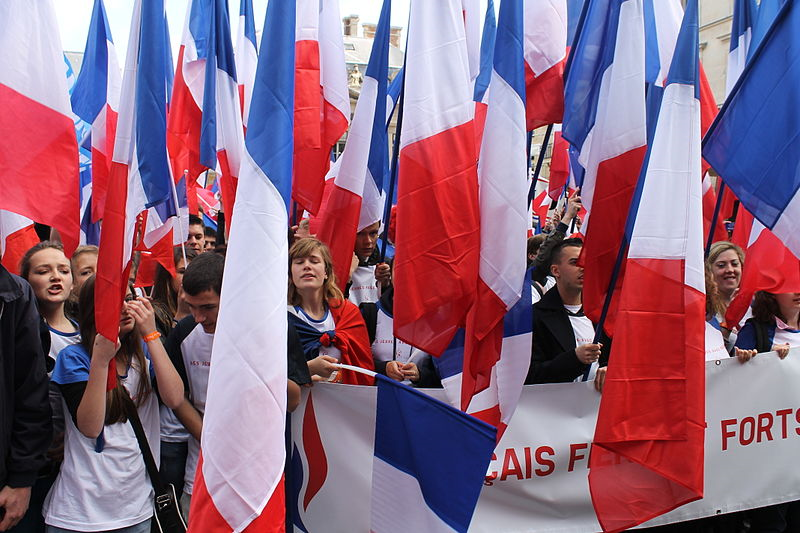
May 1, 2026 Gauthier Bouchet, A Parade in Support of the Front National in 2012
October 31, 2026
The French governmental administrative system is organized into regions, departments, and communes. A commune is roughly the equivalent of an American municipality or township. There are elections in a commune every six years to elect a conseiller général who will sit on the conseillers généraux which acts as the local authority of the department. The elections consist of two rounds of voting.
Recently, the commune Brignoles in the south-eastern Car department has been receiving headlines. In a first round election on July 7th voting came out in favor of the National Front (FN), an extreme-right party. Their candidate, Laurent Lopez, received 40.4 percent of the vote and his opponent Catherine Delzers of the Union for a Popular Movement (UMP), a center-right party, only earning 20.8 percent of the vote. The second round on October 13th also went to Lopez. He received 53.9 percent of the vote, while Delzers received 46.1 percent.
During the first round 67 percent of voters abstained, however between the first and second round there was a 12-point increase in voter participation, raising the participation rate to 45 percent.
This is significant because Laurent Lopez is the first FN candidate to be elected as a conseiller general (Mr. Dispard of the FN, was also elected in 2011 in Vaucluse, but the separation between the two candidates was only by 5 votes and the election was cancelled) which deserves attention due to the nature of the political platform and belief system of the FN.
Nicolas Sarkozy was the president of the UMP from 2004-2007 until he became President of France. It could be seen as a more socialized version of the Republican Party. However, since the election of Hollande and Sarkozy’s loss, there has been uncertainty as to whether or not the FN might take the UMP’s place as the right-winged popular party.
The displacement would be interesting due to the FN’s strong economically protectionist, socially conservative and Eurosceptic beliefs. To put it simply, the FN is a nationalistic party, only for the French. The FN has no interest in being part of the Eurozone or the European Union. “Immigrants” and “Europeans” are not their constituency and are not welcome in their France. Of course, the FN has other policies that seem abhorrent to much of the French citizenry; these being are the few that most directly clash with France’s current foreign policy agenda.
The FN party was founded in 1972 by Jean-Marie Le Pen and is now lead by his daughter, Marine Le Pen, whose entire 2012 campaign was focused on differentiating her image from her that of her father in an attempt to erase the negative perception of the FN party. This approach seemed to work as the FN is now the third most popular party in France behind the Socialist Party (PS) and the UMP.
That a FN candidate has won a cantonal could be quite alarming for the UMP party, and for France as a whole. Le Pen was glowing as she praised the amount of political support for her party and deemed the victory a “belle victoire, un double victoire.” She then declared this election “the confirmation of the death of the Republican Front altogether: the end of the Green Party, the UMP, the PS, the PC, etc.” Although blatantly over-zealous, her statements are nonetheless troubling.
The growth in popularity of the FN party is reflected by the growth of other conservative, nationalistic, economically protectionist parties. Germany has seen the ascension of the AfD – Alternative for Germany, which almost reached the 5 percent mark for representation in the Bundestag, the German Legislative body (4.7 percent). Germany has simultaneously witnessed the diminution of the Free Democratic Party (FDP) which, for the first time in its history, missed the 5 percent mark at 4.8 percent. The FDP is the center right party of Germany, and the AfD – while still in favor of EU membership, completely rejects the euro.
The AfD, FN, and the Tea Party all have some things in common. Though they manifested differently, they are desperate political reactions to the harsh economic environments. With the rise of the Tea Party in the U.S., the political right was delegitimized and deemed unfocused; many called for a regrouping and redirection of the Republican Party. The UMP and the FDP have been similarly delegitimized, and the AfD and FN have cropped up in their wakes.
It is clear that the economic crises of the past six years have had irreparable effects economically, socially and politically. However, the solution does not lie in the political extremism that the FN propagates. It does not lie in marginalization or exclusion. It does not stem from any sort of sociopolitical hatred. The only way we as a global community can solve crises is through communication and cooperation; it is naïve and cruel to think otherwise.