


The Week of April 23rd, 2012
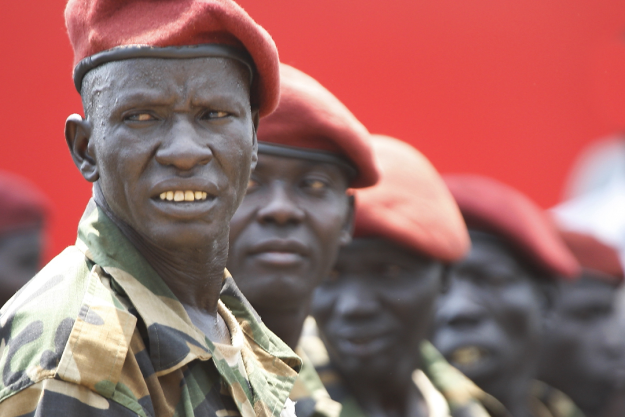
South Sudan's presidential guards during independence celebrations on July 9, 2011. Creative Commons photo by Steve Evans.
Care
1. Fighting Breaks Out Between Sudan and South Sudan
The border region between Sudan and South Sudan is rapidly deteriorating into open conflict between the two countries. While accusations have flown over who the aggressor is, it seems that both sides have been guilty of provocative military movements on either side of the border. Last week, South Sudanese troops invaded the oil rich Heglig region that is claimed by Sudan. Likewise, Sudanese troops have reportedly shelled and crossed over into multiple regions along the border. The Arab League has condemned the South Sudanese for their aggression, while the African Union has called for Sudan to stop bombing South Sudanese territory. Meanwhile, the US and UN have called on both sides to end the fighting.
The conflict, while physically limited to a local level between the two countries, has larger geopolitical implications. South Sudan enjoyed support from western countries throughout most of its quest for independence, and immediately received aid when it finally became an independent state. The perception that Western support will remain could have been a reason why the South Sudanese have been this openly aggressive. Sudan, on the other hand, has been backed by China due to Chinese oil interests in the country. However, China has significant investments in both countries. In fact, Salva Kiir, the President of South Sudan, delivered statements about the conflict while on a trip to China designed to find financial support for an oil pipeline. This conflict is unlikely to draw in outside powers in the immediate future even if it escalates, but China will have to be careful about its future decisions in the region if fighting persists.
2. Austerity Negotiations Create Upheaval in the Dutch Parliament
Queen Beatrix of the Netherlands accepted the resignation of Prime Minister Mark Rutte and his cabinet last weekend after the government failed to negotiate a deal on austerity measures to meet European Union targets. The government, which formed in 2010, was a coalition between center-right and far-right political parties. After seven weeks of negotiations, the leader of the far-right Party for Freedom, Geert Wilders, walked out of talks and withdrew the party’s support for the coalition. Typically, coalition forming in the Netherlands is very difficult; the Rutte cabinet was formed after more than 4 months of discussions and negotiations. The next election is not until September 12th, and the likelihood of a prolonged absence of government is an alarming prospect for the rest of the European Union. The finance minister, Jan Kees de Jager, was able to deliver a finance deal that met EU standards later in the week with the support of smaller parties, although Wilders and the main left-wing parties still withheld support. The deal provides hope to the EU that the Dutch are not in chaos and may in fact be able to form a new government without elections.
While the Netherlands have the lowest unemployment rate in the Eurozone and relatively reduced sovereign debt compared to Greece, Spain, and Italy, it has the highest levels of private debt in the Eurozone. In 2010, household debt in the Netherlands was equivalent to 249.5% of its disposable income, mainly because Dutch banks routinely wrote large mortgages during expansive economic times. A large part of why the Dutch leaders demanded austerity measures is due to this private sector debt, as having a low public debt could cushion the potential damages caused by these mortgages.
The collapse of the government also reveals the unpopularity of austerity measures across the European continent. It is notable that the Netherlands was among the northern European states that pressed hard for greatly reduced government spending in debt-laden states; while the Dutch may have been successful in arguing the merits of austerity to other nations, it seems the government is struggling to deliver the message to its own public.
3. Illinois Internet Tax Struck Down
An Illinois court recently struck down a law that would force sales taxes to be collected by online retailers for sold items. Although consumers are supposed to report online purchases and therefore pay taxes for them on their state’s income tax return, few do. Traditionally, only retailers with a brick and mortar presence in the state would be required to collect and pay the tax. This law, entitled the Main Street Fairness Act, would have extended that mandate to retailers with affiliates, such as advertisers, in the state. Clearly, there was a specific target in mind when the law earned its nickname, the “Amazon-tax law.” This attempted taxation was blocked when a Cook County Judge struck down the law as unconstitutional.
This issue highlights the difficulty of managing traditional sales taxes with regards to online business. While Amazon deliberately avoids maintaining a brick and mortar presence (warehouses or offices) in states like Illinois in order to maximize profits, traditional retail businesses are still burdened with the additional expense and cash- strapped states are unable to collect the revenue they need. Several other states have had similar issues and pursued similar solutions, though in many cases, including in Illinois, online companies have broken off business in the state to avoid taxes. Like the protection of intellectual property and the maintenance of privacy, an effective system of tax collection is still elusive in the relatively young frontier of the internet.
4. Libya Bans "Divisive" Political Parties
This week election officials in Libya banned participation by parties formed on the basis of religious affiliation, tribe, or ethnicity. The official reason is to "preserve national unity" said a spokesman from the National Transitional Council. The next election is scheduled for June 9th and will decide the new constitution. The regulation of political party participation in the Middle East is common, as seen in the banning of presidential candidates in the upcoming Egyptian elections, and has largely been seen as a strategy of regime preservation in autocratic states.
The banning of parties on the basis of religious affiliation is generating the most headlines in the West, especially since residents of NATO countries are unlikely to want an Islamic government emerging as a result of their intervention. The Muslim Brotherhood’s Freedom and Development Party is the most organized political force in the country and is poised to see massive successes in the elections if they are allowed to compete. However, its exclusion will have dramatic consequences for the election. In addition, banning parties based on tribe and ethnicity will also have significant effects on the future of Libya’s government and institutional makeup. There has been a push by eastern residents to reinstate the system of federalism that existed before Qaddafi took control of the country. Residents of Benghazi, which would be the capital of the eastern region, are ready to benefit from the oil revenues of the east if federalism is reimposed. Banning parties based on tribe and ethnicity will subvert this movement and many others, keeping control in the central government. It may help legitimize the political process in the eyes of some observers, but has the potential to stifle discussion on important issues and fragment the opposition. Ultimately, it is the NTC that seems to benefit the most from this decision.
5. Connecticut Abolishes Death Penalty
After an extended debate, Connecticut abolished the death penalty this Wednesday, joining sixteen others states which have also abolished the practice. While Connecticut has only executed one person in the last 52 years, a public opinion poll conducted by Quinnipiac University found that 62% of voters actually support the existence of a death penalty, compared to the 30% who oppose it. This is attributed, in part, to the 2007 Cheshire murders, where two men assaulted, robbed, and murdered a family before burning down their house. An attempt to eliminate the death penalty in 2009 was vetoed by Connecticut's then governor Jodi Rell, who cited the killings as part of her rationale.
The constitutionality of the death penalty has been challenged under the Eighth Amendment as cruel and unusual punishment, dealing with issues such as the execution of the mentally retarded and juveniles. In 1972, The Supreme Court banned the use of capital punishment, ruling that it was “arbitrary and inconsistent” in Furman v. Georgia (1972). But then in 1976, the Court reversed itself and allowed for the death penalty in the case of Gregg v. Georgia, providing a jury is furnished with specific criteria to direct and limit the sentencing discretion. Connecticut's recent passage of a ban indicates two things. First, even popular opinion supported by the recent memories of horrific murders aren't enough to completely resist the strong forces arrayed against the death penalty, which include religious and political groups. Second, the debate about capital punishment has a mixed record, but for the past decade the number of executions in the United States has been consistently declining. Even Texas, which has more than four times as many executions as any other state since 1976, executed only 13 persons last year, a fifteen-year low. Connecticut's law is not the final word in the debate over capital punishment, but it indicates how strong the opposition to the punishment has become.
Don’t Care
0. Medvedev Announced as Party Leader of United Russia
Russian PM Vladimir Putin has announced his resignation as party leader of United Russia, and has named outgoing president Dmitri Medvedev as his replacement. Mr. Medvedev's succession is expected to be unanimously approved by the party congress, and will take effect after Mr. Putin's inauguration to a third term as president of the Russian Federation on May 7th.
United Russia, while still the majority party in the Duma, suffered a disappointing loss of support in the elections last year. Allegations that the election was rigged sparked a number of protests, which were then further incited when Putin announced that he would replace Medvedev as United Russia's presidential candidate. Putin's departure from the party leadership might initially seem like a response to these protests, and an attempt to quell criticism of United Russia as an autocratic cult of personality.
Party leadership at this stage, however, is irrelevant. Whatever the state of his party and despite recent protests, Vladimir Putin has retained significant popularity, and is about to begin another six-year term as President of Russia. Putin recently stated in an interview that, having served 12 years as president and prime minister, he is fully prepared to seek 12 more years in power. Dmitri Medvedev has likewise stated that he and Putin will dominate Russian politics for "a long time." Furthermore, Medvedev is unlikely to change United Russia's policies in any way, and will not alter the rampant state of corruption within both the party and the administrative positions it holds. Finally, the fact that Putin's Popular Front (an unofficial offshoot of United Russia) might become an actual political party could lessen Putin’s need for United Russia in campaigning and may decrease his influence on the party in turn. As a whole, Putin leaving United Russia will have little effect on the future political landscape of the nation.