


The Week of January 27th, 2014
Care
5. Instability in Nigeria
On January 20, Air Marshal Alex Badeh, Nigeria’s new Chief of the Air Staff, declared that the Boko Haram insurgency would be wiped out by April of this year. Nigerian government’s conflict with Boko Haram dates back to 2009, when attacks by the Islamic insurgents prompted a brutal government crackdown in Bauchi and Maiduguri, two predominantly Muslim northeastern Nigeria cities. These crackdowns left 800 people dead. Nigeria’s President Goodluck Jonathan has flip-flopped between an aggressive and reconciliatory stance with Boko Haram, pledging alternately to wipe the group out and to initiate peace dialogues with their leaders. Since the Monday announcement from Air Marshal Badeh, 70 people have died in attacks attributed to Boko Haram. On Sunday, gunmen in Kawuri, a northeastern Nigerian town 20 miles from Maiduguri, shot and killed 45 people. The attack demonstrates the difficulty Nigeria’s military will face in wiping out Boko Haram. After more than four years of clashes between the two groups, the insurgents still maintain a powerful presence in the northeast as roughly 50 gunmen participated in the Kawuri assault.
Pervasive violence in Nigeria spells political trouble for the country’s president. This week 11 senators from President Jonathan’s ruling People’s Democratic Party defected to the opposition All Progressives Congress (APC). The senators’ defections are only the most recent wave of defections to hit the embattled president; last year 37 members of the House of Representatives defected to join the APC. Even former political allies, like former Nigerian President Olusegun Obasanjo, have criticized President Jonathan in recent months(3) citing “factionalism” as their primary motive. The APC has declared its main purpose, should it come to power, would be to restore “rule of law” in Nigeria. Ironically, neither factionalism nor lawlessness will be eliminated anytime soon, thanks to Nigeria’s abrasive political stalemate.
4. A Constitutional Amendment in Nicaragua
On Wednesday January 29, the National Assembly of Nicaragua voted overwhelmingly to change the constitution in order to allow President Daniel Ortega to run for a third consecutive term. Mr. Ortega, a member of the Sandinista party, returned to power after a 17 year hiatus in 2007. Since then, his Sandinista party has dominated the government, assuming an increasingly authoritarian appearance. In 2011, Mr. Ortega won the right to run for reelection through the Supreme Court to much controversy. This time around, his victory comes through the legislature, where the Sandinistas hold a super-majority. The Constitutional reforms passed by a margin of 39 votes with 64 yeas and 25 nays. Only one yea vote came from outside of the Sandinista party. After President Ortega approved the proposal, he can look forward to a reelection bid in 2016.
The Sandinistas, while broadly supported, face many potential hardships. Nicaragua, already one of the poorest countries in Central America, faces increasing economic threats from the environment. The main cash crop—and a driving force behind the economy in Nicaragua—is coffee, which is becoming increasingly harder to grow. Across Central America, coffee rust, a fungus, is wreaking havoc on coffee plantations. With yields down, the potential for unrest remains a factor. However, if Nicaragua’s plan to build a Panama-rivaling canal comes to fruition, the country could see an economic boon. Until then, Nicaragua’s economic future remains grim. Yet, with a weak opposition and high approval ratings, Mr. Ortega is likely to remain in power for the foreseeable future.
3. Tapering at the Fed
In 2014 the Federal Reserve will continue to taper its monetary stimulus, a sign of optimism from the organisation that America’s slow recovery is finally gaining traction. Since the onset of the Great Recession, the Fed has engaged in unprecedented expansionary monetary policy, purchasing bonds and lowering the nominal interest rate in order to encourage private spending. Many argue that one problem in the 2007-2008 crash was the rupture of a bubble created by previously expansionary Fed policies during recovery from the 2000-2001 recession. Because overzealous monetary policy can backfire in this way, the Fed may taper to avoid putting the current recovery’s growth in future jeopardy.
Fed Chairman Ben Bernanke is generally rated highly by current economists, but the effect of his policies will continue to play out for years. Janet Yellen will officially take over his spot next week and has the intimidating responsibility of maintaining the fragile recovery. She will be the first woman in the position.
Emerging markets, which gained from investment during the Fed’s bond buying program, are losing that advantage as Fed policy reverses. In other words, while US interest rates were kept artificially low, investors turned to emerging markets with higher rates of return. This opportunity is now ending. What effect this will have on these markets remains to be seen, but it is unlikely to be good.
2. Vigilante Militias in Mexico
Vigilante groups in the western Mexican states of Michoacan and Guerrero have taken up arms against a ruthless drug cartel, the Caballeros Templarios, or Knights Templar. The vigilantes are made up of local doctors, farmers, and shopkeepers who have grown tired with the cartel’s extortion and violence. What started as isolated groups in 2011 has grown tremendously, so much so that on January 14 soldiers were sent to disarm the vigilantes. Two civilians were killed, prompting the administration of Mexican President Enrique Pena Nieto to legitimize the vigilantes instead. On Monday, January 27 the government incorporated the militias in Michoacan into the Rural Defense Corps, under the head control of the army. Interior Minister Miguel Angel Osorio Chong made a point to stress that the units were "temporary”.
If the government cannot increase their control of the area, the local militias may not be so temporary. However, according to Jose Miguel Vivanco, Americas director of Human Rights Watch, these militia groups have the potential to morph into paramilitary groups like those in Columbia that traffic drugs and facilitate kidnappings. Many of their guns are smuggled in through the United States, or picked off the bodies of Knights of Templar members. All in all, in a war that has raged since 2006, it is not surprising that the violence has spread beyond just the cartels and the government.
1. Players Unions in the NCAA
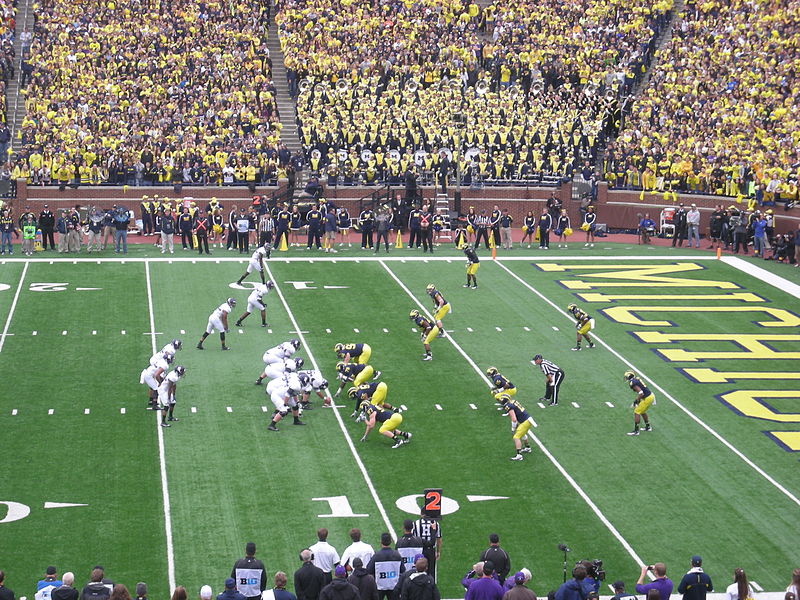
Last Tuesday in Chicago, Kain Colter along with members of the National College Players Association and the United Steel Workers Union announced that members of the Northwestern University Wildcat football team had submitted an application to the National Labor Relations Board (NLRB) to form a union. This is the first time in the history of the NCAA that players are seeking to organize under a union. In order for a union to be formed, 30 percent of the team needs to sign a petition, and Colter claims that an overwhelming majority of the team has already signed on. After this, the case that the team is eligible for unionization needs to be argued in front of the NLRB office in Chicago. Ultimately, the case for unionization can be appealed all the way to the Supreme Court, and the team behind the effort seems to be willing to take it that far.
The union, if formed, would be called the College Athletes Players Association (CAPA). While Northwestern University seems unlikely to let CAPA form without resistance, the union effort has identified the NCAA as its main opponent, calling the organization a dictatorship. The players are looking for protections such as healthcare, scholarship protection, and graduate school pay, but are not actively pursuing monetary compensation for play.
This effort comes as the NCAA is under increasing scrutiny for its policies and treatment of athletes. Three months ago the Grambling State football team staged a wildcat strike over their training conditions. The media has increasingly brought up issues such as player compensation and health, with some even making comparisons to the old Southern plantation system. While there is a good chance the unionization effort will fail, it shows that college players are willing to organize to achieve their goals. This development could be the start of a transformation of college sports, and even universities themselves.
Don’t Care
0. SOTU Given to a Do-Nothing Congress
Tuesday January 28 saw President Obama deliver his State of the Union speech. As usual, the speech contained a long series of promises, vague or concrete, about his plans for the country in 2014. From immigration reform to Pre-K for all Americans, President Obama has made a myriad of statements on policy for the coming year. A pervasive theme throughout the speech was his call for Congress to cooperate, something they have not been very willing to do over the past several years. With such a division, the question remains if anything can change simply because the president demands it.
This speaks to a larger point of the growing irrelevance of an annual national address. Half a century ago when information disseminated far slower due to the relatively nascent nature of television and the absence of the internet, such a communication served as a platform for the president to declare his intentions. Today, presidential statements and dictums diffuse through the public with relative ease. In today’s world, a televised series of ambiguous hints at reform becomes increasingly out of place and mundane in a media saturated environment. One purpose that remains relevant for the State of the Union is the opportunity for the president to use the bully pulpit, yet President Obama’s declining popularity and the stark polarization of Congress makes persuasion almost a moot point.
Alexi Stocker, Valerie Zuckerman, Don Gross, Liam Conway-Pearson, Ben Mandel, and Sam Houskeeper contributed