


The Week of October 13th, 2014
Care
1. Bolivian Elections
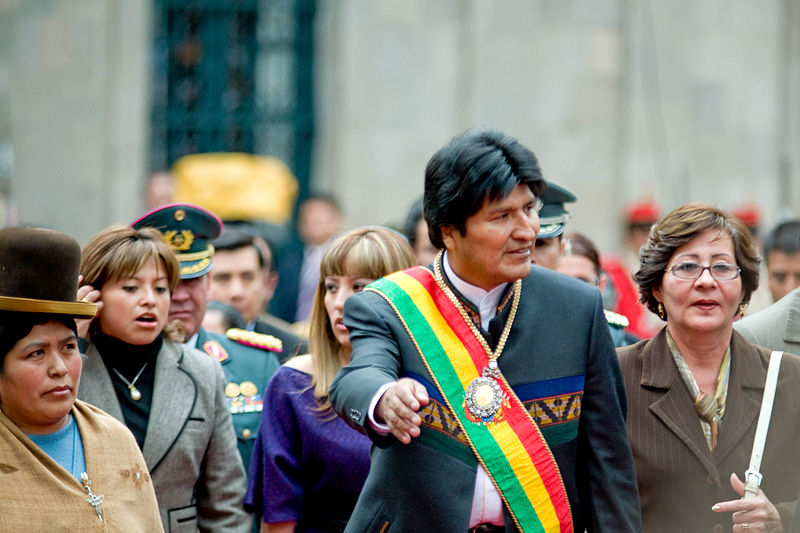
As widely anticipated, president Evo Morales emerged as the winner of Bolivia's national elections with over 60 percent of the vote. The popular incumbent beat out a fractured opposition of four challengers. This victory secures Morales' third consecutive term as president, an unprecedented allowance in Bolivian democracy owing to a constitutional referendum passed in 2009. The constitutional change also permits Morales to run for a final term in 2020, raising concerns over the democratic value of a rule that would by then total 20 years, especially in a region with precarious and eroding "third wave" democracies.
Morales is known for his anti-imperialist agenda. He has censured US corporate capitalism and international financial institutions. Yet, during his time in office he has opted for a prudent and pragmatic approach to macroeconomic policy. This has yielded impressive results: inflation has remained stable, foreign reserves have surged, and economic growth was estimated at 6.5 percent in the last year. Under Morales, cash transfer programs have reduced income inequality and the percentage of population living in extreme poverty levels has dropped from 38 percent in 2005 to 24 percent in 2011. Concerns exist, however, over the sustainability of Bolivia's most important export, natural gas.
Standing on a balcony of a government building in La Paz following his election victory, Morales continued to claim the socialist rhetoric of his peers, dedicating his victory to Fidel Castro and Hugo Chavez. And yet, Morales' leadership has guided Bolivia to become an outlier in Latin America, with countries like Argentina, Brazil, and Venezuela underperforming economically. With his party, MAS (Movement Towards Socialism), dominating in all three branches of government, the onus falls heavily on him to continue prospering third time around.
2. Iraqi Chemical Weapons
One of the Pentagon’s top secrets is out: following the 2003 invasion of Iraq, U.S. forces discovered over 5,000 chemical weapons and failed to report these discoveries to the public. The stockpile included warheads and bombs containing nerve agents and mustard gas which were produced in the 1980s, during the Iran-Iraq war. However, these weapons were not particularly effective for mass destruction, as they mostly consisted of short-range rockets and artillery shells.
Because many of the decaying weapons were designed in the United States and manufactured by Western-built plants, the Pentagon deemed the discovery “too embarrassing” to release to the public. However, at least seventeen American soldiers and seven Iraqi police were exposed to sarin and mustard gas from the warheads. In order to aid in the cover-up, the troops, suffering from disorientation and severe burns, were refused adequate medical treatment. They were also encouraged to report that nothing of significance was found.
To further keep the weapons secret, U.S. personnel were ordered to leave the weapons in the ruins of the plant in which many of them were stored. Now, IS militants have been seen raiding the site. The terrorist group is in control of the compound holding 2,500 chemical rockets, which, although old, can be repurposed and utilized in attacks, though only on a small scale. ISIS has similar ambitions to seize Syrian chemical weapons, worrying experts that the group may be planning to carry out a series of attacks in the respective region.
3. Libyan Conflict
Since the end of the Libyan Civil War in 2011, the country has slid into sectarian turmoil. The weak and ineffective government that attempted to take power after the deposition of Gaddafi failed to stop numerous militias from running wild and sowing instability. The government, which has international support, is now weak and in control only of Tobruk, a small city near Egypt. Most of the country, including its capital in Tripoli, is dominated by an Islamic group of militias that claim legitimacy as Libya’s true rulers. A smaller militia, named the Islamic Youth, has taken control of the town of Darnah and declared its allegiance to the Islamic State, active in Syria and Iraq.
Besides the obvious significance of an IS affiliate, the US has other reasons to be concerned about Libyan instability. The 2012 terrorist attack on the US State Department complex in Benghazi, which resulted in the death of Ambassador J. Christopher Stevens and three other Americans, is now infamous, mostly due to the interminable Republican investigation of President Obama’s response to the event. Americans were also disturbed several weeks ago by the release of a video showing Libyan militias partying at the pool of the abandoned US embassy in Tripoli.
Egypt, a country with strong historical opposition to Islamism, has reportedly come to the aid of the internationally recognized government in an attempt to retake the country, beginning with air strikes on Benghazi, the main city of the East. Egypt has not acknowledged their attacks. Some believe the UAE is also supporting the effort. These strikes are in support of the advance of Khalifa Haftar, a former general under Gaddafi and at the head of rebel forces in the 2011 revolution who now heads the forces of the moderate government.
4. Catalan Referendum
Confusion reigns in Catalonia over a nonbinding November referendum on independence for the region. After the suspension of the referendum by Spain’s constitutional court and pressure from the central Spanish government, Artur Mas, regional president of Catalonia, called off the referendum. Instead, Mas announced that Catalonia will instead hold a “consultation” to be run by volunteers rather than civil servants. Technicalities aside, it is meant to have the same effect as the referendum – a nonbinding means to measure sentiment.
The recent resurgence of the independence movement has been fuelled partly by last month’s Scottish referendum as well as economic troubles – Catalans, who live in the wealthiest region in Spain, are aggrieved by paying more in taxes to Madrid than they receive. Polls show that Catalans are divided on independence, but a vast majority want the right to vote on the issue; however, a large plurality of Catalans (23% to 45%) want Catalonia to stay within the court’s orders rather than push on with an illegal referendum.
Mas is likely to be pushed and pulled in opposite directions in the coming months. Spanish prime minister Mariano Rajoy is unlikely to welcome the new consultation; Rajoy claims that Catalonia cannot unilaterally make a decision that affects all of Spain. From the other side, the strongly pro-independence Republican Left of Catalonia (ERC) and other hard-line secessionist parties would prefer to defy the court and hold the referendum; they are skeptical of the significance of the consultation. Complicating matters is that the ERC props up Mas’s own party in a regional coalition government and leads in polls. Both Mas and the ERC, among others, would prefer to ultimately pursue independence by creating pro-independence majorities in the Catalan parliament, but they disagree on the strategy. Whether that strategy comes to fruition – or is allowed to – remains to be seen.
5. Ebola Aid
There have been at least 9,000 reported Ebola cases, and almost 5,000 deaths, since the outbreak started in March of this year. The three hardest-hit nations – Liberia, Guinea, and Sierra Leone – have borne the brunt of the crisis, and all three are struggling to provide adequate medical equipment, including beds, gloves, masks, and even body bags, to the physicians struggling to contain the outbreak.
The Obama administration announced this week that it would commit 3,000 military personnel to the fight against Ebola in West Africa. President Obama promised the Liberian government 17 new Ebola treatment centers, with 100 beds a piece, as well as training for up to 500 healthcare workers. The deployment marks a significant step by the administration to stop the spread of Ebola, but many critics argue that it is too little, too late, and not far-reaching enough. Numerous healthcare professionals criticized the administration’s focus on Liberia, arguing that the virus is just as great a threat in other affected countries.
The Obama administration’s efforts may be stymied by the relative sluggishness of its response. The WHO has warned that there may, soon, be up to 10,000 new cases of Ebola per week in Liberia alone. As noted, the military is preparing to construct 17 new Ebola treatment centers, adding a paltry 1,700 beds to a country with many thousands of infected people. In addition, spokesmen for the military have told reporters that completion of the treatment centers will take until mid-November or early December, time that Liberia, and much of the rest of West Africa, simply does not have.
Don’t Care
Kim Jong Un
In further non-news about North Korea this week, Kim Jong-Un reappeared after disappearing for 40 days from the public. Rodong Simun, the official Chosun workers’ party newspaper, published a photos of the leader leaning heavily on a cane as he visited a new residential complex for scientists. This reappearance in ill-health is surprising, because in the past, North Korean leaders maintained a carefully cultivated image, making sure to release only photos portraying them in good health. Kim Jong-Un's predecessor and father, Kim Jong-Il, was in poor health in the years before his death in 2011, but the North Korean media was careful to release only photos of him looking well and able. It was the same for Kim Il-Sung before him, as well. Kim Jong-Un has been shown walking with a limp back in July as well. It is speculated that the supreme leader's poor health arose from his obesity. His ailment is highly ironic given that the North Korean population is chronically starving and always receiving foreign food aid, yet its leader suffers from an obesity-related illness.
Speculation continues to grow around the meaning behind Kim Jon-Un's unexplained disappearance for more than a month. Is he still in control? Is he not? Some commentators have even gone as far as to say a coup has already occurred, while others say Kim was merely sick for a while and nothing is amiss. The world continues to know as little as ever about this hermit regime while outsiders make speculations impossible to support or deny. The simplest, and the most obvious answer, may be that Kim just happened to be sick for a while.
Julia Cohen, Wooyoung Lee, Alexi Stocker, Young Sun Park, Monika Hur, and Sam Houskeeper contributed