


The Week of October 20th, 2014
Care
Opium in Afghanistan
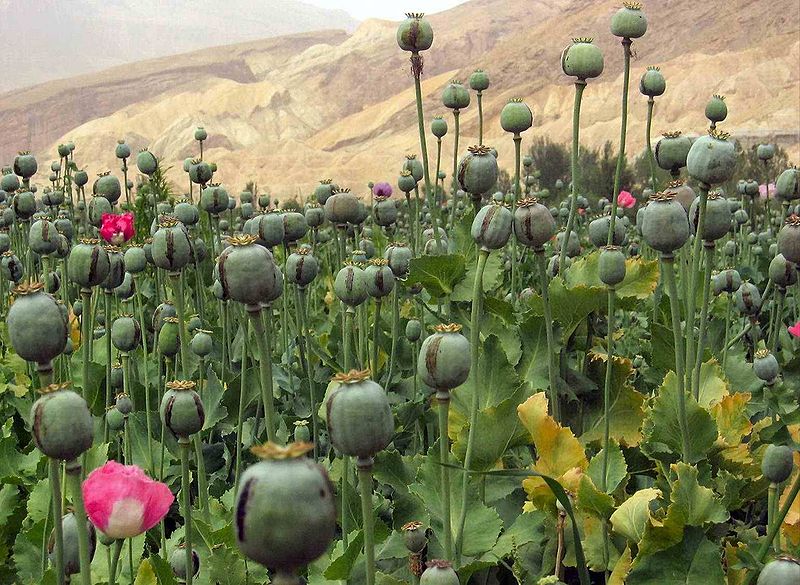
A recent US government report revealed that the American attempts to destroy the drug trade in Afghanistan is and has always been a catastrophic failure. More than $7.6 billion has been spent in an ineffective effort to stem the surging tide of the international heroin trade, 80% of which is grown in Afghanistan. Contrary to all efforts, heroin profits are up to $3 billion in 2013, a whole $1 billion higher than in 2012. In addition, the 2013 crop set new records, filling 209,000 hectares of space.
This news highlights several pressing issues in American foreign policy. It is interesting to note that the military forces that the United States has spent billions fighting are actually kept in business by this burgeoning opium trade that has been so ineffectively combated. So the crippling cost of the war was compounded by entirely wasted funds spent combating the drug trade. This situation also has several striking parallels to American attempts to stifle drug trading in Mexico, namely a similar lack of efficacy. As more and more information comes out on these strategies, a change may become necessary for American drug policy to remain viable.
Blackwater Conviction
On Wednesday October 22nd, four Blackwater Worldwide guards were convicted of murder, manslaughter, and gun charges over the infamous bloody shooting of unarmed Iraqi civilians on September 16, 2007.
The verdict came after a lengthy eleven week trial, in which jurors rejected the guards’ defense that they acted in self-defense against incoming AK-47 gunfire. In the bloody shooting of Iraqi civilians, the Blackwater Worldwide guards threw grenades and fired recklessly into Baghdad's Nisour Square. One of the guards, Slatten, faces a sentence of life in prison for murder, while the other three face minimum sentences of 30 years in prison. The trials ends a years-long effort to bring justice for the Iraqi victims and hold the American contractors accountable for their actions. The difficulty of the process to bring the guards to trial has made Blackwater synonymous with unaccountable power abroad. The US's refusal to allow the men to be tried in Iraq also caused tensions between the two countries.
During the years of prosecution efforts, the Blackwater Worldwide firm was renamed Xe Services, then sold and renamed once against Academi. The trial reflects the difficulty of prosecuting criminal wrongdoing committed overseas by private contractors hired by the US government, as well as the way private contractors can cause serious stress on diplomatic relations despite acting in an unofficial capacity.
Gamergate Controversy
Videogames are often seen as harmless diversion, but they have recently been in the news as the cause of a shocking scandal. A monumental controversy was sparked when one game developer, Zoe Quinn, was called out by her ex-boyfriend Eron Gjoni for cheating on him with several notable people in the video game industry, including Joshua Boggs, her then boss, and Nathan Grayson, a writer for the game-review site Kotaku. This was followed by streams of misogynistic and threatening harassment against Quinn, and soon against other women in the gaming world. While some claim that the gamers simply want to improve journalistic ethics (an early but false claim was that Quinn’s affair was planned to improve the review of her newest game), most observers outside the gamer community have taken Quinn’s side and dubbed the scandal “Gamergate.”
Gamers in the movement claim to desire a public discourse on the fifth estate, internet journalism. Many, however, have described the efforts of the gamers as nothing more than sinister and anonymous threats. One site that has taken the anti-gamer position, Gawker, has has difficulties with several sponsors including Adobe and Intel, who paused advertisements on their sites as a result of serious pressure. It seems that gamers have significantly more power than many would have expected, though one wishes it could be used for good.
Boko Haram Deal
On October 17, Nigerian officials announced that they had reached a deal with the terror group Boko Haram that would secure the safe release of the nearly 200 kidnapped girls that went missing in April. The news of this deal is accompanied by an agreement to a ceasefire between the two sides, which the Nigerian military has honored to this point. Details on the announced deal are scarce but a few key points have been released: not all of the girls will be released at once, and there is no specific timetable for their release except that it will be soon. Some believe a prisoner swap may be in the works, with the Nigerians sending back captured Boko Haram members in exchange for the girls.
The cautious optimism this deal has provoked in Nigeria has been marred by doubt of its strength. Some believe this to be a politically motivated announcement, as Nigerian elections take place next February and peace brokered by incumbent Goodluck Jonathan would bolster his chances at a victory. On top of that uncertainty, there are doubts about the current status of Boko Haram. Besides the fact that Boko Haram’s leadership is very decentralized (making a ceasefire difficult to enforce) there is the news that there are two growing factions within Boko Haram, one for peace and the other for jihad. The jihadist faction may continue fighting despite a nominal peace. These uncertainties make it unlikely that a secure peace deal will soon be found, but the Nigerian people seem able to accept that for now as long as their girls are returned safe and sound.
Missing Mexican Children
The mayor of the Mexican town of Iguala, Jose Louis Abarca, is on the run this week following the disappearance of 43 students from his town on September 26th. The students, who were attending school to become teachers, were supposedly in town to protest a speech being given by Mayor Abarca’s wife. According to Attorney General Jesús Murillo Karam, the police arrested the students on orders of the mayor and then handed them over to the local gang, Los Guerreros Unidos, who made them “disappear.” The gang likely followed through with the abduction in order to solidify its control of the area. They are known to have been tied to Mayor Abarca and his wife, and routinely take bribes from the local government.
Mayor Abarca and his wife have been ordered arrested, but are currently on the run. So far, no searches have turned up the missing students. Nine mass graves in the area show remains of 30 or more people, but initial tests show that none of them include the missing students. Their disappearance and presumed death have sparked outrage throughout Mexico, and renewed criticism towards President Enrique Peña Nieto, who has failed to stem the violence in his country despite several high profile initiatives.
Don’t Care
Palin Family Brawl
Bristol Palin, Sarah Palin’s eldest daughter, published comments on her blog on Wednesday about the large bar brawl that her and other Palin family members were involved in on September 6th. The blog post came shortly after audio regarding the brawl was released, and the media circus around the story was breathed new life long after most people should have stopped caring. Palin attacked the liberal media for giving undue attention to her family’s personal issues while ignoring the embarrassing moments of other political families, like the discharge of Joe Biden’s son from the navy for cocaine usage or the conviction of Chelsea Clinton’s father-in-law for bank, wire, and mail fraud. She argued that these stories were treated as delicate out of respect between liberals, while her story was fed to the masses gleefully. She also argued that if Chelsea Clinton had gotten into a physical fight in an effort to defend herself she would be held up as a liberal hero.
Perhaps there is some reason behind Palin’s indignation over the media’s attention, but another cause for greater focus on her brawl is that it is simply a lot funnier than cocaine or bank, wire, and mail fraud. Palin also claimed that the fight was started by someone wanting to get famous, and she denied throwing numerous right hooks as reported by eyewitnesses. While the image of a Palin clan rumpus is highly entertaining, it should be remembered that it does not constitute news and is a continuation of the American media’s undue focus on sensationalism over substance. Carol Costello, a CNN anchor, apologized Thursday for her coverage of the event and for calling the recent audio release “quite possibly the best minute and a half of audio we’ve ever come across.”
Kevin Corkran, Ryan McGinnis, Ben Mandel, Monika Hur, and Sam Houskeeper contributed