


The Week of October 27th, 2014
Care
1. The End of QE
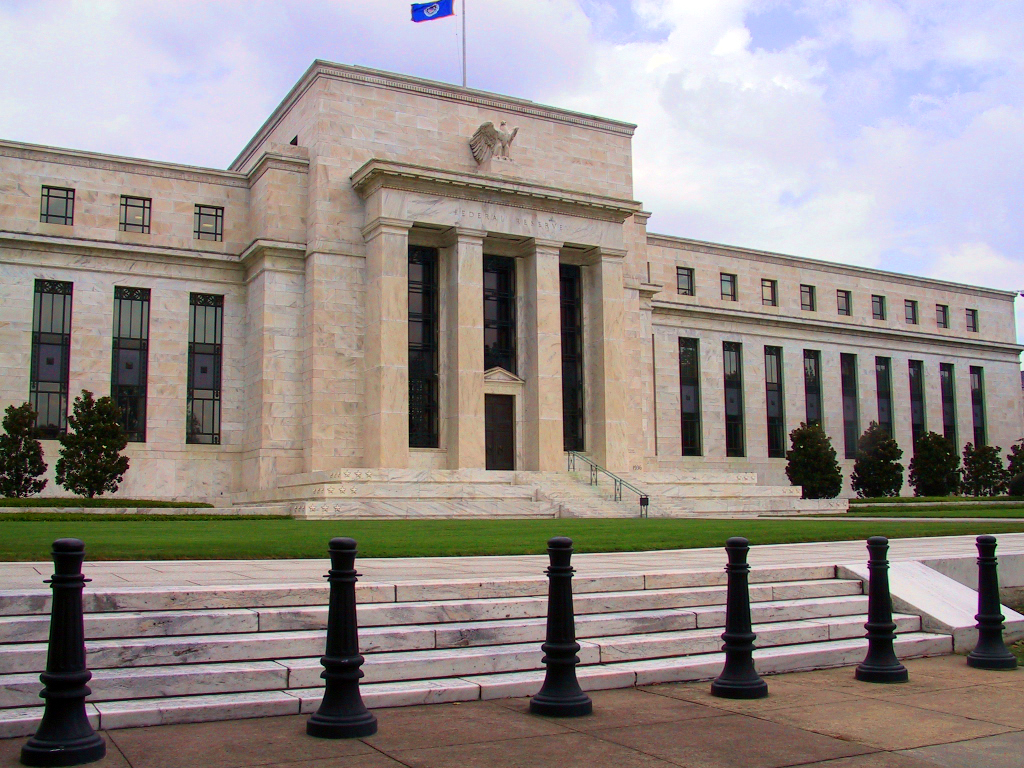
Earlier this week, the Federal Reserve announced the end of quantitative easing (QE), the bond buying program that many believe helped prevent the recession from becoming a depression. The program has been winding down for a long time; Janet Yellen inherited former fed chair Ben Bernanke's planned cuts to QE. Under Yellen, the Fed has continued to reduce QE, acting optimistic but not completely satisfied with the economy’s performance.
Quantitative easing is a relatively new method of expansionary monetary policy. It was first used by the Bank of Japan to fight deflation in the early 2000s, and is useful for affecting long term interest rates when short term rates are at zero, meaning that traditional monetary policy no longer has any effect. Despite finally ending its QE program, the Fed has stated that it will keep interest rates relatively low through other monetary strategies. Rather than selling off its bonds, ending QE simply means that the Fed will stop buying bonds, but will hold onto those it owns until they come due. As its bond holdings shrink, economists expect the Fed will begin to allow the short term interest rate to rise as well. This may happen sometime in 2015.
Quantitative easing has been criticized by many for creating a regressive recovery, or for benefitting the financial sector over helping a recovery in the goods and services market. The recovery from the 2008 recession has been long and slow, especially in terms of employment, but financial markets are doing well. In time, this recovery may translate into increased growth and employment, affecting the average American.
2. Brazilian Election
Incumbent Dilma Rousseff won Brazil’s extremely close presidential election against challenger Aecio Neves on 26 October 2014. As a member of the Brazilian Worker’s Party, Rousseff was not favored by much of the business community, both domestic and international. Her last term was marked by rampant corruption and ineffectiveness; many voters are still hurting from the evident misuse of public funds that occurred during the World Cup over the summer. Nevertheless, the election results are final, and the country’s desire for better educational systems, reduced inequality, and a fair chance in the new world economy is again the responsibility of Rousseff.
Following the election, international markets dropped in response to the loss of Neves, and Brazil’s Central Bank raised interest rates to 11.25 percent in response, attempting to ward off inflationary expectations. But this does not help the fact that Brazil’s slow growth and rising prices may make prosperity impossible. Petrobras, Brazil’s partially government-owned gas company, wants to raise prices, but will not be allowed to do so until the government is more confident in the stability. In the face of all these obstacles, President Rousseff must also worry about a potential credit downgrade; her best option would be to look out for the middle-class and calm international markets through smart business policies, exactly what was expected of Neves.
3. Private Space Disasters
On October 28th, the rocket of Orbital Sciences, one of the country’s main private spaceflight companies, exploded shortly after liftoff. There were no deaths or injuries from the incident, but it could have serious ramifications for the burgeoning private space industry, which includes many companies like Orbital Sciences competing for cargo contracts with NASA. The stock of Orbital Sciences has plunged since the explosion, and some see SpaceX, the company of Tesla’s Elon Musk, and the United Launch Alliance (ULA), a cooperative venture between Boeing and Lockheed Martin, as potential beneficiaries of the accident. It has been revealed that Orbital Sciences was planning on retiring the fairly old, Soviet-made engines used in the doomed rocket.
On October 31st, the rocket plane used by Virgin Galactic, a potential space tourism company, exploded during a test flight, resulting in one death and one crew member seriously injured. It is unclear what rivals could benefit from this accident, as there are fewer competitors in the space tourism industry. It seems more likely that the industry as a whole will suffer.
Clearly, rocketry is a very dangerous and risky industry. There are a huge number of variables that need to be accounted for; a misstep on any one can have explosive consequences. Either accident could have been simple bad luck, SpaceX had it’s fair share of exploding rockets in its early days, but this accident at this advanced stage in the increasingly competitive private space industry could seriously affect the prospects of Orbital Sciences or Virgin Galactic.
4. Tunisian Election
Almost four years after the Arab Spring uprisings began, Tunisia passed another democratic milestone: a peaceful and uncontested election. On October 26th, Tunisians voted in national parliamentary elections. Nida Tunis, a secular liberal party, gained the most seats among Tunisia’s political parties, winning 85 of 217 seats in parliament, which grants it the right to form a government and name a prime minister. What makes Nida Tunis’s victory significant, at least for the moment, is the Islamist Ennahda party’s acceptance of the results. Ennahda officials called Nida Tunis’s leaders Monday night to congratulate them on their victory. Moreover, Ennahda officials expressed desire to form a coalition government with Nida Tunis, a significant step towards pluralistic democratic rule. Nida Tunis, however, has largely rejected the idea of a coalition with Ennahda. Fortunately, a number of smaller parties with similar liberal views won enough seats to conceivably form a governing coalition with Nida Tunis.
Tunisia’s path to stable democracy is still in progress. Nida Tunis’s coalition government will take over from a caretaker technocratic government that took power, peacefully, from Ennahda in early 2014 following a political crisis precipitated by assassinations in late 2013. Overall, though, Tunisia has fared considerably better than other Arab Spring states; Libya and Syria are in turmoil, and Egypt has effectively reverted back to military rule. Tunisia’s future is far from certain at this point, but the success of this week’s elections mark a major step forward to stable democracy.
5. Ukrainian Election
Pro-Western parties were the biggest victors in Ukraine’s fairly clean parliamentary elections. President Petro Poroshenko had hoped that his party (the Petro Poroshenko Bloc) would win a solid majority, allowing him to appoint a like-minded prime minister. Instead, current Prime Minister Arseniy Yatsenyuk’s People’s Front did unexpectedly well; preliminary results indicate that the People’s Front won a plurality of the popular vote (by less than half a percentage point) although the president’s party won more overall seats. The two parties, as well as the third-placed party, called Self Reliance, will enter into negotiations to make a coalition; the three parties espouse general pro-Western views but may differ in other areas. Vladimir Putin is likely displeased at the performance of pro-Russian parties, which, along with far-left and far-right parties, fared poorly. There was no voting in Crimea and some parts of the separatist-held Donbass region.
Yet while Ukraine was busy tallying up the votes, tensions rose yet again in the eastern part of the country after the separatist Donetsk and Lugansk People’s Republics announced they would hold parliamentary elections next weekend. While Ukraine, the United States, and the European Union have refused to recognize the election, Russia has indicated it will, despite their being a violation of the Minsk Protocol, a ceasefire that Russia and others, helped broker last month. The agreement states that in early December, local elections are to be held “in accordance with” Ukrainian law, although Putin claims a different interpretation of the latter part of the statement. Putin also claims that Kiev had reneged on a promise to hold local elections before November 3 and called on Ukraine to not “cling to some village or another.” With Ukraine giving no sign of doing so, the situation remains tense.
Don’t Care
0. Russia’s Test of NATO
Russia has been in the news recently after several high profile incursions into allied NATO territory over the last several weeks. In Sweden, a Russian submarine was supposedly picked up on sonar after broadcasting a distress single. However, after a weeklong search around the waters outside of Stockholm, the Swedish military turned up nothing. Meanwhile, Russian airplanes have been spotted flying over NATO airspace as far west as the Atlantic Ocean.
This activity has sparked alarm among some world leaders, who fear increased Russian aggression, especially with the recent annexation of Crimea and the proxy war in Ukraine. While some leaders are lambasting NATO for appeasing Russian advances, others like Germany’s Angela Merkel are cautioning patience. In a recent press conference, Ms. Merkel downplayed concerns over Russia’s aerial incursions, saying she was “not acutely concerned about grave airspace violations.” Most likely, Russia’s military actions are motivated by political concerns at home. As such, they should not be taken seriously as a violation of international borders, but rather seen as a feeble attempt at propaganda by the Russian government. While Ukrainian territory has proven to be vulnerable to Russian expansionism, a Russian war with NATO is unthinkable.
Kevin Corkran, Alexi Stocker, Julia Cohen, Ben Mandel, Wooyoung Lee, and Sam Houskeeper contributed