


Affordable Care Act and the Supreme Court
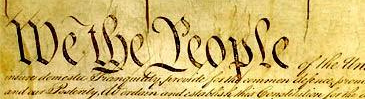
The opening words of the US Constitution. Courtesy of flickr.com/photos/roberthuffstutter.
Two years ago, Congress passed and President Obama signed the Patient Protection and Affordable Care Act (ACA). This piece of legislation significantly changed the functioning of the health care system in the United States and was controversial from its inception. Inevitably, the controversy over the bill soon led to a number of legal challenges filed, and after a number of cases, and a variety of Federal courts ruling differently, the Supreme Court granted certiorari to one of these cases. This particular case, headed by the Florida Attorney General on behalf of 26 states and the National Federation of Independent Business, was heard in the US District Court for the Northern District of Florida. This Weekly Focus examines the key issues argued in front of the Supreme Court last week, identifies certain legal precedents relevant to the case, and ponders the implications of the different potential outcomes.
The first day of oral arguments focused on whether the Court had jurisdiction over the case. The main point behind the day’s discussion was whether the penalties stipulated by the mandate clause could be considered a tax. The law in question, the Anti-Injunction Act of 1867, stipulates that the case be heard by United States Tax Court if the actual tax in dispute has not yet been paid. This would mean that the Supreme Court and the lower courts would not have jurisdiction until 2015 when the penalties are set to be enforced. The government, which initially supported this argument soon retracted, but the Supreme Court decided to appoint a litigator to argue this point in order to clarify the application of the 1867 law in such cases. Attorney Robert Long argued that in its core nature, the penalty is assessed and collected in a manner similar to a tax.
All indications point to the Supreme Court finding that the Anti-Injunction Act is inapplicable in this case. Justice Breyer questioned whether the penalties could be considered a tax to begin with, while Chief Justice Roberts and Justice Sotomayor brought up the history of exceptions that have made for cases involving the Anti-Injunction Act.
On the second day, the Court deliberated over the minimum essential coverage provision, also known as the individual mandate, which requires all citizens, absent a very small pool of those excepted, to purchase health insurance with some relatively basic uniform characteristics. The ACA requires that health insurance companies cover large classes of people who have previously had difficulty obtaining all but the most expensive coverage, including those with preexisting conditions, which would create massive costs without generating much new revenue. The individual mandate is designed to address these concerns by requiring the purchase of health insurance by all citizens including those who might not otherwise, such as the young and healthy, which will generate revenue while lowering medical costs. The individual mandate is thus seen as a means to make the provisions of the ACA, which expand coverage and lower the cost of health insurance, fiscally viable.
The constitutionality of the individual mandate can be judged on several constitutional powers, the most significant of which is the Commerce Clause. The government's position is that the individual mandate is necessary for the fiscal health of the ACA and constitutes regulation of an existing market because all individuals will almost certainly buy healthcare at some point in their lives. By forgoing it when they are young, people adversely affect the market for healthcare insurance. The commerce clause allows Congress to “regulate activities which substantially affect interstate commerce.” (Gonzales v. Raich, 545 U.S. 1, 16-17 (2005)).
The states’ position is that forcing individual to buy healthcare is a compulsory act on the part of the federal government. Rather than regulation of an existing market, the government is seen to be creating one anew. This goes beyond the power of the commerce clause which allows Congress only to, “prescribe the rule by which commerce is to be governed” which in turn assumes that such commerce already exists (Gibbons v. Ogden, 22 U.S. 1, 75 (1824)).
In all likelihood, the individual mandate will turn on the question of whether or not Congress, by requiring purchase of healthcare by individuals who might not otherwise, has created a new market in order to regulate it. The justices have expressed concerns over this power and legal precedent. Justice Kennedy offered the strongest note of concern, stating that, “the reason this is concerning, is because it requires the individual to do an affirmative act...here the government is saying that the Federal Government has a duty to tell the individual citizen that it must act, and that is different from what we have in previous cases and that changes the relationship of the Federal Government to the individual in a very fundamental way.”
Just as important as the fate of the healthcare insurance mandate is the fate of the rest of the ACA should the mandate be ruled unconstitutional. The third and final day of oral arguments dealt with the question of “severability,” or whether the remainder of the healthcare law would still be valid should the insurance mandate be deemed illegal, in particular with regards to “guaranteed-issue and community-rating provisions” that protect patients with pre-existing conditions from being denied coverage, along with the planned expansion of Medicaid.
Both the government and the insurance industry stated that if the mandate goes, so must the provisions attached to it. Without mandatory insurance, claimed US Solicitor General Donald Verrilli, patients with more costly health conditions would be more inclined to obtain insurance, thus leading to a strain in the insurance market, pushing out healthier patients, and increasing costs and premiums. The rest of the law could still be upheld. The states’ attorney, Paul Clement, however, argued that if the mandate was struck down, the entire law should go with it. The Court did not express a clear sentiment on this issue, though expert opinion sees the Court upholding the severability of the mandate if it is indeed deemed unconstitutional.
The source of debate for the Medicaid expansion lies in the risk of states losing further federal funding should they fail to pay for those with incomes up to 138% of the federal poverty line. Clement argued that this constituted no more than an “offer the states couldn’t refuse.” Both conservative and liberal justices showed skepticism over Clement’s claims, citing the lack of historical precedent and a mechanism for determining “coercion.” At the end of an 85 minute session on Medicaid alone, the expansion appeared to be less at risk of being struck down than the mandate provision. Even so, the question of whether the healthcare reform act could stand on its own without the insurance mandate continued to loom large in the minds of both supporters and opponents alike.
Further Reading:
Oral Argument
ACA Background
State’s Brief
Government’s Brief