


French Election a Potential Game Changer
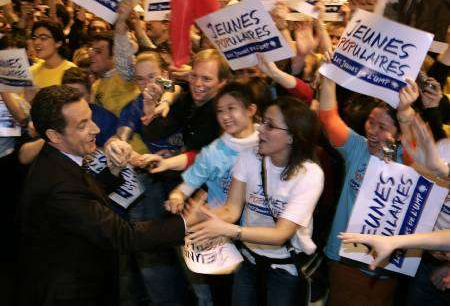
President Sarkozy campaigning in Strasbourg in 2007. Courtesy of Wikicommons.
On Sunday, the citizens of France, in addition to voters in France’s Overseas Departments (including Martinique and Réunion), voted in the first round of the presidential election. On May 6th, the top two candidates, incumbent President Nicholas Sarkozy, and front-running Socialist François Hollande, will compete in the runoff. This Weekly Focus looks at the unique French voting system, the candidates for this year’s election, and how they have campaigned.
Presidential elections in France are held in a majority-runoff, two-round system. Under this system, the initial round of elections will produce a winner only if a candidate wins by an absolute majority (greater than 50%). Otherwise, a runoff election will occur between the two leading candidates from the first round.
This system was put in place in 1962 through a referendum that established the modern French Presidency. In the Third and Fourth Republics, the presidency was a largely ceremonial position elected by the French Senate, much similar to other presidencies in parliamentary democracies. In 1958, faced with a wave of decolonization and a crisis in Algeria, a new constitution was established which drastically strengthened the presidency. The president now has the power to name cabinet members, including the prime minister. Charles de Gaulle, who was instrumental in writing the constitution for the French Fifth Republic, was elected the first president. Realizing that a direct election would improve his political positioning, de Gaulle proposed that the public, through an electoral system that required an absolute majority, elect the presidency.
The majority-runoff two-round system has certain advantages. Because a majority is necessary for a candidate to win, the system balances the increased power of the presidency with more legitimacy. The system also allows voters to vote sincerely rather than strategically—voting for the candidate they like rather than for the candidate who is more likely to win—since voters often get a second opportunity to affect the election. This, however, can also backfire, as seen during the 2002 election; the runoff election was held between Jacques Chirac, a center-right candidate, and Jean-Marie Le Pen, a far right-wing candidate. Because left-wing candidates ended up splitting the votes of the left-leaning electorate, a left-wing candidate failed to advance to the second round.
In the current election, Nicolas Sarkozy, of the ruling Union for a Popular Movement, and his campaign seem hapless. He has made several promises during the campaign: he will eliminate France's chronic deficit by 2016, deftly lead France through the Eurozone crisis, and cut annual immigration by half. But the French do not seem willing to accept this new platform. They remember Sarkozy as the president who raised the pension age, embroiled himself in scandals, and whose "bling-bling" presidency showed a disregard for the common people. Sarkozy's 2012 agenda is said to capitalize on his economic management — his one non-weakness—while pandering to the far right's xenophobia.
François Hollande, the Socialist candidate, was two points ahead of Sarkozy in the first round of voting. Hollande has postured as a "normal President." He says he is the antithesis to Sarkozy, who wants to dismantle some of the redistributive power of the French state. Instead, Hollande promised to sustain France's public services through higher taxes on the rich and by taking a tougher stance against Germany's austerity measures.
The two most important candidates who did not advance were Marine Le Pen and Jean-Luc Mélenchon. Both of these candidates played up their opposition to the European Union and have targeted the working class. The heiress to her father's party, the National Front, Le Pen emphasized her support for a strong state and most importantly her belief that immigrants have only destabilized French society. Her winning eighteen percent of the vote shocked the political establishment and shows the strength of the French far-right. Meanwhile, Mélenchon, the far-left firebrand and Communist candidate, has supported for policies like a 100% top income tax and drastically increased minimum wage. Though he led impressive rallies, the fact he received a lower than expected eleven percent of the vote indicates that his revolution still lacks public support.
Sarkozy's campaign has primarily drawn support from French middle- and upper-class voters due to his claims that technocratic experience this will enable him to weather the Eurozone crisis. However, the unprecedented successes of the National Front has forced him to devote less energy to campaigning on economic policies, and instead focus on an anti-immigration platform and a stronger stance on terrorism. This was seen particularly with the introduction of legislation that would define verbal defense of a terrorist organization as hate speech. His shift to the right may be seen as an electoral necessity, but it may end up alienating more moderate and socially progressive voters.
Hollande has also not campaigned strongly among the French working class (unlike most of his predecessors in the Socialist Party), instead appealing to France's educated and elites. Unlike Sarkozy, Hollande has the more typical credentials of a French president such as having graduated from the Ecole Nationale d'Administration, the prestigious academy which educates most of France's political elites. Hollande has also tried to present himself as a stronger, more aggressive candidate in recent months, although perhaps not successfully. As the First Secretary of the Socialist Party, his reputation was that of a quirky, affable administrator. Critics have noted his attempts to imitate the fierier tone of Francois Mitterand, the only other Socialist to be elected President in this Republic.
Hollande's campaign has also notably adopted a more regionalized approach, including campaign stops in Lille and Marseille. This again plays to Hollande's strengths: Hollande hails from the rural Limousin region, while Paris-born Sarkozy's presidency has been criticized as centralizing power at the expense of regional government.
Opinion polling conducted prior to the first round suggests that Hollande has a large lead in the runoff. However, there are multiple factors that could change the outcome. One is the voter turnout for the second round as a drop in turnout is predictable. Further, while the two-week period between the elections is a short time, it does provide time for additional campaigning and debates. Ultimately, whether Sarkozy can bring back the disgruntled right-wing electorate, which voted for Marine Le Pen in large numbers, will be a key factor that determines the winner.
Further Reading:
Election Results