


Rahm's Return to Chicago: The First Year
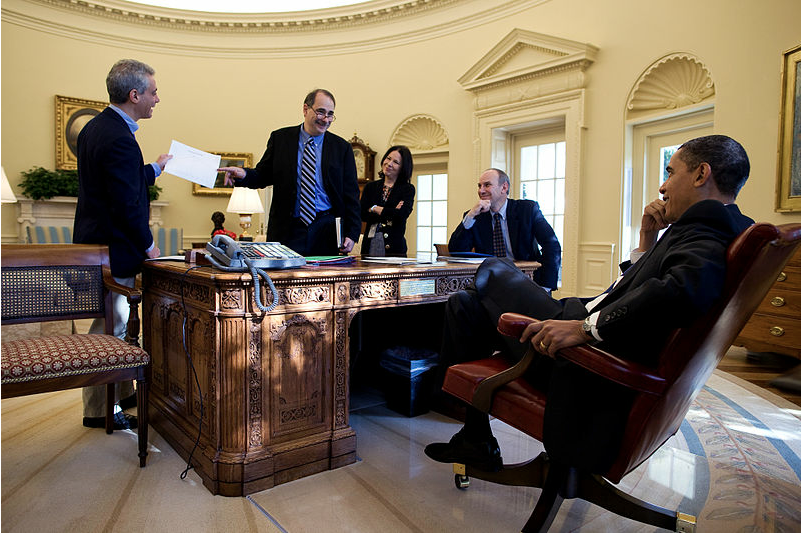
Rahm as Chief of Staff meeting with the President in 2009. Courtesy of wikicommons.
On May 16, 2012, Rahm Emanuel celebrated his one-year anniversary as the mayor of Chicago. For the first time in decades Richard Daley is not the mayor, and the change in leadership has been apparent. This Weekly Focus explores the major policies enacted by Emanuel and how his administration has differed from those of previous mayors.
In the last year, the new mayor has vigorously pursued his agenda, focusing most intensely on revamping the business sector in Chicago. One of Emanuel’s main goals is to make Chicago a more lucrative destination for white-collar workers, and so far he has changed regulations to make it easier for firms to move into the city. To date, almost 15,000 jobs have been created since the start of the Emanuel administration.
In order for more firms to move to Chicago, Mayor Emanuel determined that the infrastructure in the city needed to be improved, and this is where many say Emanuel is already creating his legacy. In March, Emanuel announced the creation of the Chicago Infrastructure Trust (CIT), a public-private hybrid that is the first of its kind. The trust is designed to match public infrastructure needs to private investment firms. The city will fund the operation of the trust, but private companies will pay into it, to the tune of several billion dollars, funding everything from road improvements to new schools. For the companies paying into the trust, it is a long-term investment—they will receive no profit, but the expenses created from operating in an outdated infrastructure will, if this initiative works as it should, be erased. If the CIT is successful it could revolutionize the way city projects are developed.
Those skeptical of the CIT fear that it could lead to all too familiar corruption and patronage. Additionally, under that last mayor, Chicago faced an embarrassing fiasco with the privatization of its parking meters. It is still unclear how comprehensively the CIT will change Chicago, but one thing is clear: its success or failure will help define the legacy of the Emanuel administration.
Overall, the citizens of Chicago have been pleased with Mayor Emanuel’s job so far, but when it comes to crime many believe Emanuel has been less than successful. The homicide rate in the city has risen by more than 50% in the first few months of 2012, and while some argue that it may be a statistical anomaly, others point to the entrenched gang culture that permeates throughout the city.
Although Emanuel was a supporter of fellow Democrat former Mayor Richard M. Daley, he seems to have been chipped from a different block. While Daley was linked to corruption and personified entrenched power in city politics, Emanuel has proven to be an energetic Democrat and, of course, a fresh face in comparison to the Daleys. That being said, Emanuel has encountered tough criticism for several of his initiatives, including a battle with teachers unions and the aforementioned infrastructure project.
All in all, however, Emanuel is strikingly different from Daley in his national exposure. Other cities are already eagerly watching the infrastructure project and its results in Chicago, Emanuel championed Chicago’s hosting of the NATO conference which he thought solidified Chicago’s place on the world stage (in contrast to Daley’s failure to get Chicago the bid for the 2016 Summer Olympics), and his comments on national politics gain significant media coverage. There were some setbacks for Emanuel, such as the relocation of the G8 summit, scheduled at the same time as the NATO conference, from Chicago to Camp David by the Obama administration. While Mayor Daley never served outside of Illinois, Emanuel’s experience in the House of Representatives and the White House makes him an experienced player that can guide Chicago on the national and the world stage. Globetrotting aside, only time will tell if Emanuel’s experience can continue to successfully convert into navigating the muddy trenches of Chicago city politics.
When asked what grade he would give his performance in his first year in office, Emanuel said “incomplete.” Certainly a lot has changed in the last year, but there is still plenty of time left In Emanuel’s first term. For a mayor with grand ambitions like Emanuel, he will need more than one year to create his legacy.
Further Reading:
G8 Summit
Teacher's Reaction