


Right-wing Resurgence Haunts Europe
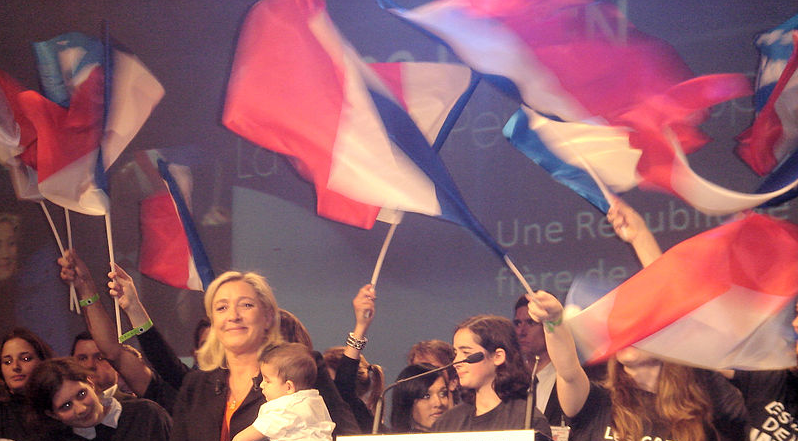
Marine Le Pen addressing a crowd at a National Front event in 2012. Courtesy of Wikimedia Commons.
The economic recession in Europe has had wide-ranging effects, from tensions within the Eurozone to the rise of new political parties in across the continent. While rising right-wing parties has been cyclical in Europe—they tend to grow during economic downturns and fade during periods of growth—their current resurgence is nonetheless troubling. As the economic stagnation continues on the continent, it remains to be seen what will happen to these political groups.
In France, the National Front has been a major third party since its inception in 1972, when it was created by Jean-Marie Le Pen to unite the country’s various nationalist movements. Although the party’s popularity has fluctuated, it has never received significant representation in the legislature due to the French electoral system. In 2011, leadership of the party was handed off to Jean-Marie’s youngest daughter, Marine Le Pen, who has revitalized the group and significantly boosted its popularity. Like other far right parties in Europe, the National Front is eurosceptic, harsh on immigration, and traditional on social issues. Its economic policy is also highly conservative; it favors protectionism and a return to the gold standard.
The Great Recession and resultant Euro Crisis seem to have strengthened the National Front, reinforcing euroscepticism and leading many frustrated by a stagnant economy to embrace xenophobia and social conservatism. In the 2012 French presidential election, many saw Sarkozy veer to the right in the second round of voting in an attempt to win Le Pen’s votes. This strategy ultimately failed as it allowed Hollande, a left-wing candidate, to win the center. More recently, as Hollande’s popularity has declined, one poll placed Marine Le Pen’s popularity at an incredible 32 percent, over Hollande’s dismal 24 percent. Frightening to many, the National Front has become a strong and persistent force in French political life.
In Greece, the Golden Dawn has arisen as a political force because of anger over austerity measures, forced upon Greece as a condition of the numerous Eurozone bailouts, coupled with racial and ethnic prejudice, high unemployment and soaring poverty rates. In Greece’s June 2012 election the party gained seats in the parliament. Since last June, the party’s popular support has climbed to roughly 11.5%, and has stayed steady for the past few months. Golden Dawn draws its primary support from the rural poor and unskilled labor force, mixing violent rhetoric (and action) against Jews, Roma, and other minorities, while also promoting plans for support networks for the poor. The party promises a “social action program” for the economically disadvantaged, provided, of course, that they can prove Greek heritage. Golden Dawn has organized several Greek-only blood banks, food drives, and support services for the elderly. These programs are popular among Greeks with few social supports left, but within Golden Dawn they are part of a wider campaign which often includes activities like “protecting” neighborhoods from immigrants. Golden Dawn’s “stormtroopers” patrol many urban centers, beating, and sometimes killing, foreigners and minorities. In March, the party’s attention turned to Greece’s youth, starting a campaign to attract future voters as young as six
In Hungary, Jobbik, the far-right anti-Semitic party, won a staggering 17% of the vote in 2010’s parliamentary elections. Unlike Golden Dawn, which targets the rural poor and unskilled labor force, Jobbik draws a large portion of its support from young, college-educated professionals. Supporters cite economic concerns as equal to issues of “national identity,” expressing anti-Roma, anti-Semitic, and anti-immigrant sentiment and fears of other perceived threats to Hungarian culture. The government of Prime Minister Viktor Orban’s increasingly autocratic Fidesz party has done little to stem the rise of Jobbik; instead, the Hungarian far-right and far-left are often seen joining forces in anti-Fidesz rallies. The supporters of Jobbik, however, are not fighting against autocracy; rather, they are fighting against the current government and its policies. Jobbik’s agenda is simple; stronger laws against Roma “criminality,” restoration of Hungarian culture through expulsion of “unwanted ethnic groups,” and severing of ties to the European Union, which the party claims will both boost the economy as well as stem unwanted immigration.
Germany too has seen the rise of right wing parties in recent years, most notably, the National Democratic Party of Germany. It is best described as racist, anti-Semitic and anti-foreigner, in addition to its desires to abolish the current German Constitution. The upper house of the German Parliament is seeking to ban the party from taking part in elections. This has become an issue in recent years after a report published by the Social Democratic Party found that anti-foreign sentiment, right-wing authoritarian dictatorship, chauvinism and social Darwinism is on the rise. Another report by the Friedrich Ebert Foundation found that nearly a third of respondents believed foreigners were in Germany to take advantage of the welfare state’s benefits and that about 60 percent of respondents were in favor of restrictions on the practice of Islam. The prevalence is the highest it has been in East Germany since the fall of the Berlin Wall. Although not a political group, terrorist groups like the National Socialist Underground have drawn particular attention for their increased use of violence as a political tool. Law enforcement aims to combat right wing groups with tactics of prevention and repression. Repression includes traditional law enforcement methods while prevention aims to educate parents and teachers on the methods these groups use to recruit young people.
Over in the United Kingdom, the rise of the Independent Party (UKIP) has garnered attention after they enjoyed surprising success in recent local elections, in which the party won 147 council seats. Led by Nigel Farage, a former commodities trader, the party promotes a platform of euroscepticism and xenophobia. Popular in response to the financial and eurozone crises, the party seeks a restricted immigration policy, and withdrawal of United Kingdom from the European Union. Although the party won local elections, it is unlikely that they will do well on the national stage, despite speculation that they may destabilize the essentially two-party system now in place. The party is not expected to gain more that 25 percent of the vote, which is a generous estimate. The UKIP has poached core Conservative voters from the Conservative Party, so the ruling party now has to focus on regaining its base rather than turning its efforts to expanding its appeal to solidify their governing majority. Despite the Independent Party’s recent news coverage, the UK is hardly witnessing a similar emergence of far right parties like other European countries have seen.
Further Reading:
Far-Right Attitudes in Germany
Right Wing Parties in France and the UK
Sam Houskeeper, Alexi Stocker, and Val Zuckerman contributed