


Homelessness in France: Empathy Turned Apathy
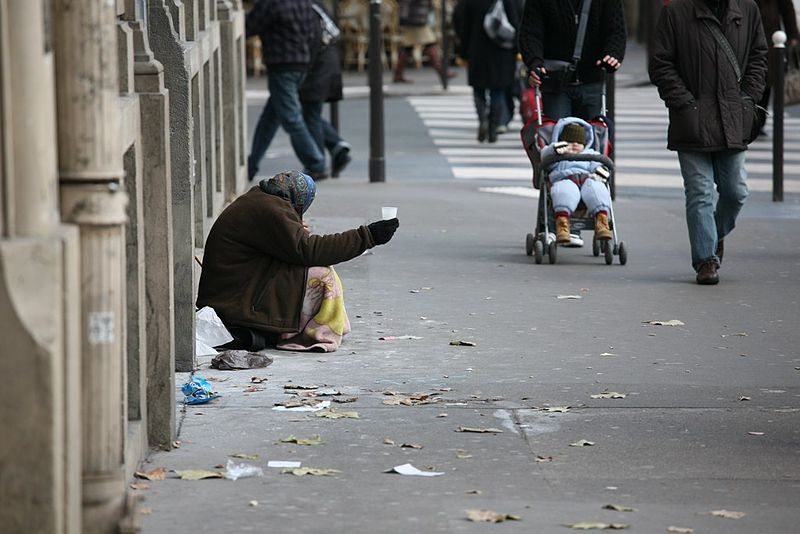
December 14, 2025 Alex Proimos, A beggar in Paris.
November 14, 2025
The clearest statistic that portrays the dire situation of France’s homeless is that between 2001 and 2012 homelessness had increased in France by around 50 percent. There are approximately 274,000 living in shelters and 33,000 living rough (or on the streets). The U.S., as a reference, has 633,782 homeless; the US has a population almost five times as large as that of France, and yet France has about half of the amount of homeless people as the US. There are reported to be 3.6 million people in France that lack decent housing. Those are a few quick numbers to impress upon the reader the vastness of France’s homeless population; however, the nature of homelessness makes it quite difficult to get accurate data. The first survey on homelessness was only conducted in 2001 and the second at the end of last year, due to the expense and difficulty of data collection.
To add to the standard problems of inefficient bureaucracy and unfulfilled political commitments, Paris is also one of the most convenient cities to be homeless. Parisian police will not bother those living rough, and 75 percent of citizens claim solidarity with the homeless. Citizens of Paris perceive homelessness as a product of unemployment and the economic downturn instead of alcoholism or drug addiction. While this is empathetic, kind, and often accurate—perhaps it also engenders complacency in the Parisian culture where there should be indignation. Do not misunderstand the interpretation. This complacency does not lie with the homeless, but those NGOs, companies, and citizens who could improve the lives of the homeless but choose to be conveniently “tolerant” instead. It is important not to misunderstand in an effort to be kind. The end goal for the homeless is not a warm, egalitarian regard, but rather a roof over their heads.
The last ingredient to homelessness in France is the economic downturn and unreliable housing market. 25 percent of the homeless have children with them. This is a relatively new, observable phenomenon considering this was not nearly the case 8 years ago. Housing prices are reported to be the most expensive in comparison to disposable income since the 1930s, with apparently 7 percent of Parisian apartments uninhabited. Some houseless families have adapted and become squatters. One story describes 16 families usurping a four-story office block between Gare du Nord and Gare de L’Est. Even though the building legally belonged to the owner who had buyers lined up, they moved in en masse, ordered food to the apartment to gather witnesses of residence, and invited over the housing minister. While local governments worked to ameliorate the situation, the owner, Lasa Georgas, while justifiably frustrated, continued to provide heating and plumbing, and the residents took solace in their relatively stable, however short-lived, life-circumstances.
There are some concrete moves being made on the issue. The DGAS (General Directorate of Social Affairs) is a government body in charge of funding shelters and other organizations that provide basic social services for the homeless. In addition there are several NGOs such as Fondation Abbé-Pierre, Emmaus Habitat, SAMU social, and Pauvreté-Precarite that each contribute in their own ways through medical assistance, providing food/beds, and raising awareness. France has the NGO’s, the government programs and even the money to achieve this solution. But when it comes to combating its large and deepening homelessness crisis, France simply lacks organization and commitment.