


African Accord? M23 and the Congolese Government
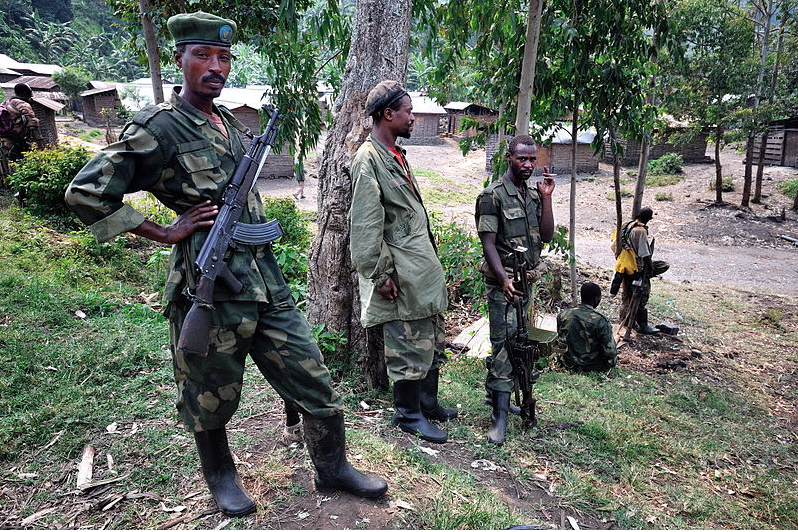
M23 fighters in 2012. Courtesy of Wikimedia Commons
The past few weeks have witnessed a major, and some say, historic change in the African nation of the Democratic Republic of the Congo. The Weekly Focus explores the momentous ceasefire signed by the rebel group, M23, and the Congolese government.
M23 has its roots in an older rebel group called the National Congress for the Defense of the People, or CNDP. The name M23 commemorates the date, March 23, 2009, that CNDP signed a peace agreement with Congolese army. After the treaty, many of the members of CNDP were absorbed by the military. However, the fighters complained of poor pay and a lack of necessary resources. They also claimed that the Democratic Republic of the Congo failed to implement the 2009 peace treaty. In April 2012, around 300 soldiers rebelled and deserted the army. The rebels cite mistreatment as the reason for their desertion, but analysts suspect the real reason might have been pressure from DR Congo to arrest their leader, Bosco Ntiganda. Nicknamed “The Terminator,” Ntiganda turned himself in to the US Embassy in Rwanda after losing a power struggle within M23. He has now been transferred to the International Criminal Court in The Hague.
The rebels are ethnic Tutsi, a minority in the Democratic Republic of Congo. After the genocide in Rwanda, nearly a million ethnic Hutus fled into DR Congo. Some of them, including fighters responsible for the deaths of Tutsis, formed the armed group FDLR. CNDP coalesced in response to the influx of Hutu fighters. When past members of CNDP formed M23, ethnic identities continued to dictate who was friend and who was foe. The rebels maintain close ties with ethnic Tutsi in Rwanda. Both the Democratic Republic of Congo and the UN have accused the Rwandan military of supporting M23, although the Rwandan government denies it.
Over the past year, accusations of human rights abuses by the M23 rebels have grown louder and more frequent. Internal and external displacements had surpassed 140,000 by November 2012. As a result, the United Nations authorized “offensive” action, as of March 2013, to defend civilians in the region, dispatching heavier weapons, more soldiers, and attack helicopters to aid the Congolese army in their struggle against the rebellion. The addition of the UN Force Intervention Brigade is widely credited with turning the tide against the rebellion.
The conflict intensified dramatically over the spring and summer, as government forces, backed by the U.N. Force Intervention Brigade, sought to regain control of rebel-held towns. The summer clashes resulted in allegations of abuses against both the Congolese army and M23 rebels; the Congolese were accused by their UN backers of abusing M23 detainees, and the M23 rebels allegedly abused thousands of civilians in territory they controlled. Coupled with a large civilian death toll in July at the hands of Ukrainian UN peacekeepers piloting government attack helicopters, Uganda and other DRC neighbors persisted in their call for a cease-fire and peace talks.
Following more than a year of conflict, the M23 rebel group agreed to meet with the government of the Democratic Republic of the Congo to discuss a possible peace in early September of this year. Brokered by eleven countries neighboring the DRC, including Uganda and Rwanda, the peace talks failed to establish a permanent cease-fire, with combat operations continuing despite negotiations between representatives of the DRC and the M23 rebellion in Munyonyo. As the peace talks broke down, the conflict’s intensity mounted, culminating in a massive series of assaults on rebel-held towns in the eastern DRC by the U.N.-backed Congolese army.
The agreement was not meant to end the rebellion, but rather to provide amnesty for M23 members. The government was prepared to offer amnesty for acts of rebellion, but refused to extend amnesty to human rights violations or war crimes. It was also to include a provision to reintegrate rebels into the army, as well as disarmament and demobilization of M23 rebels.
While the laying down of arms by M23 is certainly a positive step forward for the region, several other rebel groups are still active nearby. It appears the long term plan is for the newly rejuvenated DRC army and UN task force is to force these groups to surrender or disarm. The most prominent in the region is the Democratic Forces for the Liberation of Rwanda (FLDR), a group consisting of Rwandan Hutus forced out of the country in 1994 after the genocide and more recent recruits native to the DRC. The group is intent on overthrowing the current Rwandan government. According to the UN force charged with stabilizing the region, FLDR is the largest rebel force in the area with 2000 fighters. There are reports that the FLDR is the next target of the DRC army and UN force. The DRC moving against the FLDR would likely mend relations with Rwanda, who backed M23 in part to limit the influence of FLDR.
If FLDR is dealt with, then the DRC apparently plans to move against the Allied Democratic Forces, a Ugandan group aiming to enact Sharia law in that country. After that, the Lord's Resistance Army, led by the now infamous Joseph Kony, is apparently a target. The UN and the DRC seem to have both the resources and the will to transform the Eastern DRC from its current status as a lawless zone where armed groups fight over mineral wealth, ethnicity, and religion. However, that will be a long and tough fight with many groups trying to keep it in its current state. Even if the three groups described are defeated, many other armed groups and decades of strife still have to be overcome. If peace were to be achieved, the country could exploit the copper reserves in the region, which make up 80 percent of the global total, and boost its weak economy.
On the other side of the border, the end of M23 opens an opportunity for Rwanda to renew its ties to western powers. Rwanda's support for M23 cost the country when the US cut off military aid due to the group's use of child soldiers. If M23 passes into the history books, then the US can restart that aid. The same holds true for the UK, which also suspended aid due to Rwanda's support for M23. Though the near future for the DRC seems fluid-- and indeed, it seems that peace talks may be starting to fail--it is clear that the change in the status of M23 will have far-reaching effects on this country and the region more broadly.
Further Reading:
UN description of various factions
What's next for Congo
Elizabeth Fillion, Don Gross, Alexi Stocker, and Valerie Zuckerman contributed.