


Not So Clean After All – Implications of Corruption in the Turkish AK Party
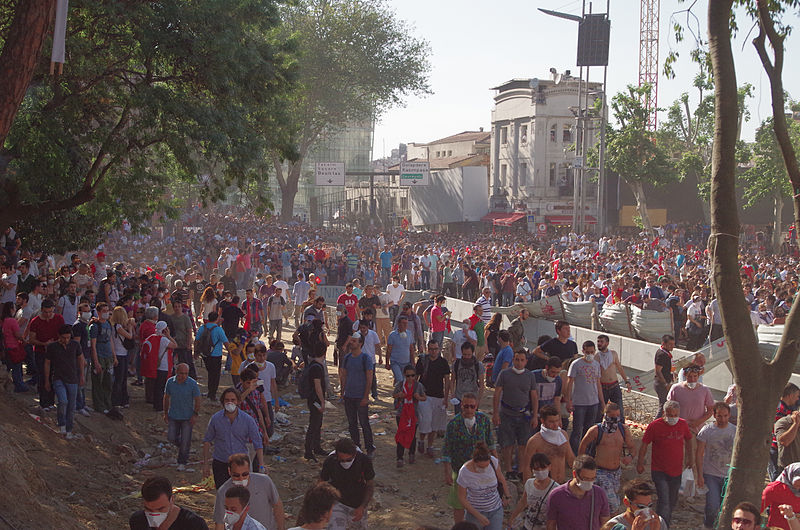
Gezi Park protesters, June 2013. Photo Courtesy of Alan Hilditch
On December 17th, Turkish police detained around fifty individuals accused of corruption and bribery. The scandal—and what implicated Prime Minister Recep Tayyip Erdogan—was that the arrested ranged from sons of government ministers to political allies in Turkey's financial sector. Thus began a new chapter in Erdogan's battle between his movement and the Turkish "deep state"—pockets of the administration loyal to their own interests.
While the Prime Minister has, over the last five years, quelled both opposition from the military and from the street, he holds less leverage over security forces and the judiciary. His response the next day was to fire police chiefs involved with the arrest and decry an "operation" against his democratic government, rhetoric he is wont to use. In return, by Christmas the most notorious of the arrested were charged with bribery, including Suleyman Aslan—CEO of Halkbank and accused of smuggling gold to Iran—and the sons of the Economy and Interior Ministers, Zafer Caglayan and Muammer Guler. Both would resign within the day.
To reassert order and control on the government, Erdogan chose to renominate half of his cabinet before the new year. But the damage to his reputation was done. Parliamentarians leaving his AK Party have lashed out at his authoritarian rule before the media. Many publicly wished the Prime Minister would resign in order to restore confidence. Meanwhile, the case's prosecutor has accused the government of threatening his work, and a second wave of arrests was called off. The Prime Minister, who has by now fired hundreds in the police force, is poised to remake this branch of the state in his image. To him, the scandal is a product of foreign meddling, as if he were the target all along—a view his opponents are unwilling to concede.
Erdogan’s Justice and Development Party (AKP) was once seen as a model for Turkish governance. The moderately Islamist party came to power in 2002, and since has been credited with removing power from the military and reviving the Turkish economy. However, it was a difficult rise to leadership for Erdogan, who was once imprisoned over charges of seeking to topple Turkey’s secularist regime. One of Erdogan’s closest allies in his rise to authority was Fethullah Gulen, often considered the most powerful cleric in Turkey. Gulen, a Muslim preacher born in the eastern Turkish city of Erzurum, has been based in the rural eastern Pennsylvania town of Saylorsburg in self-imposed exile since 1999, having fled Turkey over the same charges that led to Erdogan’s imprisonment. Gulen has a large following, which operates schools around the world and maintains strong ties to media, finance, and government in Turkey. Gulen’s movement supported the AKP in toppling the old secular elite and played a key role in making the AKP Turkey’s most powerful political party today.
Gulen’s followers were able to infiltrate the secularist regime’s judiciary and police in the 1990s and early 2000s by defying the stereotype of Islamists through presenting themselves as clean shaven, Western-educated, and English speaking. A leaked video of one of Gulen’s sermons from 1999s shows that this was exactly the strategy he espoused. The prosecutors who beat the power of Turkey’s authoritative military through mass trials were also believed to be Gulen’s followers. With several hundred military officers now imprisoned, Erdogan and Gulen’s common enemy have been defeated. Over time, each side has increasingly grown distrustful of the other, seeing each other as a threat to their power. They were united in fighting the secularist regime, but they originate from two different traditions of the Islamist movement in Turkey. And with their common enemy defeated, the alliance has frayed and intensified into a struggle to control state institutions. In early 2012, a Gulenist prosecutor tried to summon the head of the National Intelligence Agency, an Erdogan confidant, as a suspect in a terrorism trial. Later that year, an eavesdropping device found in Erdogan’s office was linked to Gulenists in the police. Erdogan’s camp has retaliated by planning to outlaw extra-tuition schools, of the kind run by Gulen, which provide funds and followers to the movement. This most recent scandal is believed to be yet another battle in the proxy war for power between the two camps.
Mr. Erdogan has built up a compelling image of his government as a corruption-free, clean alternative to a murkier past. These Recent events have critically damaged this image of the AKP important not only to the Turkish people, but also to aspiring democrats across the Arab world and to friendly E.U. governments working to advance European-Turkish ties. For many people, both within and without Turkey, the AKP represented a model of functioning democratic Islamism, an alternative to western secularism or the old totalitarian regimes of countries like Egypt, Tunisia, and Libya.
The most recent allegations served only to further alienate secular and liberal Turks, who had drifted away from what they perceive as an increasingly pious Islamist movement prone to cronyism. Although the implicated ministers have since resigned, Prime Minister Erdogan’s reaction to the corruption allegations and police investigations, especially his administration’s removal of dozens of high-ranking police officials and hundreds of other officers involved in investigating bribery allegations, has stirred up populist anger against the AKP, especially in Istanbul. Sporadic street protests broke out in mid-December, and some Turkish politicians predict a return to street protests on the scale of the past summer’s, in which many thousands of Turks in Istanbul and other cities protested the violent suppression of an earlier protest to defend a popular Istanbul park.
The most immediate electoral effects of the corruption scandal will likely be felt in Istanbul’s mayoral race in March. Mustafa Sarigul, the opposition Republican People’s Party candidate for the mayoralty, casts the choice between himself and AKP candidate, and current Istanbul mayor, Kadir Topbas, rather as a choice between himself and Prime Minister Erdogan. The Republican People’s Party hopes to use public disillusionment and disgust with the AKP to win the Istanbul mayoralty, an office often used by politicians (including Erdogan) as a springboard to national prominence.
In August, Turkey will hold its first-ever direct presidential elections. Prime Minister Erdogan plans to seek the office. Although he remains the favorite even in the wake of the recent corruption allegations, an AKP loss in the Istanbul mayoral elections in March could damage his chances. Moreover, details in the corruption scandal continue to surface; even Mr. Erdogan’s populist appeal could not withstand evidence directly linking him to illicit activity. For over ten years, Mr. Erdogan has served as the head of a model government, but now it looks like some cracks in that model might begin to show.
Further reading:
On the scandal
On the mayoral race
Alexi Stocker, Tom Cui, and Monika Hur contributed.