


The Week of January 20th, 2014
5. NATO Summit Terrorism Trial
On Tuesday, January 21, the trial began for three men accused of plotting terrorists attacks during the 2012 NATO summit in Chicago. The men were arrested in a police raid days before the summit began, during which authorities found Molotov cocktails as well as other materials, like a crossbow, and throwing stars, potentially useful for an attack. Controversy has surrounded the trial, as some have suggested that the suspects were entrapped by undercover police officers who goaded the individuals into preparing an attack in the first place. This possibility seems strengthened by evidence from the trial suggesting that the three men seemed too incapacitated from alcohol and marijuana to actually fully plan an attack. The individuals are being charged with 11 separate indictments, the most serious of which is an Illinois state anti-terrorism law.
This state anti-terrorism law is what makes the case noteworthy. No other state has brought a case using its own anti-terrorism laws. The trial of the Boston Bombing suspects for instance is being handled by federal prosecutors. While state officials argue that this makes states more flexible in responding to potential terrorist threats, others worry that these types of cases being handled by individual states could lead to state legislation that infringes on civil liberties. The constitutionality of the Illinois law was challenged shortly after the three suspects were arrested, however the challenge was not upheld. This trial could determine if other states want to pursue terrorist charges on their own, without federal support.
4. Syrian Peace Talks in Geneva
Iran was invited, then disinvited within the span of 24 hours, to Syrian peace talks in Geneva on Wednesday. U.N. Secretary General Ban Ki-moon rescinded his invitation, citing Iran’s lack of commitment to supporting a transitional government that would end the war in Syria. Iran has played a leading role in the Syrian Civil War, supplying the Assad regime with money, military equipment, and advisors. Opposition forces claim that fighters have been flown in from Iran as well, but evidence of the charge is suspect. Iran has long been a sponsor of Hezbollah, the Lebanese Shiite Militia, labeled as a terrorist organization by the United States and another major player in the conflict.
Very little is expected to be accomplished at the Geneva II talks. While the outlook was not rosy before Iran’s departure, as many rebel groups refused to attend, it was thought that Iran’s inclusion could at least increase the weight of the negotiations; now even that hope is dashed. In addition to Iran’s absence, Syria has made it clear that their priorities lie in fighting “terrorism” rather than achieving peace. However Peace talks planned between Representatives of President Bashar Assad and members of opposition are already postponed from there previously planned Friday date.
3. McDonnell Indicted for Corruption
Former Republican Governor Robert McDonnell and his wife Maureen have been indicted on 14 counts regarding corruption charges, although he claims to have done “nothing illegal.” It is alleged that the McDonnells accepted numerous gifts, more than $165,000 in value, from a maker of dietary supplements in return for various measures for ease of doing business. The couple was apparently completely broke from poor real estate investments. Bystanders are furious at the revelations, though some other politicians have come forward to state that McDonnell legally did nothing wrong; even so, he may have significant trouble funding his defense. If McDonnell were to win by the letter of the law, which places surprisingly few significant restrictions on lifestyle subsidies for politicians, the public could react with anger.
Just a few years ago, some saw McDonnell as a possible star of the GOP. He delivered the State of the Union response in 2009 and was praised for his governorship. Along with Christie’s current corruption struggle in New Jersey, McDonnell’s fall from grace seems to be all too familiar. Even if McDonnell were to win his case, he could never return to politics and so joins the thick ranks of disgraced politicians.
2. EU Bond Recovery
The European debt crisis has seemingly dragged on for ages, but its dynamics have shifted almost unnoticed. Europe's "PIIGS" (Portugal, Ireland, Italy, Greece, and Spain) struggled economically and bond sales suffered through recent years, but they are no longer on the brink of imminent crisis. On Wednesday, the Spanish Central Bank auctioned ten billion Euros in state debt, one of the largest one-time bond sales in Eurozone history. It received four times that number in buy orders and had the freedom to sell bonds at the lowest interest rate since the financial crisis. This is consistent with a declining trend in rates over the past two years, as well as significant improvement for bonds Irish, Greek, and Portuguese. Even if the Spanish economy is still mired with 26 percent unemployment, the demand for bonds suggests the financial sector believes the country will recover and debts will be repaid.
There remain forces working behind the scenes. For one, traders may not be confident in a Spanish recovery and just want to gamble, since the return on the debt of safer economies has been pushed down. Furthermore, Spain's solvency is not ensured by better funding for the government at the moment but by the European Central Bank (ECB), which has promised to buy up unlimited government debt if the need arises. While this type of purchase has not yet occurred, its possibility has been cited as one reason why the crisis has been defused. In other words, the debt crisis - which used to be a national issue - has been transformed into a European one. With no movement toward greater monetary integration, Spain and countries like it have to gamble again on European politics working in their favor. However, they are not free to veer away from austerity; if the ECB's policies change or confidence plummets again, these European economies might be in for another round of painful cuts.
1. Protests in the Ukraine
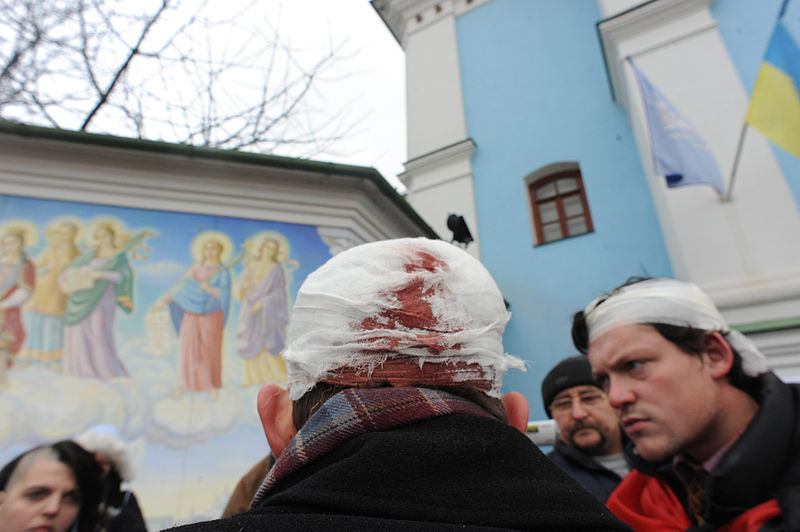
Protests in Ukraine continue this week as the pro-European factions flooded the streets of Kiev, facing off against government forces. Since President Viktor Yanukovych's surprise end of the year announcement of an economic shift toward Russia and away from the European Union, thousands of Ukrainians have demonstrated in Kiev's Independence Square, Maidan, in favor of closer ties with the West and greater independence from Russian influence. However, the make-up of the opposing groups is not so cut and dry; there are reports of neo-Nazis and other nationalist groups taking part in the protests and violence, while there are many Ukrainians, particularly in the East, who continue to favor the government's pro-Russian position.
In a macabre and ironic twist, the protests have reignited due to the government's proposal to restrict the right to protest, resulting in a number of deaths. Text messages received in Ukraine identifying those who had connections to the protests demonstrate the increasing intensity of the conflict. Though Ukraine has been straddling the East and West for years, these protests have thrown this issue into stark relief. While there has not been any credible talk of the country splitting or the current government being deposed—and reports yesterday indicated a ceasefire might be in the works—it is increasingly likely that if the protests persist and continue to intensify, the consequences for Ukraine could last for decades.
0. Hollande’s Affair
News reports have implicated French President François Hollande in an extra-extra-marital affair. Hollande is apparently seeing the famous French actress, Julie Gayet, behind the back of the reporter he left his wife for two years ago, Valerie Trierweiler and Segolene Royal respectively. Trierweiler was only recently released from the hospital after taking several sleeping pills. This kind of infidelity, while somewhat par for the course for French Heads of State (link to CNN article), is not typically reported on in France, at least compared to similar scandals in the United States and the United Kingdom. Popular analyses attribute this to a “Puritanical” attitude permeating UK and US political life, or the French legal system’s emphasis on privacy over freedom of the press. In any case, such silence has now been broken, leading major public response to the affair. Making headlines all over the world, this affair serves to illuminate how easy it is for people to get caught up in the personal, rather than political lives, of their political representatives. Hollande’s already low popularity has not suffered from the scandal, but it has distracted from his governance.
Whether this ushers in a new era of American-esque politics in France, or it ruins the family life of Mr. Hollande, this turn of events is rather inconsequential for the world and not worth the attention it has received.
Tianfang Tom Cui, Aaron Levine, Don Gross, Valerie Zuckerman, Sam Houskeeper, and Liam Conway-Pearson contributed