


Ongoing Violence in Venezuela Highlights a Divided Country
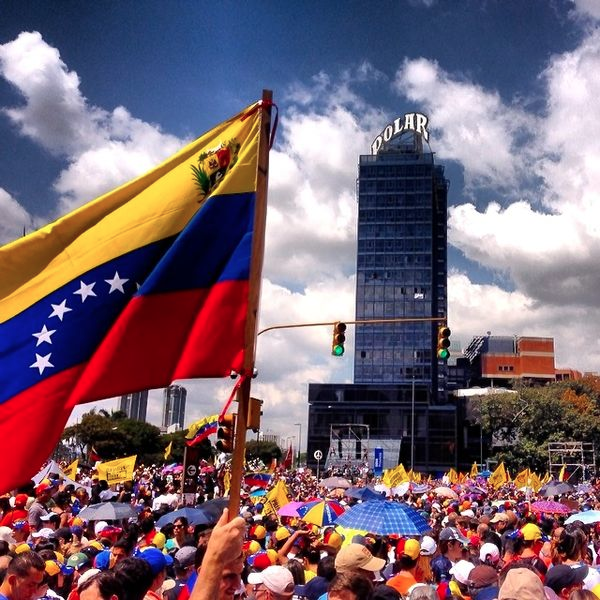
Protesters rally in Caracas. Photo Courtesy of Wikimedia Commons
March 15, 2026
For the better part of 2014, anti-government protests have been raging in Caracas, the capital of Venezuela. These protests reached international attention when three people were killed on February 12. Since then violence on the street has claimed 17 lives and injured hundreds of people. The protests, ostensibly anti-government in nature, were sparked by poor economic growth. Tensions have been brewing since the death of Hugo Chavez one year ago. Elections to replace Chavez, which brought Nicolas Maduro to power were widely viewed as fraudulent. So far, little has been done that has quieted the opposition, spurred on by the rally cries of their leader Leopoldo Lopez who was jailed for inciting violence on February 12th.
The Venezuelan protest movement comprises a coalition of students, who are relatively conservative, compared to students in other countries, members of the main opposition umbrella organization Table for Democratic Unity (MUD), and members of the middle class. The protesters have three common immediate demands; all are calling for the release of the two to five hundred protesters arrested in mid-February (the count varies depending on source), an investigation of alleged torture by the police and other security forces, and the disarmament of pro-government thugs, known as colectivos (“collectives”). Students and members of the opposition are protesting against state censorship, demanding free flow of information. The middle class, and the opposition politicians they support, is voicing concern about the situation of the economy. In 2013, inflation topped 55%, and many consumer staples, such as toilet paper and toothpaste, are difficult to come by. Crime is pervasive and worsening in many cities, as well as in rural areas, and opposition leaders blame Maduro’s government for failing to protect the people and punish criminals. The opposition is also calling for fresh elections; the past year’s election, in which Nicolas Maduro won a slim majority, was rife with fraud, bullying, and vote buying, according to opposition leaders. At the extreme end, some MUD hardliners refuse to stand down until Mr. Maduro resigns, arguing corruption and state-sanctioned violence are irredeemable crimes against the people.
Despite the intensity of the past few weeks, Mr. Maduro seems, at least for now, unlikely to stand down. This is because the majority of Venezuelans still support Mr. Maduro; he has continued almost all of the economic policies of his predecessor, Hugo Chavez, designed to ensure the loyalty of Venezuela’s poor. The Chavista movement, built up by Hugo Chavez over a decade-and-a-half spanning political career, maintains support from a powerful base, unlikely to waver even in the face of mounting disorder and economic trouble.
There are three main potential outcomes from the protests. First, Mr. Maduro could step down and call fresh elections. This, however, is extremely unlikely to happen, due largely in part to the support he continues to enjoy from his base, described above. Second, the government could repress and ultimately ignore the demands of the protestors. This has, for the most part, been the case so far, but continuing with this line of behavior threatens the government’s long-term stability. A brutal repression could turn Maduro’s Chavista base against him, thus setting the stage for his ultimate downfall. Third, Mr. Maduro could negotiate with the opposition. This final option is, although unlikely, not impossible. The question, however, would be how many concessions Maduro would be willing to make to Mr. Capriles. Whatever happens, any solution would hinge on the well-being of the economy.
The Venezuelan economy took a rapid nosedive after the death of Hugo Chavez one year ago. The quickness of this downturn may lead to a stronger association of Chavez with the good times and Maduro with the bad, thereby cementing Chavez’s reputation. Nevertheless, Maduro has pursued economic policies in nearly exactly the same vein as his predecessor. The reasons for the dramatic tumble in Venezuela’s economic prospects are diverse.
Chavez built a socialist state heavily dependent on borrowing, especially from his ally China. When Chavez died, risk of default increased and so did the premium on China’s loans and investments in Venezuela. This made it extremely difficult to manage Maduro’s inherited debt. This debt had been accumulated from years of overzealous socialism under Chavez and recently increased by the extremely expensive final reelection campaign of Chavez and the election campaign of Maduro.
Currently, prices in Venezuela are astronomical and shortages are endemic. The only good in abundance seems to be oil. Petroleum became the mainstay of the economy under Chavez. While heavy regulation strangled nearly every other industry, Venezuela’s oil boom allowed it to maintain a functioning economy, but made that economy increasingly less diverse. For years, Venezuela attempted to make its lopsided economy less precarious by playing with exchange rates and protecting domestic markets. This policy led to enormous inflation, however, which Maduro attempted to tame by limiting access to the artificially lowered rate to only state owned companies. This attempt to fight inflation led to greater shortages and a general downturn in economic activity. The resultant rioting and unrest has only further crippled the economy. And so, economic poverty led to a socialist state, which led to more economic poverty, which led to unrest and a repressive state, which has finally caused outright economic privation. While Maduro may very well be able to hold his regime together, the immediate future of Venezuela is not promising.
Further Reading:
Effect on economy
Contributions by Ben Mandel, Alexi Stoker, and Sam Houskeeper