


Examining the Failure of Israeli-Palestinian Peace Talks
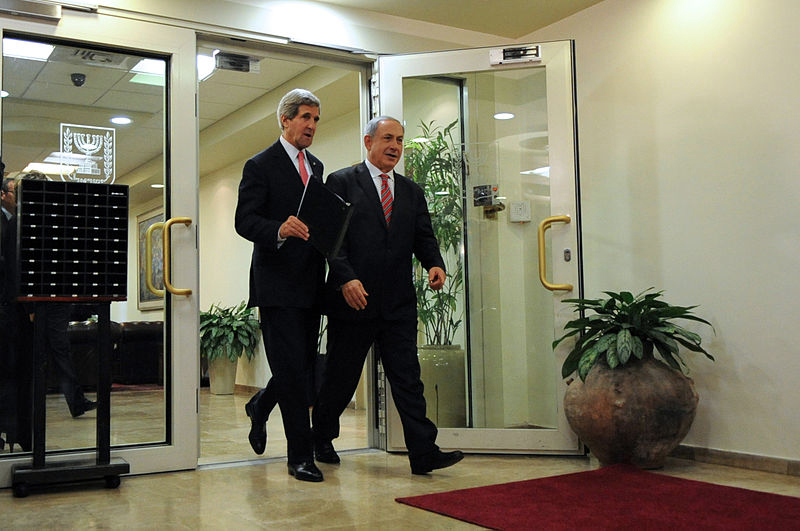
Secretary of State Kerry and Prime Minister Benjamin Netanyahu. Photo Courtesy of Wikimedia Commons
April 18, 2026
Brokering peace in the Israeli-Palestinian conflict has long been a holy grail of US presidential administrations’ foreign policy agendas. Nearly every president and secretary of state since the 1967 Six Day War, which saw the beginning of Israeli occupation of the West Bank and the Gaza Strip, has sought to be the arbiter who brings the two parties to the negotiation table and finds a lasting solution. Riding a wave of international popularity, Barack Obama came into office with such intent, reviving direct negotiations in 2010 between Israel and the Palestinian leadership with his Secretary of State Hillary Clinton taking point. Those first term talks stalled, triggering a three year hiatus in negotiations.
Clinton’s successor, longtime Massachusetts senator and former Foreign Relations Committee chairman John Kerry, came into the office in February 2013 with ambitions of restarting negotiations and playing a close personal role in the peace process. Staking a portion of his legacy as Secretary on the prospect, Kerry brought both sides back to the negotiating table in July of last year to commence a nine month process aimed at resolving the issues left untouched by the Olso accords of the mid-1990s.
Negotiations between Israel and the Palestinian leadership have always been contentious, but this installment seemed a more hopeful one to many observers until events this month derailed the entire process. Early in the Kerry-led talks, Israel agreed to release hundreds of Palestinian prisoners over the course of the nine-month-long negotiations, but in the last few weeks had been delaying that process in order to retain a bargaining chip if the talks were to be extended beyond their April 29 deadline. In retaliation for this delay, the Palestinian Authority, under the leadership of Prime Minister Mahmoud Abbas, applied for official recognition in 15 UN institutions. The application for international recognition led Israel to halt the prisoner release entirely and Secretary Kerry to cancel a planned meeting with the Palestinian Authority. Additionally, Israel announced 708 new housing units in East Jerusalem.
As the mediator, the United States attempted a last ditch effort to get Israel and Palestine back to the negotiation table. The proposed agreement would have released Israeli spy Jonathan Pollard as an incentive for Israel to free the remaining Palestinian prisoners of the previously agreed upon 104, and a partial freeze of settlement development in exchange for an extended deadline past 2014. Pollard, a former naval analyst, has spent the last three decades in jail for espionage. He was sentenced to life in prison in 1987 and will be up for parole in November 2015. He had provided Israel with “suitcases” full of classified information in exchange for large sums of money. Some within the intelligence community view his potential release as a wrong move, especially in light of recent intelligence breaches by Edward Snowden.
Palestinian Authority President Mahmoud Abbas chose to apply to join the 15 treaties and international organizations in an attempt to gain legitimacy for Palestine. Notably, one application went to the Fourth Geneva Convention, which sets humanitarian standards for war zones. The Palestinians have been consistently blocked from joining the UN by Israel and its allies (most notably the United States), but applying to these organizations could be a way around formal membership in the larger organization. If Palestine were to be recognized by these other groups at an international level it could undermine Israel's control of the Palestinian Authority and give the Palestinians a major morale boost.
Israel has declared that the applications violate previous agreements regarding the status of Palestine until a peace agreement is reached and so Netanyahu has threatened retaliation against the Palestinian Authority for its actions. John Kerry reportedly asked the Palestinians to rescind the applications, but they refused. With peace talks now fully unraveled, it seems that Kerry’s optimistic plans for peace in the Middle East will have to be put on hold for a while. For now, it appears that an Israeli-Palestinian peace deal will remain as elusive as ever.
Contributions by William Kirkland, Sam Houskeeper, and Valerie Zuckerman