


Afghanistan at a Crossroads
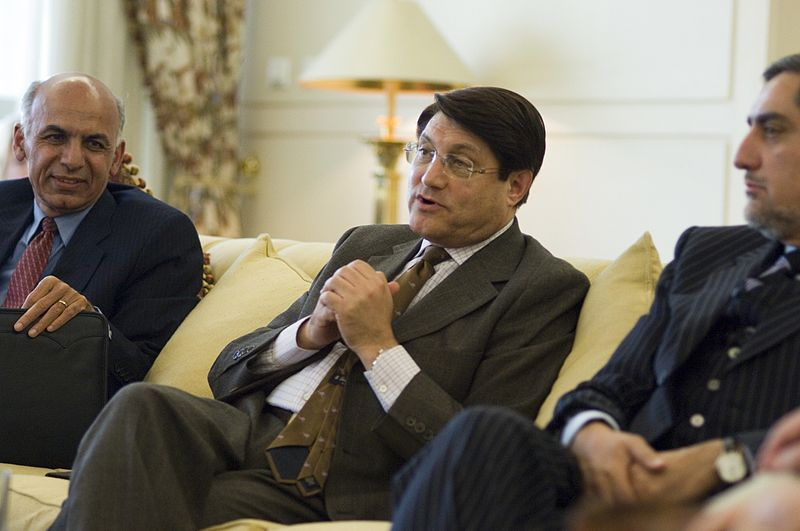
Ashraf Ghani, Anwar ul-Haq Ahadi, and Abdullah Abdullah. Photo Courtesy of Wikimedia Commons.
April 22, 2026
In an official report released this Sunday, April 13th, the Independent Election Commission announced that Abdullah Abdullah and Ashraf Ghani are the two leading candidates of the Afghan elections so far. This early data is derived from about 10 percent of the votes cast in 26 of 34 provinces, with about half a million votes counted. Voter turnout is expected to exceed seven million voters, and the total could end up at 7.5 million. Mr. Abdullah is in the lead with 212,312 votes, or 41.9 percent of the votes counted, followed by Mr. Ghani with 190,561, or 37.6 percent. Vote counting will continue over the next few weeks, and all votes are expected to be counted by April 24. According to the preliminary results based on the early data, a runoff looks increasingly likely to occur. A runoff election would be held by May 28, according to officials.
The head of the election commission warned that the results are still changeable, as only a fraction of the votes have been counted so far. He also noted that some votes will likely be disallowed, due to voting fraud. In the parliamentary elections in 2010 and the presidential election in 2009, more than 20 percent of all votes were disqualified due to fraud and irregularities.
Dr. Abdullah Abdullah is a former Afghan foreign minister who placed second in the 2009 election. In 2011 he created the main opposition coalition group, the National Coalition of Afghanistan. Afghanistan consists of a multiplicity of ethnic groups, and local tribal ties and larger ethnic ties can be extremely important. The four largest groups are Pashtun, Tajik, Uzbek, and Hezara. Dr. Abdullah is half Tajik and half Pashtun, but predominately identifies with the Tajiks, thus his base of power is in the northern region of Afghanistan. Tajiks and Uzbeks shared roles in the Northern Alliance resistance to Taliban rule. His vice presidential candidate is Mohammed Mohaqiq who is ethnically Hazara (a smaller ethnic group in central and northern Afghanistan constituting about 9% of the population). Mohaqiq also has historical ties of support to Pashtun leaders in the early days of post-Taliban rule in Afghanistan, so it is likely that a limited amount of support will be gained from Pashtuns. Therefore, Dr. Abdullah and Mohaqiq are able to appeal, to some extent, to the four biggest ethnic groups in Afghanistan. Dr. Abdullah’s main issue if he were to become president would be to turn an election victory into a legitimate government able to control the entire country, especially as the US withdraws and the Taliban seem set to aggressively regain control over areas of Afghanistan.
Ashraf Ghani is a former World Bank economist, Chancellor of Kabul University, and finance minister of Afghanistan. He is well educated, has international experience, and fits in comfortably with the urban elite of Afghan society. In 2009 he ran in the presidential election and placed fourth. Mr. Ghani is ethnically Pashtun, and draws much support from this group, the largest ethnic group in Afghanistan. Running alongside Mr. Ghani is Abdul Rashid Dostum, an ethnic Uzbek. Dostum has been classified by some as essentially a warlord, and it is true that Dostum led the Uzbek faction in the Afghan civil war in the early 90’s, as well as Uzbeks participating in the Northern Alliance. However, the distinction between leader and warlord are somewhat blurred, as militias loyal to a leader of the same ethnicity were not uncommon in the fractious history of Afghanistan after the Soviet withdrawal. Ashraf Ghani and Abdul Rashid Dostum are likely to place second and face a runoff against Dr. Abdullah and Mohammed Mohaqiq. If Ghani and Dostum were elected, they would face similar issues to Dr. Abudllah and Mohaqiq, namely consolidating power over the entire country and dealing with Taliban threats from Afghanistan’s eastern regions.
In 2011, President Obama announced that the U.S. military’s combat role in Afghanistan would end in 2014. This statement, however, did not mean that the U.S. would remove all troops from the country; a large number of American soldiers would remain in Afghanistan in a “supporting” role, training Afghan soldiers and security personnel. In February of 2014, tension between President Barack Obama and Afghan President Hamid Karzai lead to threats of a complete withdrawal of all U.S. personnel from Afghanistan. As Presidents Obama and Karzai clashed, Abdullah Abdullah, the current leader in the Afghan vote count, publicly vowed to sign the deal with President Obama to keep U.S. forces in, and international aid money flowing into, Afghanistan for the next few years.
Despite the success of the April 5 election, most international observers express concern about Afghanistan’s future. Experts fear that U.S. policy in Afghanistan has produced a number of undesirable results. First, the Afghan army and other security forces, bolstered by U.S. aid money, sophisticated weapons, and superb training, are now stronger than the Afghan state, according to some political scientists. Such a situation is “not a recipe for lasting stability,” according to Paul Miller, a former Bush and Obama administration White House staffer. Furthermore, the Afghan government is widely seen as one of the most corrupt in the world, built on patronage and graft. Many of the worst warlords of the violent 1990s are now members of Hamid Karzai’s government, either as members of parliament or bureaucrats. U.S. aid money keeps local demagogues content, and U.S. soldiers keep the more violent types at bay. Experts fear that the government could fall to infighting.
Lastly, the specter of the Taliban has yet to be dealt with properly. Although kept at bay, the U.S. army and Afghan forces have failed to fully defeat the remaining insurgents. Intelligence experts and U.S. officials, including many who served or serve in Afghanistan, fear that a full troop withdrawal will allow the Taliban to reemerge, stronger than before. In the absence of a peace deal, this outcome looks ever more likely. No matter who wins the election, they will need more victories before they can govern a peaceful nation.
Further Reading:
Partial Results
Contributions By Alexi Stocker, Sam Ide, and Monika Hur