


Reexamining the Death Penalty in the United States
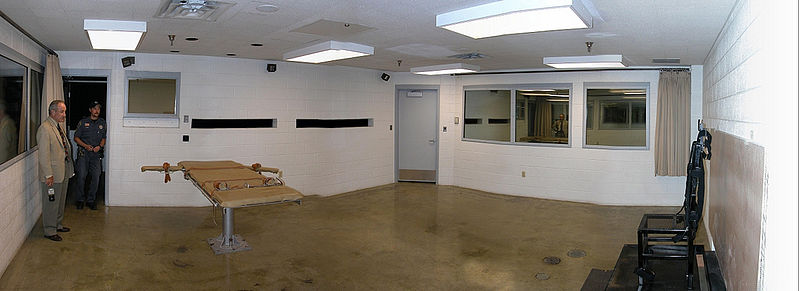
An execution chamber at Utah State Prison. Photo Courtesy of Wikimedia Commons.
May 12, 2026
The State of Oklahoma brought capital punishment back into the news cycle in an unusual way: controversy arose over the State's inability to effectively kill someone. The story itself concerns two death row inmates, Clayton Lockett and Charles Warner. Both were convicted of murder and fated to execution by intravenous injection. Lockett was chosen first, and Oklahoma officials injected a cocktail of lethal drugs into his bloodstream.
Ten minutes later Lockett remained conscious, the sedative Midazolam first injected into him having failed to work. Over the next forty minutes, he is said to have writhed and convulsed until he died of a drug-induced heart attack - all while blinds shielded the execution room from any surrounding reporters.
As the execution of Warner was stayed, the expected group of politicians voiced their opinions. Oklahoma Governor Mary Fallin talked plenty about an independent review of the process. President Barack Obama called the incident "deeply troubling". A United Nations official even wondered if the execution violated international law. One can be cynical about these political gestures, for the death penalty in the United States has consistently withstood legal challenges and efforts to shift public opinion. The Gallup polls on popular support for the death penalty has almost always shown a majority in approval, and the act itself is clearly not considered unconstitutional.
Cynicism about the death penalty, however, misses the current picture of how the practice in America is transforming itself. The central question revolves around drugs, the sedatives and poisons used by wardens and officers to ensure rapid and failsafe death. Since the 1970s, most states administering capital punishment shifted to lethal injections as a way to defend themselves against claims of "cruel and unusual punishment," unconstitutional by the Eighth Amendment.
Until 2011, state level executioners seemed to have had a magic formula: anesthetize the executed with enough sodium thiopental to kill. This changed when the only manufacturer of the drug refused to supply prisons with it any longer, followed by a European embargo on lethal drugs to U.S. prisons in late 2011. States with the most executions, like Texas, Ohio and Oklahoma, have resorted to buying animal sedatives from unauthorized dealers to circumvent all bans.
Even before the drug shortages, the time between conviction and execution has lengthened in recent years. Death row inmates are now confined for up to an average of 15 years before their execution. Defense for the accused can go through the entire appeals process, questioning the evidence used in conviction, the constitutionality of detainment standards and the new secrecy surrounding the drug cocktails used. An argument is emerging that claims the time spent in solitary confinement by death row inmates is itself an intolerable form of torture.
With all of these legal barriers, it is no wonder that only a few dogged states commit most of today's executions: Texas, Oklahoma, Florida and other Southern and Midwestern states.
Last year, the U.S. executed 39 people – down from the post-1976 peak of 98, but still high relative to the count of zero in two-thirds of the world countries. In fact, the U.S. ranked amongst the top five executors in 2013, along with China, Iraq and Saudi Arabia, according to an Amnesty International report.
To date, the U.S. has seen just one nationwide halt of executions: between two Supreme Court decisions in 1972 and 1976. The first one, Furman v. Georgia, found inconsistent application of the death penalty and temporarily halted executions. However, judges did not agree on a common rationale and did not issue a binding decision. As a result, states reworded their penalty codes and in another case in 1976 the court upheld their right to use the death penalty, subject to certain procedural requirements.
Almost forty years later, a binding Supreme Court decision remains one of the the most viable paths towards a permanent nationwide ban. In fact, this already happened in 2005 when the court found that juvenile offenders cannot be sent to the death row because the punishment is cruel and unusual. The judges evaluated the clause by looking at the evolving understandings of decency of society as measured by the number of states using the punishment (less than half) and the trend (dwindling frequency of use).
Richard Dieter, executive director of the Death Penalty Information Center, wrote in an op-ed for the New York Times, "The court is likely to apply the same analysis to the death penalty itself."
Currently, 50 states and three jurisdictions – the District of Columbia, the federal government and the military – have the discretionary right to exercise the death penalty. However, nineteen of them have abandoned capital punishment, while 14 have opted to retain it but have not used it in the past five years, according to the Death Penalty Information Center.
In 2013, Maryland became the sixth state to end capital punishment in the last six years. Last year Colorado Governor John Hickenlooper issued an indefinite reprieve and this February, Washington state’s Governor Jay Inslee announced a capital punishment moratorium as well. Meanwhile, Obama has reiterated his views that the death sentence is merited for "heinous" crimes. Even with some continued support in the U.S., doctors, the pharmaceutical firms, and foreign governments are exercising pressure for repeal of the capital punishment.
Further Reading
Gallup death penalty polls
controversy over sodium thiopental
Contributions by Tom Cui and Vesko Cholakov