


Regulating the Sharing Economy
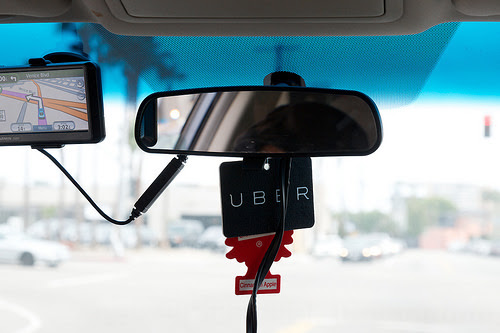
Inside and Uber Taxi. Photo Courtesy of Joakim Forno.
May 21, 2026
Innovative companies such as Uber and Airbnb have created a novel word to describe their new mode of business: the sharing economy. Uber, a car sharing service, allows individual car owners to act as taxi drivers, connecting individuals seeking rides with those with cars willing to drive them, through a mobile app. Airbnb is a similar service: individual homeowners can rent out a room in their home for short periods of time to travelers, and the company takes a share of the fee.
Though these startups have enabled a thriving sharing economy, they have run into opposition from elected officials seeking to clamp down on this unregulated economy. Airbnb faces a lawsuit by New York regulators accusing it of illegally renting out multiple properties for short periods. Regulators are demanding more transparency and data from Airbnb, in an effort to prevent unregulated hotels. According to attorney general Schneiderman, 60 percent of Airbnb rentals in New York are illegal. Airbnb is fighting similar efforts in Arizona as well.
Uber, the car sharing service, faces an even uglier tangle of legal complications. The company is battling thirteen active lawsuits in cities across the US, as well as scrutiny from eleven state insurance agencies over its insurance practices. Uber has being criticized by both private and public sectors for its gaps in insurance coverage. The numerous lawsuits it faces originate from a variety of places – passengers, traditional taxi companies, as well as Uber drivers.
One of Uber’s most successful early markets was in Chicago, where Uber began operating in 2011. The company soon grew to have over 1,000 affiliated drivers, and gained recognition for the new dynamism it brought to an industry dominated by entrenched taxicab companies. However, in October of 2012 the Illinois Transportation Association, a trade group representing taxis, sued the city of Chicago, claiming that the lack of regulations that ride-sharing companies operated under in Chicago was unfair to taxicab companies. These regulations, such as the need to purchase expensive operation permits, serve the purpose of limiting competition as well as maintaining tight control over the supply of taxis in the city. Uber disrupted this controlled supply by operating outside of these regulations, positioning itself as a company which facilitated ride-sharing, not a taxicab company.
While the initial lawsuit against Chicago weaved its way through the judicial system, taxicab companies turned to the legislation process to combat the disruption of Uber and other ride-sharing companies. In Illinois, lobbyists pushed state legislators to create new regulations that would apply to ride-sharing services. These efforts resulted in HB 4075 being passed in the Illinois House. The law requires rideshare drivers to obtain a chauffeur’s license, have commercial insurance, and bans these rideshare company drivers from operating at airports and designated taxicab stands. These regulations impose a serious burden on rideshare drivers that previously operated with little regulation beyond company policies. The bill is currently being considered by the Illinois Senate. If it passes, the effects on Uber’s local operations in Chicago would be dramatic.
The rise of companies like Uber and Airbnb has come with a great deal of worry and protest around the globe. Cab drivers in London have planned to stage protests against Uber in the upcoming weeks, while drivers in Paris have also taken to the streets against the app. The main item of contention for critics is that such apps create unfair competition for more established entities like taxi associations and landlords. Currently most major cities require drivers to hold one of a fixed number of permits each year, a policy that has created a huge market for permits in the billions of dollars, ranging as high as $2.38 billion in total market value in Chicago alone. While traditional taxi associations must pay for the permits, apps like Uber can get around permit laws due to their unofficial nature, a business tactic that has ruffled many in the industry.
In some cases safety and fairness concerns are also a point of disagreement. Critics claim that Airbnb has lead to a constant stream of strangers entering buildings and disturbing neighbors as well as incentivized some landlords to displace residents so that they can rent out apartments full time. Furthermore others contend that Uber’s dependence on the personal auto insurances of drivers can’t handle the risk of constant taxi rides.
The fact that such apps, despite their criticisms, have nevertheless been met with widespread support and customer satisfaction has led lawmakers to think twice about simply banning their use. Instead many states are now trying to revise laws to deal with the new realities apps like Uber and Airbnb bring. In cities as varied as New York and San Francisco laws have been proposed to regulate short-term rentals. These responses underscore the impact semi-formal economic companies have had on the global marketplace, and point to the fact that many people now believe Uber and Airbnb’s commercial success indicate that they are here to stay for the long haul.
Further Reading
Uber Lawsuits
Regulations
Contributions by Sam Ide, Monika Hur and Mohamad Akef