


The Aftermath of the Paris Attacks: Reflections from the City of Light
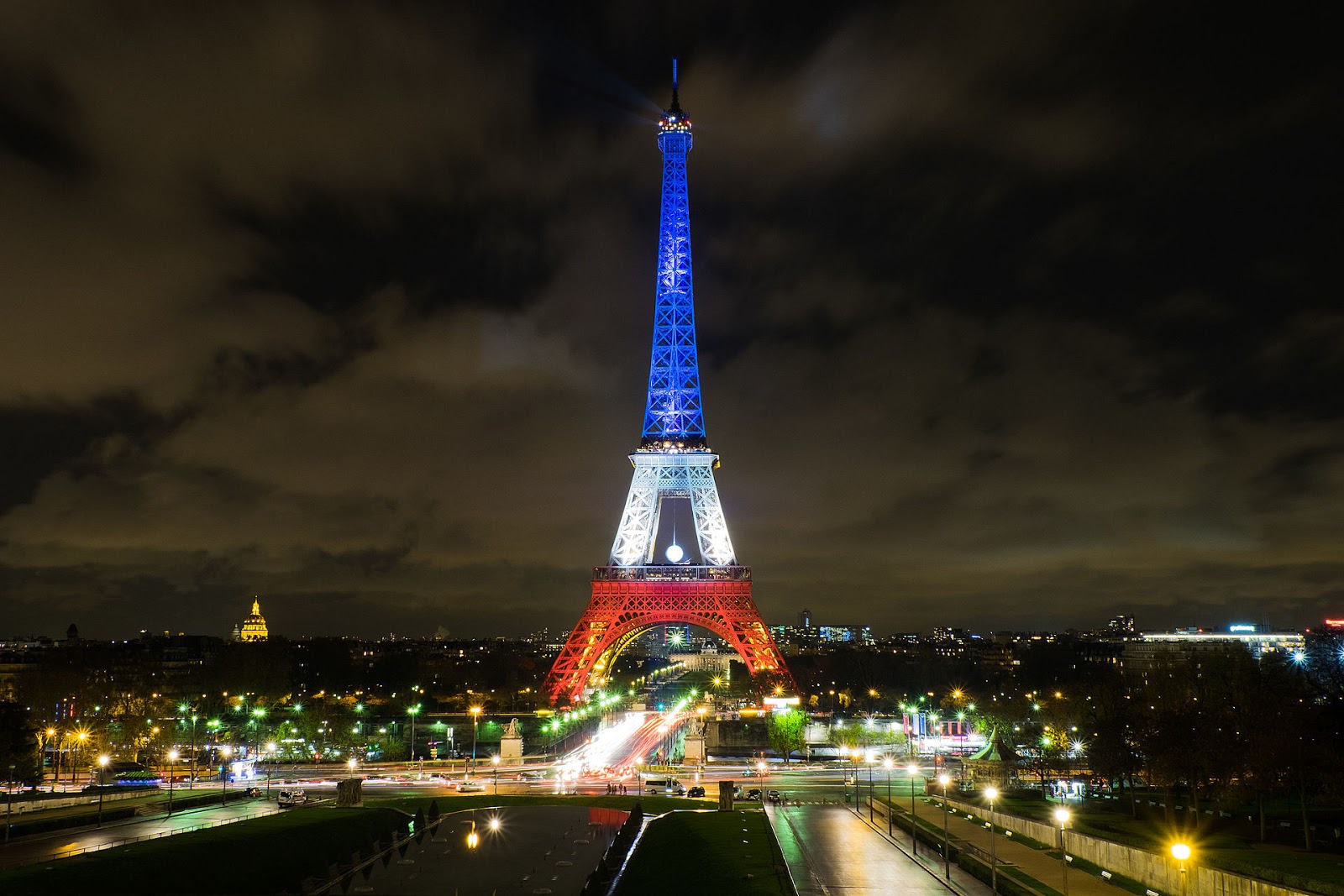
From Wikimedia Commons, accessed 5 December, 2015.
By Beliz Bolukbasi
PARIS, France
Saturday, November 14
During the weekends, I enjoy going to Jardin des Plantes, a beautiful botanical garden in the peaceful 5th arrondissement of Paris, for a morning run. The garden is open seven days a week, from seven in the morning to eight in the evening. But today, on Saturday, November 14, it was closed. A note sticking from the massive shiny black door read:The garden is closed all day on November 14 due to the terrible attacks in Paris.
Right outside the garden, there were military police, dressed in tight, navy-blue uniforms, leaning against the cold, gray wall with huge guns in their hands. It was a scene that I was not used to seeing. It felt weird. It felt different. Then I saw some people running on street parallel to the garden, so I joined them. Still, there was something wrong. The air seemed denser than usual; the people seemed timid—their steps were short and wobbly. Everyone looked each other in the eye, judging, questioning if they have taken a step too far by leaving their houses right after the attacks of the long night of Friday, November the 13th.
Sunday, November 15
One thing I appreciate about the French way of living is how the French can be happy with little things. On Sundays, Parisians go to the farmers’ markets to cook with the freshest ingredients, the ripest tomatoes, the most aromatic zucchinis, the reddest, yellowest bell peppers. On November 15, I decided to visit the Marché Monge down the street to get some vegetables. To my surprise, there was no Marché Monge that day. The quarter usually bustling with people who smoothly maneuvered their wheeled shopping bags was now empty and deserted.Many Paris Métro stations in the 10th and 11th arrondissements were closed. People had to walk, rely on the city bike Vélib or change their daily routes and routines. I realized this whole situation presented an interruption of a Sunday ritual, an involuntary abstinence from a celebrated way of living for hundreds of Parisians.
Monday, November 16
On Monday, I had my first class at Sciences Po after the attacks. I got in and took my usual seat. As if knowing exactly what we all wanted to hear, the professor started talking about the attacks. More than half of the class was absent, but the professor still went on.
He said, “Friday morning, all hospitals in Paris had a training. After the Charlie Hebdo attacks of last January, the government and the hospitals were ready and prepared.”
From his words, it was clear that he trusted l’État— the state. He went on: “we are not in London of August 1940. This is not war. And these people will be destroyed. ”
When the professor took a long breath, the curious students raised their hands. A girl asked if it would be okay to keep running along the river Seine each morning. Half amused, the professor answered, “Yes!”
Soon after, we heard sirens echoing throughout the building. Everyone grabbed their bags and flew down the stairs. The whole university, with over 1200 students- some of whom chose to stay home that day- was evacuated in less than 3 minutes. People gathered in groups on the Boulévard Saint-Germain, cold and confused.
After fifteen minutes of confusion, they let us back in. The professor came a couple of minutes later. He said the evacuation was due to an unattended bag in the entrance. Everyone was relieved, but we also knew our relief would be short-lived.
. . .
The attacks of November 13, 2025 marked the beginning of a period with increased surveillance, control, judgment and anxiety. In response to the attacks, France was put under an état d'urgence—state of emergency—for the first time since 2005. French borders were temporarily closed. 1,500 soldiers were called in to help the Parisian police to maintain order.
I was sure that the increased security and tighter border controls would be going on for a while. On Monday, November 30th, the 12-day United Nations Climate Change Conference began in Paris. 8,000 police, gendarmes and soldiers stationed along national borders and 2,800 at Le Bourget—the site where the global climate conference is taking place— are serving to protect French citizens and world leaders like presidents Barack Obama and Vladimir Putin.
Tuesday, November 17
On Tuesday I got to see my friend from high school who is a literature student at Université Paris-Sorbonne IV in the Latin Quarter. Over our little chat, he mentioned that most of his French friends were stupefied by the attacks’ magnitude and the unpredictability.
In the wake of the attacks, there were different reactions from different groups of people: some blamed Muslims for threatening the peace in the rest of the world, and did not hold off from saying how much they hated Islam and its believers; some were genuinely mournful, confused and disordered as these were the cafés and bars they liked to go on a typical afternoon; some were in denial, as they refused to say a single word about the attacks. It was clear that the French and the surrounding European nations were going through a hard time.
A French student from Sciences Po that I met on Tuesday expressed her feelings with these words: “I could have never imagined something like this happening, especially in France, as a fundamental principle in France is Liberty. When the attacks happened, first I was shocked, it didn’t seem real; it was kind of fictional. Then I was scared that someone I knew was affected. The worst thing is that the people who carried out the attacks are French and they live in France: The society helped these people, gave them money and then they did this in return.”
Wednesday, November 18
On Wednesday, I met another friend of mine—an exchange student from Sweden. When I ran into her in the bathroom, she seemed different, a little bit off. Her hair was up in a bun; she didn’t wear any make-up. When we got to talking, I realized that she has been going through a pretty difficult time. Since one of her friends got shot in the restaurant that was attacked, she felt very unbalanced and started having nightmares, where the events recurred on her mind each night. I tried to comfort her, but the words that came out of my mouth were limited.
On Wednesday afternoon, I learned that some universities in the United States were calling their students back. Discussing how many exchange students went back to their home university was some kind of a taboo; we didn’t talk about it much, but I knew it was happening. Two girls that I know from a university in Baltimore went back. Twelve out of the sixteen exchange students from a prestigious research university in Washington DC chose to leave Paris in the middle of their exchange semester, according to unofficial sources.
On Wednesday night, I came across to the hashtag #monplusbeausouvenirdebataclan (“my most beautiful memory from the Bataclan”) on Instagram. People were sharing videos, photos and happy memories from the Bataclan Concert Hall, which over the course of one long night came to be associated with terror, blood and cruelty. It was a simple but generous gesture. It was an important step in the healing process. It was a way to show solidarity, resiliency and vitality for French. That night, before I went to bed, my eyes were moist and my pillow was cold.
Thursday, November 19
On Thursdays at Sciences Po, I go to my class for art and design. This Thursday, when our professor came in, it was impossible not to notice how sad she looked.
Earlier this week, she had sent us a heartfelt email, which had arrived even before the official email from the President of Sciences Po. Now, she was standing in front of us, talking, discussing, sharing her very own emotions:
“Here in France, we live our lives. We have good lives. We are happy. In the eyes of these terrorists, drinking, smoking, enjoying yourself is crime. That’s what has been punished here. "
“Le Petit Cambodge is at the top of the list on Trip Advisor. I go there a lot because it’s cheap and good quality. It’s not touristy and it is a meeting point for French people.”
Then she moved to the attacks on the French newspaper Charlie Hebdo in January, which became the target of Islamist fundamentalists with its irreverent and stridently non-conformist cartoons that ridicule political figures, religion, and culture of all kinds. The attacks resulted in the death of twelve people, five staff cartoonists, an economist, two editors, a guest, a maintenance worker and two police officers. Referring to the murderers, she said “you can draw things for Prophet Mohammed, Obama, François Hollande and that’s no reason to kill somebody. Here in France, we have freedom of expression.”
Friday, November 20
I’m feeling tired and overwhelmed. I had a lot of work to do and the task of constantly keeping up with all the pieces of information from thousands of different channels is just very exhausting. I keep hearing sirens all day long. I understand that it is for our own good to show my ID and open my bag each morning before entering the school, but why are you making me unzip my coat in this freezing cold, 2 degrees Celsius Paris?
I respect the resiliency of French. I really do. I stand with them in their view that life has to go on. It would have been exactly what the terrorists wanted if we stopped going to the small and cozy bars up the street, decided to leave that last sip of wine in our glasses, to turn down the music, to pay no mind when beautiful women in short dresses or handsome men in vests smiled at us on the street.
For many young adults, the words of my French friend accurately describe how we feel:
“We are young and alive, so alive. Drinking wine on the terrace and partying with friends is the essence of our lives and our culture, and this is probably the biggest thing the Parisian youth is gifted for.”
We won't give them the victory. We won't stay home. Paris is a wonderful place on this Earth and it deserves to stay like that.