


Change at the State Level
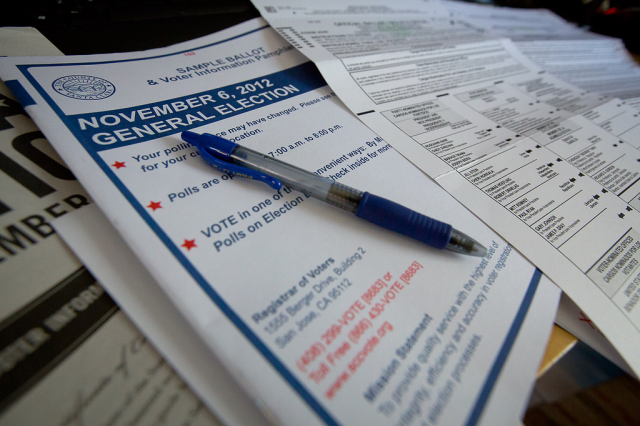
A mail in ballot. Creative Commons image courtesy of hjl.
Change at the State Level
Gay marriage and the legalization of marijuana came to the forefront of the 2012 general election. While the Presidential race and most Congressional races did not touch on either of these issues, they were addressed in several state ballot initiatives. The passage of these initiatives has the potential to drastically reshape both state policy and the national conversation. Four states had proposals regarding gay marriage on the ballot; voters Maine, Maryland, and Washington affirmed the legalization of same-sex marriage, while Minnesotans denied the ballot initiative to ban it. Until this election, no state had approved gay marriage by popular vote. Winning the right to marry via elections may bestow democratic legitimacy to the movement for gay rights in a way that courts cannot.
The other major social issue on the ballot this election was marijuana policy. Arkansas, Massachusetts, and Montana had proposals regarding the legality of medical marijuana, which, while relevant to state policy, did not constitute a major change from previous proposals in other states. Colorado, Oregon, and Washington had initiatives to implement a radical marijuana legalization policy that no other state has attempted. Washington's proposal would create an entire state licensed marijuana industry, whereas Colorado's would legalize possession and growing plants.
Another issue at stake on state ballots was a Massachusetts initiative to allow physician-assisted suicide of terminally ill patients went to the polls. Although not as high profile an issue as gay marriage and marijuana legalization, especially among younger voters who are passionate for those issues, it is another socially libertarian issue that saw its day at the polls, even though it was defeated.
Although there was a lot of contention during the campaign, many of these social libertarian victories came relatively easily at the polls. In both Colorado and Washington, marijuana legalization passed with a healthy 55 percent of the vote. Medical marijuana in Massachusetts passed easily with 63 percent of the vote. Same-sex marriage passed in Maine and Washington with a slightly smaller 53 percent. In Maryland, it was even closer garnering only the support of 52 percent of voters. Minnesota voted down a measure to ban same-sex marriage by a margin of around 100,000 votes.
And while these are all clear victories for social libertarians, measures in some states didn’t fare as well. Arkansas narrowly voted down a measure to legalize medical marijuana, and complete legalization in Oregon was struck down with 54 percent of the vote.
Opponents of marijuana legalization are confident that their losses will be short lived. They believe that the federal government will enforce national laws even without state support. However, federal officials are still wrestling with how to handle the issue. It is expected that the Justice Department might sue Washington and Colorado to stop the laws from going into effect, but the administration has remained noncommittal about its position. They do not want to risk offending young voters who tend to be very supportive of legalization. The laws passed in Colorado and Washington are the first of their kind, and it is still unclear how—if at all—the federal government will respond.
Supporters of marijuana legalization do not mourn their inability to convince federal legislators; marijuana liberalization laws succeed through ballot initiatives, and consequently more states allow medical marijuana than they do civil unions. Even if the federal government continue to prosecute marijuana possession, it is a great victory that state authorities will not. Because local police can also take their own position on investigating marijuana, it remains crucial for legalization activists to support decriminalization ordinances on the municipal level.
Support for gay marriage seems to be in the process of becoming the default political position. A key fact is that LGBT activists scored victories at the ballot box; they, coupled with Obama's turnout machine, delivered several state legislatures to the Democrats. In New Hampshire, where Republicans swept into power shortly after gay marriage was legalized, a Democratic retaking of the state House opens the door to prohibiting discrimination based on orientation. Supporters now see possible marriage bills in Hawaii, Delaware, Rhode Island, Minnesota and Illinois. Gay marriage is constitutionally banned in Colorado, but the new Democratic legislative majority can entrench civil unions. Gay rights opponents are now on the defense, hoping for constitutional amendments defining marriage as between a man and a woman in Indiana and Wyoming. Those efforts could leave less than five states wavering on the issue, leading to a stalemate only resolvable through federal arbitration.
With Congress paralyzed, any federal decision on social issues ought to come from the Supreme Court. The justices will decide whether to hear Perry v. Brown, the case surrounding the constitutionality of California's Proposition 8. No such docket exists for marijuana, and 2005's Gonzales ruling affirmed it was constitution for federal bans on drugs to trump state legalization. Nevertheless, a federal appeals court can strike down the classification of marijuana as a Schedule I drug, like another did to DOMA, which forces the highest Court to decide on the matter once and for all. Even with all their electoral victories at the state level, advocates for social change are looking towards the unelected branch of the federal government to advance their causes.
Major State Ballot Initiatives In 2012
The Federal Government and Marijuana Policy
Gonzales ruling
Perry v. Brown
11/15/12