


Chicago Workers Wrangle for their Rights
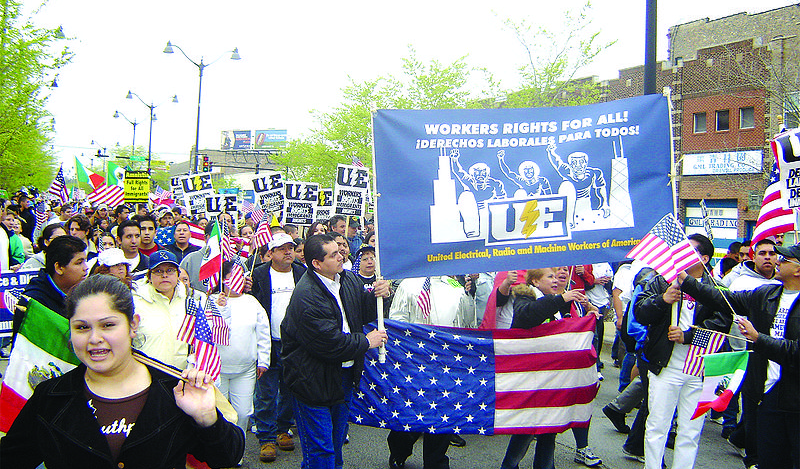
Chicagoans at a May Day rally in 2006. Courtesy of commons.wikimedia.org
Last Wednesday hundreds of protesters in Chicago went to the streets to call for a higher minimum wage and to increase public awareness their struggle. What makes this protest different from usual is that most of the protesters were employees from fast-food and retail employers--industries which unions have traditionally had difficulties organizing due to high job turnover. The protests were organized by a broad coalition of forces, most notably the Workers Organizing Committee of Chicago, as part of the “Fight for 15” campaign, which is called as such because of its push to increase the minimum wage in the state of Illinois to at least $15 per hour. The Workers Organizing Committee of Chicago is a recently-created organization that is mostly comprised of retail and food workers, and are also pushing for the right to collectively organize in their workplaces.
In some respects, it comes as no surprise that fast-food and retail employees would be the next set of workers to make a push for a higher minimum wage and unionization. Low-wage positions, including in the retail and food industries, have grown the fastest in the years following the recession; indeed, a recent study by the National Employment Law Project estimated that 58% of the jobs gained since 2010 pay $12 or less. As a result, increasing numbers of low-wage workers have begun to make the case for higher wages and more benefits, including fast-food workers in New York City a few weeks ago and employees at Wal-Mart last year. Employers, however, are more skeptical about the “Fight for 15”, claiming that such proposed wage increases would threaten to hinder profits, increase prices for consumers, and force layoffs. In addition, some employers point to currently existing programs that provide extra incomes for hourly workers as well as the possibility of wage increases with promotions.
The Chicago Teachers’ Union held a strike back in September, closing schools for more than a week and angering parents. Despite raising the ire of parents and city officials, the CTU came away with four major victories: average pay increases of 17.6% over the next four years, reduced importance of students’ test scores in teacher evaluations, a freeze on health insurance price increases, and protection of seniority and additional education pay increases. This past week’s retail strikes, however, are significantly different.
The Chicago Teachers’ Union benefits from well-structured and well-financed organizations. Unlike the CTU strike, which resulted in eight days of closed schools across Chicago, the stores and franchises affected by this week’s labor protests remained open for business, with only a fraction of each business’s employees participating. The success, or failure, of this week’s protests will largely depend upon whether or not Macy’s, McDonald’s, Subway, Victoria’s Secret, and other affected business choose to fire employees that participated.
The key difference, though, is one of skilled versus unskilled labor. The fact that retail workers are typically difficult to organize because of high turnover rates also generally discourages them from protesting. The protesters’ claim to higher wages rests on the fact that service jobs have largely driven job recovery post-recession, accounting for 58% of “recovered” jobs since 2009. However, with Chicago’s unemployment rate at 11.3%, all of Chicago’s protesting retail workers face a problem unknown to the CTU; no degree requirements and on-the-job training rarely leaves retail and fast-food positions unfilled for long in a city with roughly 160,000 unemployed residents.
Following in the footsteps of work stoppages at Wal-Mart locations and in New York fast food establishments, the Chicago protests seem to be the first step public in organizing low-income workers in the city. A major group helping to organize the movement is Action Now, which conservatives will likely harass due to many of its members’ links to the now defunct ACORN. Action Now is a community organizing group, and seems to have done much of the ground work to help make these actions possible. Under them the Workers Organizing Committee of Chicago was created. The Service Employees International Union (SEIU) is one of the main financiers of the movement, and while it is in the interest of their members to see a higher minimum wage, it seem unlikely that they will stop without at least trying to unionize the workers they help get out onto the streets.
Both a living wage increase and unionization are ambitious goals for what is now a small movement. Increased access to collective bargaining, however, is something of a Holy Grail for the organized labor movement. In a time when many conservative politicians have moved to implement right-to-work laws or crack down on state unions, this campaign is a radically aggressive move. It benefits from essentially being a grassroots campaign, so a change in political whims in City Hall, Springfield, or Washington likely will not spell its doom. It also benefits from President Obama's pledge during the State of the Union to raise the federal minimum wage, which though less than their goals, would still be a major victory. The campaign in Chicago looks to be yet another step in a nation wide struggle to organize low-income workers.
This movement could also be big news for Chicago. While its too early to tell, it seems that between an active CTU with what appears to be a devoted group of student and parent supporters, the remnants of active Occupy groups, and now low-income workers attempting to organize, there is a potential for an inclusive progressive political coalition in Chicago. With the thirty year anniversary of Harold Washington's election due to the backing of a Rainbow Coalition of diverse interests having just passed, it looks like such a group may have the chance to grow again. Even so, Mayor Emanuel probably will not have to start worrying unless a leader of these disparate groups soon emerges.
Further reading:
Unionization in Chicago
Retail and Fast Food Strikes
Mohamad Akef, Don Gross, and Alexi Stocker contributed