


Fast Trains Can't Speed Up Reform
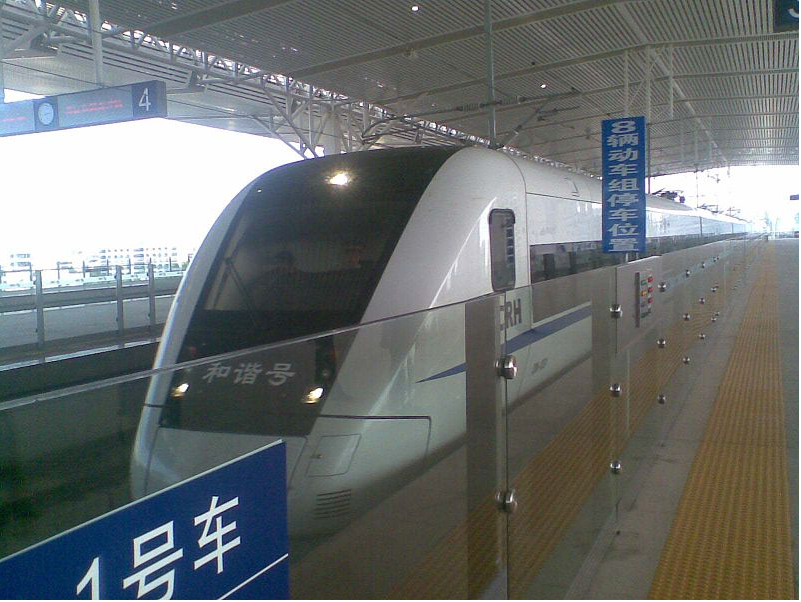
A Chinese bullet train entering a station. Courtesy of WikimediaCommons.
Recent cases of corruption in the Chinese government have again raised concerns about the system of graft and kickbacks that seem to shape the country’s bureaucracy and economy. This Weekly Focus examines corruption in the Ministry of Railways and the broader international response to this corruption.
Last week, formal criminal proceedings began against China's disgraced "Railway’s czar," Liu Zhijun. From his appointment in 2003 to head China's Ministry of Railways to his 2011 arrest, Liu planned out 7000 kilometres of high-speed rail, managed a budget as large as the Chinese military's, and embezzled millions to fuel his ascent to state leadership and fund his lust for mistresses. It is easy to paint Liu as an oddity — a womanizing sociopath absurdly convinced of his immunity from prosecution. But his behavior stems from a culture of corruption, a product of China's economic strategy and the politics within China's Communist Party.
Unlike nations with freer markets, in China there is a state-planned economic strategy at work. China's largest corporations in all sectors remain the State-Owned Enterprises, which are staffed by Party politicians taking orders from higher-ups. At the provincial and municipal levels, the means of control is the government's ownership of land; any private development requires "leasing" land from local government, leading to a process of negotiations and kickbacks. All officials are supposed to follow the Party's imperative to keep China's GDP growth above 6 percent.
Officials have reasons to embezzle money in this environment. They can invest their funds in real estate, securing wealth in the name of stimulating demand. Another is to build a political war chest. Such was the case with Liu, who wanted to bribe his way to the top. Indeed, producing high economic growth is a crucial criterion to rise up the Party ranks. A consequence of this is politicians selling off local government land to private actors in order to fund their careers, meaning potentially more corruption.
When Chinese growth crashed after the 2008 Financial Crisis, the central government responded with 4 trillion Chinese Yuan in stimulus spending. Lower-ranked officials happily took this money, which was distributed to them from elite patrons. At the same time, a litany of local party barons persuaded central ministries to prime the infrastructure pump in their jurisdictions in the name of growth. As an example, the Railways Ministry was flooded by requests for new rail lines. This ministry thus grew in importance as a vehicle for corruption.
The political element of Chinese domestic investment is that policies that seem to create growth are favored, even if that growth is unsustainable or dangerous. China's high growth is often claimed to be a product of housing price bubbles in China's largest cities, instead of tangible production. Even more problematic is institutional debt; the Railways Ministry, before its dissolution this year, had at least 2.7 trillion Yuan in debt, due to the numerous requests for rail construction. The results of all the corruption are economic disequilibriums that squeeze the average Chinese even further.
China’s entrenched corruption has only grown with their economic liberalism and increased global presence, although there have been very different responses from those inside China compared to those looking in from the outside. The Chinese Communist Party chooses leaders through an intriguing combination of a meritocracy and hereditary selection. Domestically, there have been increased criticisms of the latter aspect, with many taking issue with both the nepotism and opulence that comes with it. More often than not, these “princelings” will use their political connections to enhance their wealth, and vice versa. Unlike nations such as Russia and India, where corruption is more brazen and open, profiteering in China often takes the form of favorable government treatment, which can be quite secretive. There have been numerous recent statements by the new President Xi Jinping stating that the government will tackle these matters, but many are skeptical. Anti-corruption campaigns have become a sad cliché in China, and the many appeals to reduce graft have been met with little evidence of real progress. There are some hopes that with the recent scandals and ousting of several party leaders change may finally be at hand.
In the international community, the criticisms specifically about corruption have been more muted, but tend to flare up when health concerns arise. In 2008, when milk from China was found to have harmful adulterants added to it, nations around the world became irate. Chastising China for the venal system which could enable this crisis to occur, the World Health Organization was harsh in their criticism. Calling it the worst food safety episode in recent memory, the WHO also saw it as a result of a culture designed to “to deceive consumers for simple, basic, short-term profits.” While the government did provide a response, many international organizations believed it to be too little, too late, and a worrying example of the real-world effects of corruption.
In the years ahead, there is little consensus of how corruption will be dealt with. Cynics take the view that developing countries always have issues with sleaze, and that the potential wealth attached to government offices only attracts more unscrupulous leaders. This seems to be the case in China, with the National People’s Congress packed with millionaires. Some analysts make the claim that in their transition to a more regulatory role, the government officials will have a reduced interest in profiting from state-based corruption. It seems that corruption is here to stay in China, unless dramatic and unforeseen change comes from either the government or the people.
Further Reading:
Housing Bubble
Matt Baron and Tom Cui contributed