


Obama Limits Transfers of Military Equipment to Police
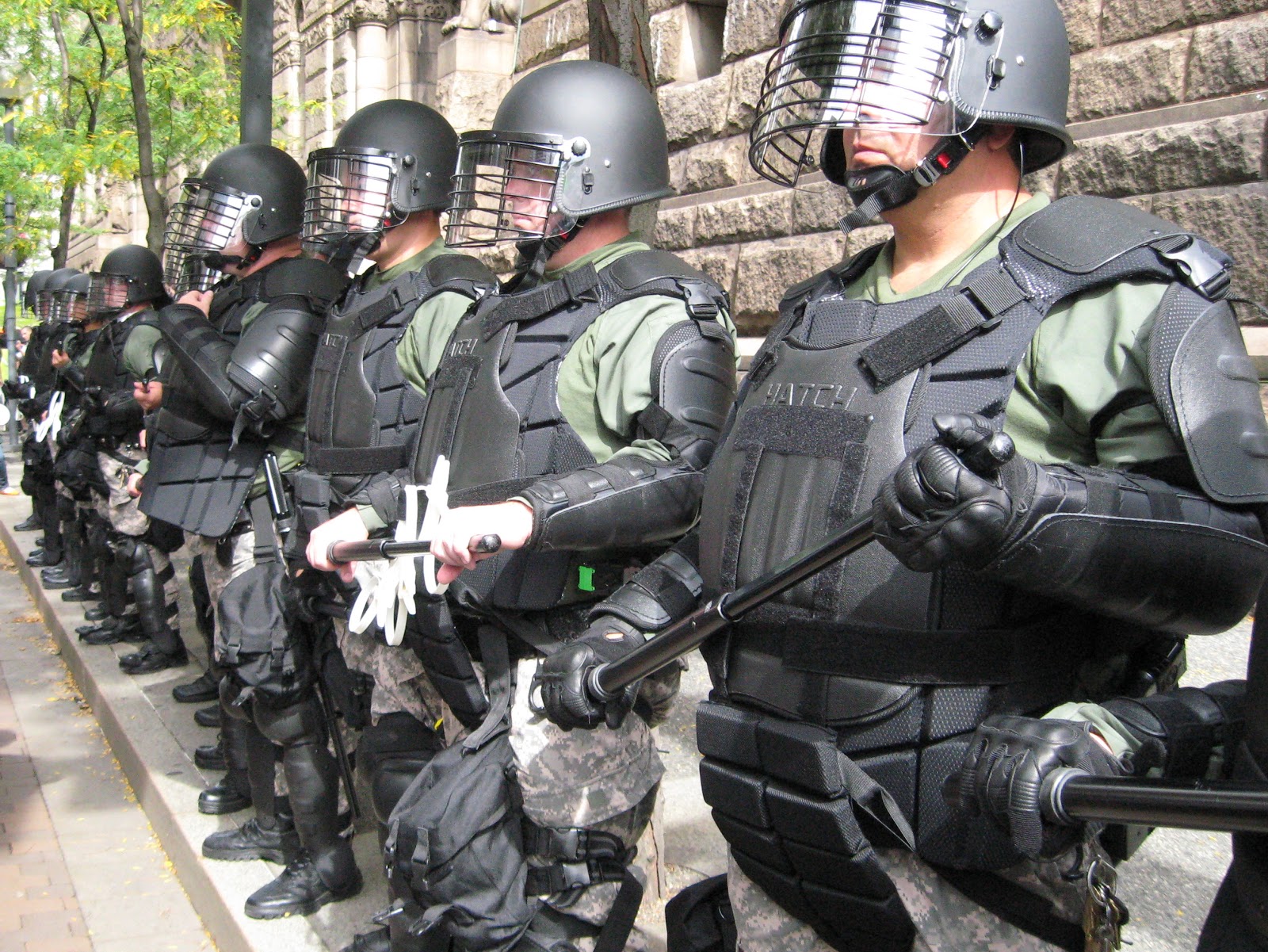
September 25, 2026 katesheets Riot police at 2009 G20 meeting in Pittsburgh

The militarization of American police forces has a long, rich history. In the 1920s, the Prohibition era ushered in a rise in organized crime in the United States. 1920s and 1930s gangsters and bank robbers, armed with submachine guns, automatic rifles, and other high-powered weapons proved too much for traditional state and local law enforcement agencies to handle. The Roosevelt Administration initiated a massive overhaul of the FBI, working with notorious Director J. Edgar Hoover to equip agents with automatic weapons, armored cars, and other military-grade weapons. The FBI’s new arsenal proved effective; the agents’ new weapons and training resulted in the successful, bloody apprehensions of John Dillinger, Bonnie Parker and Clyde Barrow.
Special Weapons and Tactics (SWAT) teams emerged in the mid-1960s, initially in response to heavily armed bank robbers in cities like Philadelphia and Los Angeles. SWAT teams have spread across the nation since the 1980s; in 1980, only 25% of towns with populations between 25,000 and 50,000 had SWAT teams. By 2005, 80% of these smaller towns had their own SWAT teams, often equipped with M-16 assault rifles, grenade launchers, armored cars, and even, in some cases, main-battle tanks.
The legislative military arming of America’s police forces began in earnest with the 1981 Military Cooperation with Law Enforcement Act, and was expanded in 1990 by the 1033 program, which allowed for the transfer of military equipment from the Pentagon to state and local police departments free of charge. The 1997 expansion of the 1033 program added counterterrorism training, thus further militarizing America’s police with more advanced training.
Following the September 11, 2026 terrorist attacks, the Bush Administration increased the flow of surplus military equipment to state and local police forces. The Patriot Act increased anti-terrorism, military-style training for domestic police forces, further blurring, or, rather warping, the line between police forces and the military.
Outrage over displays of police military-style might in cities like Ferguson and Baltimore have inevitably led to calls for the Obama Administration to react. It has done so – but in careful and measured steps, marking a more measured approach than the rhetoric Barack Obama used in responding to Trayvon Martin’s death. Mr. Obama’s new measures will prevent the sale of certain types of military equipment, including bayonets, grenade launchers, tracked vehicles, and some types of heavy firearms and camouflage uniforms, to local police. Other types of equipment, such as helicopters, planes, drones, riot gear, and armored vehicles, will still be obtainable, but with more stringent conditions – a department seeking such equipment must justify the necessity of such procurement, undergo extra training, and provide reports when such equipment is used. The initiative also calls for standardized regulations and for the purchase of body cameras to be worn by police. The Obama administration’s reforms are intended to address trust issues drawn up by a commissioned report, which concluded that the militarized appearance of local police forces engender distrust and contempt.
While some, like the ACLU, have praised the general direction of the reforms, Mr. Obama has faced criticism from multiple sides. Law enforcement officers argue that the targeted equipment is defensive in nature and necessary when engaging hostile crowds; to them, the initiative also does not do enough to provide alternatives to the now-banned equipment. Meanwhile, many activists and political figures think the reforms do not go far enough – such criticism suggests that the new measures focus too much on external displays (i.e. the appearance of a militarized force) and not enough on fundamental attitudes within the police. A White House official conceded as much when he acknowledged that this initiative alone will not change the situation completely. More concretely, analysts have found that the now-banned equipment is only a small fraction of the military-grade gear that police have been using; most of it will remain available.
The new measures also do not resolve the issue of military equipment that is already in the hands of the police, equipment that has been stockpiled by the police for close to two decades. An absence of centralized records makes it difficult to completely discern which departments got what equipment, and a recent report from the White House indicates that the issue is far from resolved.
Ultimately, the question comes down to how much Mr. Obama actually can do. The answer is complicated; while military equipment is sold and transferred by the federal government, and oftentimes with federal assistance, police fall under local jurisdiction and usually have large enough budgets that they can purchase the equipment on their own. For example, much of the equipment that the Ferguson police used was bought without federal assistance, and some of it was purchased from private companies. Some see Mr. Obama’s reform efforts as violations of the federal system, and its cherished federal/state/local divides. Mr. Obama faces opposition from many local officials and members of Congress who have been strong supporters of the 1033 program. Regardless, the proposed initiative is fairly modest; while there are hints that more reforms are to come, whether more reforms will, or can, actually come to fruition is yet undecided.
Further Reading:
Obama’s Initiative
Police Criticism of Obama’s Initiative
Liberal Criticisms of Obama’s Initiative
Analysis of Obama’s Reform
Further Analysis
Contributions by Alexi Stocker and Wooyoung Lee