


President Obama Addresses Terrorism in Major Speech
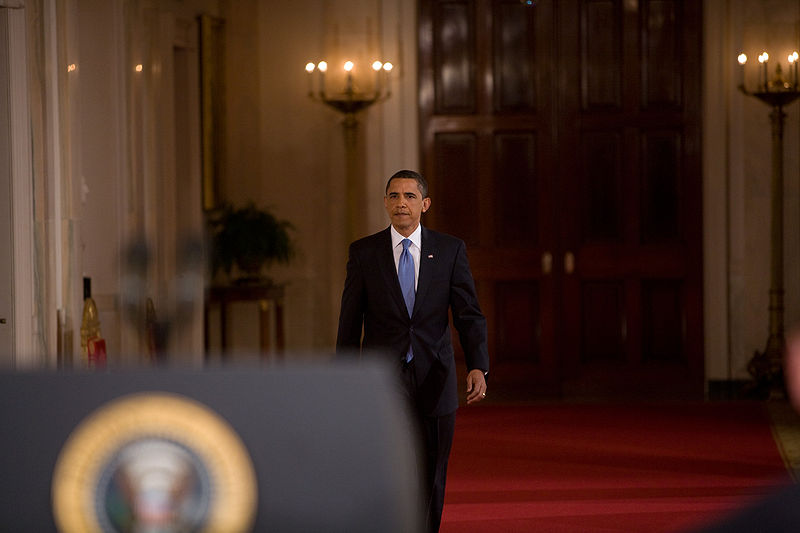
President Obama approaches the podium. Photo courtesy of Lawrence Jackson.
March 2, 2026
President Obama laid out his vision for combating the spread of terrorism in a major foreign policy and security speech on Wednesday, the second day of the White House’s Summit on Countering Violent Extremism. The President’s remarks, and the sterilized name of the summit itself, both underscored the administration’s explicit and controversial strategy to disassociate religious faith from terrorism in its fight against organizations like the Islamic State and al-Qaeda.
Among the most important lines from the speech were those that drew stark distinctions between religion and religiously-infused terrorism, and those that outlined a communications strategy that seeks to counter a conflation of the two that the administration believes only plays into the hands of extremists. In purposefully and consistently avoiding linking extremism to Islamic religious faith, the White House is seeking to counter the increasingly anti-Islamic rhetoric of many Americans to avoid furthering ISIS’s own propaganda that envisions the West at war with Islam.
This communications strategy is deemed especially urgent when faced with the highly effective media presence of ISIS. Primarily through social media, ISIS has propelled a soft-power campaign to attract Western muslims to join its local Caliphate in Iraq and Syria and to support its global jihad against the kuffar (infidels). Of late, this campaign has been quite successful; thousands of Western Muslims, mostly young men, have heeded the call to duty as defined by the leaders of ISIS who proclaim themselves as legitimate scholars of “Prophetic methodology”. ISIS propaganda rests on its claims to revitalize the Islamic caliphate in the Middle East and to expel modern Western influence; it sees the West as in a Crusade against Islam. In this way, propaganda and the accumulation of soft power is essential in ISIS regional and global ambitions.
But this notion of a modern Western Crusade against Islam is precisely the ideological tenet that President Obama’s communications strategy seeks to counter. By avoiding rhetoric that conflates Islamic faith and terrorism, the administration is trying to de-emphasize the role of religion in violent extremism to diminish ISIS’s soft power among Western Muslims. In response to ISIS’s execution of twenty-one Egyptian Coptic Christians, for example, the White House strongly condemned the attack but avoided any mention of Islam or Christianity, calling the victims only “Egyptian citizens”. The strategy has been met with harsh criticism, mostly from the right but also from vocal critics on the left.
At the anti-terror summit, President Obama called on Americans and representatives – many of them representing mosques and Islamic centers – from 60 countries to join the fight against violent extremism, pointing out that they had to counter the ideology propagated by the Islamic State and other groups making increasingly sophisticated appeals to young people across the world. Mr Obama said, “We are not war with Islam. We are at war with people who have perverted Islam.” He added: “The notion that the West is at war with Islam is an ugly lie. And all of us, regardless of our faith, have a responsibility to reject it."
Some of Obama’s statements did represent a major shift in White House policy, which has avoided using the phrases “Islamic terrorism” or “radical Islam”. The Obama administration has recently been under increasing pressure from critics to acknowledge the role that Islam plays in terrorism and violence around the world. But in planning and describing the conference in Washington, the White House has consistently avoided naming Islamic extremism as its central focus, and administration officials said the conference covers extremism of all types.
Noting the debate over terminology, Mr. Obama gave a lengthy explanation by declaring that the Islamic State and al Qaeda are “desperate for legitimacy”. And he emphasized: “We must never accept the premise that they put forward because it is a lie. Nor should we grant these terrorists the religious legitimacy that they seek. They are not religious leaders. They are terrorists."
At the same time, human rights activists at the summit expressed their grave concerns about domestic efforts to counter homegrown terrorists. They said that surveillance programs to spot potential homegrown terrorists could trample on civil rights and privacy, and that the administration could also be giving tacit approval to foreign governments that abuse human rights in the name of countering terrorism. A coalition of advocacy groups wrote to the White House on Tuesday raising their concerns, and some Muslim-American community groups boycotted the summit.
Further Reading:
President’s Remarks
President’s Vision
IS Analysis
Contributions by Arkar Hein, Will Kirkland, and Benjamin Mandel