


Sarah Weddington
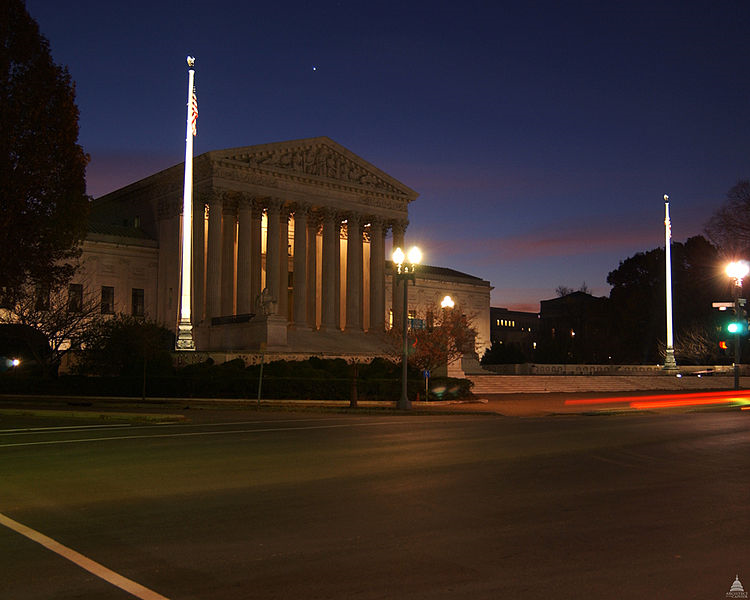
Supreme Court of the United States on 26 October 2011. Image courtesy of Wikimedia Commons
Sarah Weddington is the attorney who represented 'Roe' in Roe v. Wade. Here is Emery Weinstein's interview with her from November 28, 2012.
“More than half court? Oh no, you might hurt your innards and that is your meal ticket,” is what one coach of her physical education class said to Mrs. Weddington during a ball game. Mrs. Sarah Weddington grew up during a time when very few women went on to be something besides secretaries or teachers.
She was one of just five women in her class at the University of Texas Law School.
Emery Weinstein: What were issues that concerned female students?
Ms. Sarah Weddington: It was a time of upheaval in Texas. We needed to know something about contraception. At the time, the health center at the University of Texas had a policy that no women were allowed to have access to information about contraception, unless they could prove that they were within six weeks of being married. This was because they assumed women wouldn’t have sex unless they were married. The rule was six weeks, so you could be protected for your wedding night. But what if I’m already pregnant? What are my options? Where could I go?
EW: What was it like for women trying to find places that performed abortions?
SW: Women were first trying to looking for legal places, but many had to turn to illegal places. California made it legal and one of the ironies of history was the governor there was Reagan. He signed the bill into law as a governor. but only when he became president did he become so opposed. Doesn’t that sound familiar?
Amicus curiae means “friend of the court,” and they are people not directly involved in the case that can provide testimony. In Texas, every medical student had to go through rotation and they often had patients who were victims of abortions gone wrong. They were trying hard to save peoples’ lives. They had worked in our public hospitals and were so helpful. They didn’t want women going through those anymore and some testified about it.
EW: What other changes were being made legally?
SW: Constance Cook introduced a bill to make abortion legal in New York. The bill was going to fail by one vote. One man raised his hand just moments before the vote would be finalized and said that he could not vote in a way that would alienate his wife and his daughter. The bill passed. He lost the next election.
EW: So how did you get involved in the Roe v Wade case?
SW: I ended up being asked to challenge the Texas statute. My legal practice history included uncontested divorces and an adoption for my uncle. They said to me, “We don’t have anybody and besides you're willing to do it for free!” They asked me questions, so if someone really did ask that question, I’d be prepared to respond.
EW: What did you do to prepare? What did you base your argument on?
SW: There were two very important cases on the subject of privacy. One is the U.S. Supreme Court case called the Griswold case. The woman was the head of Planned Parenthood in New Haven, Connecticut. Estelle Griswold and her doctor, C. Lee Buxton, had given a contraceptive device to a married couple. They were arrested, prosecuted, and convicted for being accomplices to the use of a contraceptive device; and that went to the U.S. Supreme Court. And the court ruled that there was a right of privacy; married people have the right to contraception. It’s within their right of privacy.
Around that time, a man named Bill Mayer from the University of Massachusetts was arrested, prosecuted and convicted of being an accomplice to the use of a contraceptive device by an unmarried person. They argued that married people can use contraception, but that doesn’t mean single people can. That went to the Supreme Court. What do you suppose the Court rules? Whether you are married or single, it is within your right of privacy.
So as I found those cases, I thought, “We can argue the abortion cases under the right to privacy, because women should have a private right to abortion.”
EW: What events lead up to Roe v Wade going to the U.S. Supreme Court?
SW: It was fall of 1971 and Jane Roe was an alias, like the name John Doe, for a women who had already had a child who was taken away and was pregnant again. We made it a class action case. After we won at the Texas Court, Henry Wade made a direct appeal which made the case go to the Supreme Court. His granddaughter was in my class last year.
EW: What was it like to be in the Supreme Court building?
SW: I wanted to use the ladies’ room before the case. Unfortunately, there was no ladies’ room in the lawyer’s lounge. Now, there's a room for everybody. Men already had theirs.
EW: What do you remember about the case itself?
SW: Henry Wade said, “When you are arguing against a beautiful woman, you are in a difficult position.” No one laughed at his comment. After that point, we realized this was going to be something.
EW: What are current issues surrounding the abortion debate?
SW: The vaginal probe, which had been mandated for women who want abortions during their first trimester in some states, access to contraception, and who pays for it. Abortions are also increasingly hard to access.
EW: Do you have any advice for young people looking to follow in your footsteps?
SW: I was very afraid to go skiing, but I made it down the baby slopes very slowly and didn't fall. The instructor said to me, “You are never going to be a good skier because those that go a little faster than they can and are able to get up when they fall will be good skiers” and its the same for good leaders.
Flexibility is making course corrections. You do not have to be perfect. Also, be able to make use of the critical eye. Look at people in leadership positions see what they do well and what they do wrong and adapt it to yourself. Slow down. Be kind to everyone and practice good human relations. I learned from Ann Richards, the governor of Texas, who was wonderful at using humor; George Burns who said, “I can do anything today that I can do when I was 18. And that shows how pathetic I was;” and Bob Hope who said, “The world is out there waiting for you. Don't go!”
EW: What do you have to say to our readers who care about this issue?
SW: In the future you are going to be in the front line. I hope you are a group of people who care about what happens to other people.