


The Week of April 21st, 2014
Care
Tensions Escalate in Eastern Europe
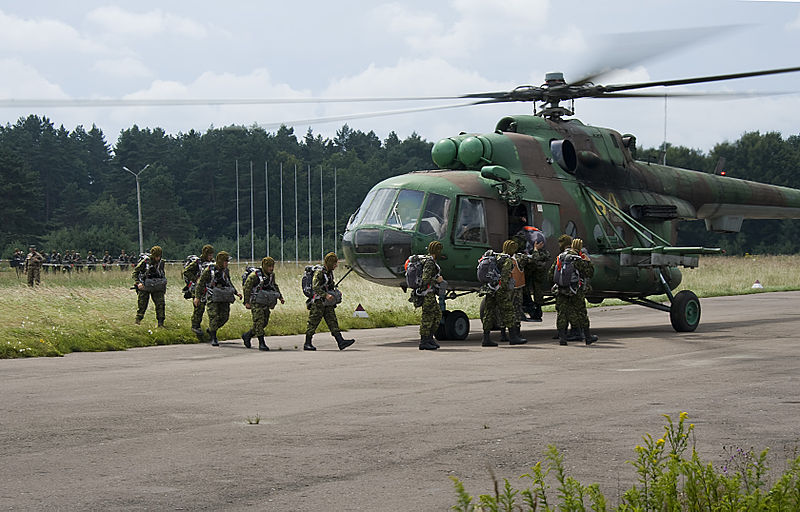
A series of American military exercises are starting in Eastern Europe in a move by the Pentagon to ease anxieties of its NATO allies as Russia is concentrating troops and military equipment at its border with Ukraine.
An initial contingent of 150 U.S. paratroopers arrived Wednesday to the Swidwin in northwestern Poland. The deployment will be followed by 450 more soldiers as similar exercises are starting in Estonia, Latvia and Lithuania in the coming days. The exercises will last for a month and will involve “real infantry training,” the Pentagon press secretary said.
Poland has been among the most vocal countries in the region clamoring for a NATO response as U.S. and E.U.-baked economic and diplomatic sanctions against Russia are failing to curb Putin's audacious moves after the annexation of Crimea last month.
This week U.K.'s Royal Air Force detected two Russian TU-95 bombers approaching north of Scotland. Netherlands scrambled F-16 jets to escort the planes, which had entered half-mile into its airspace. Britain's air-defence destroyers HMS Dragon has been also keeping an eye on Russian ship Vice Admiral Kulakov this week as it transited past the U.K.
Russian-backed separatists have taken over government buildings in at least a dozen towns in easter Ukraine and Kremlin has asserted its right to invade neighboring countries to protect Russian speakers.
South Sudanese Genocide
Last week, in the new country’s worst single incident since fighting began last December, South Sudanese opposition forces loyal to former Vice President Riek Machar took over Bentiu, the capital of the state of Unity. The death toll is currently estimated to be around 400 and reports have surfaced that the massacres were driven in part by hate speech broadcast on a public radio station. There is further evidence suggesting that the broadcasts urged men to rape women of certain ethnicities and called for the expulsion of other groups. Thousands of survivors have since attempted to take shelter in the UN base within the city, despite a total capacity of 25,000 people.
What began as a political dispute between the Dinkan President of South Sudan Salva Kiir and former Vice President Machar, a Nuer by origin, has since escalated into full-blown conflict. A set of attacks in the capital city Juba in December morphed into fighting between the two ethnic groups and the recent events in Bentiu are the latest of atrocities since then. What makes this incident far more ominous however, is the parallels it shares with the Rwandan genocide in the 1990s, which also witnessed radio stations broadcasting hate speech encouraging the subsequent killings and mass murders. One official within the UN has gone so far as to say that the use of radio broadcasts was a “game-changer.” The events in Bentiu have prompted the international community to act quickly in the fear that the events in Rwanda close to two decades ago are repeated again. Negotiations between the disputing factions are set to resume in Addis Ababa next week, but it remains to be seen whether the specters of the past will influence atrocities in the future.
Hamas Joins Fatah
Nearly seven years after occupying the Gaza Strip, the militant Palestinian group Hamas signed a reconciliation agreement with Fatah, the party in power behind the Palestinian Authority (PA). According to the April 23 agreement, both sides will agree in five weeks on a unity government that will govern both Gaza and the West Bank, with new elections to take place in six months. The stakes surrounding this agreement are considerable as both the PA and Israel try to find some reason for continuing US-led peace talks. Binyamin Netanyahu, Prime Minister of Israel, echoes the sentiments of his country's political class when he states that Israel will not negotiate with any government accommodating to the "terrorists" who rule in Gaza.
This is not the first time the two political forces have tried to reunite Palestine; similar agreements were signed in Cairo in 2011 and in Doha in 2012, none of which led to progress. What distinguishes this agreements is that Hamas today is in dire straits; Gaza's economy nears recession, Egypt has joined the Israeli blockade, and Hamas's missile arsenal is increasingly ineffective against the Israeli "Iron Dome" defense system. Meanwhile, the PA needs to strike fear in the hearts of Israelis in hopes of getting any demanded concession, all of which have been rejected by Israel so far. Israel, as expected, has suspended peace talks in response. Though both parties have credibly raised the stakes, they do so not necessarily to make the other blink. In the near future, each wants to declare an armistice and placate radicals in domestic politics - as well as prodding the United States, whose softly-worded statements satisfy no one, to choose a side.
Michigan Affirmative Action Ban Upheld
Early this week the U.S. Supreme Court upheld a Michigan voter-approved law banning
the use of racial preferences in state university admissions. In a 6-2 vote, the court ruled that voters have the right to prohibit public universities from taking race into account, dealing a significant legal blow to affirmative action policies adopted throughout the U.S. since the Civil Rights movement. While the court emphasized that the ruling does not settle the much greater question of whether affirmative action practices are lawful, the decision will likely lead to similar voter initiatives in other states. In a majority opinion Justice Robert Kennedy explained, "This case is not about how the debate about racial preferences should be resolved. It is about who may resolve it." Justice Clarence Thomas joined Justice Anton Scalia in a separate opinion, concluding that the arguments failed to show that the law was discriminatory on its face.
Ultimately, the court found no constitutional basis for restricting state voters’ rights to determine their own fate despite the contention from Civil Rights groups that the law imposed a burden on racial minorities in violation of the equal protection guarantee in the U.S. Constitution. In a scintillating dissent, Justice Sotomayor, joined by Justice Ginsburg, criticized the court for allowing an almost entirely white Michigan electorate to limit higher education opportunities for "historically marginalized groups, which rely on the federal courts to protect their constitutional rights." Calling attention to the historical track record in the U.S., Sotomayor, noted the tendency to “deny to many of its citizens the right to participate meaningfully and adequately in its politics".
The words highlight one of the underlying fundamentals of an idealized constitutional democracy, that the value placed on governance by the people, of the people, and for the people, does not and should not necessarily translate to unchecked majority rule. Rather, as Sotomayor more eloquently put it, "Our system of government is predicated on an equilibrium between the notion that a majority of citizens may determine governmental policy through legislation enacted by their elected representatives, and the overriding principle that there are some things the constitution forbids even a majority of citizens to do.” Nonetheless, the decision is one of several in recent years demonstrating the vulnerability of affirmative action policies to legal and political challenges. Whereas it was once the Supreme Court that helped turn a shifting tide of public opinion into the landmark laws and policies that have come to define equal protection as we know it since the 1960’s, now voters are empowered by the court to abandon that interpretation entirely.
The case is Schuette v. Coalition to Defend Affirmative Action, U.S. Supreme Court, No. 12-682.
Erdogan Partially Acknowledges Genocide
On the eve of the 99th anniversary of the Armenian Genocide, Prime Minister Recep Tayyip Erdogan of Turkey took the unusual step of addressing the killings in a statement released in 9 languages (including Armenian). Though Mr. Erdogan does not apologize for the killings or go so far to name them a genocide, he offered condolences to the grandchildren of Armenians killed at the hands of Ottoman officials during and after World War I. The move comes as a surprise to many considering Turkey’s longstanding refusal to acknowledge the genocide. For decades, it has been official Turkish policy to deny the systematic killing of Armenians, despite strong historical records. In the past, Turks have been jailed and assassinated for challenging the government’s stance on the issue.
Though many Armenian’s within Turkey are praising the statement as a step towards reconciliation, the Armenian government has condemned it as overtly political. Prime Minister Erdogan certainly has a lot to gain from changing positions on this matter. Already, many people in the Western media have praised Erdogan’s actions. The timing of his statement is certainly fortuitous; Mr. Erdogan has come under fire in the last months over his increasingly autocratic tendencies.
The Armenian Genocide holds a deep and complicated place within the Turkish national narrative, given its historical proximity to the founding of the Turkish state, as well as the longstanding denial of its existence on the part of the Turkish government. If Prime Minister Erdogan is serious about reconciling the past, this would certainly be a valid first step, however it is more likely that this is a political move, given his recent, scandal-laden past. Many within the larger Armenian community remain skeptical.
Dont Care
Chelsea Clinton Pregnant
Chelsea Clinton announced on April 17th that her and her husband, an investment banker named Marc Mezvinsky, are expecting a child. Chelsea Clinton is 34 years old and works for the Clinton Foundation, a global charity founded by her father after his departure from the Oval Office.
The announcement has sparked numerous reactions, many inappropriate. For example, some have commented that a grandmother can hardly run the country, even though Mitt Romney had many grandchildren and in fact welcomed three more while campaigning for president in the last cycle. Other commentators have suggested, some more explicitly than others, that the pregnancy could be a political tool, meant to make Hillary seem more likeable before 2016. Even to conspiracy theorists, that seems like a stretch.
Of course, political discourse should be focusing on real issues, and matters of the family should not generally be considered significant political analysis, but in the constant frenzy of the media, such level-headedness is merely a pipe dream. The Miami Herald quickly published an article entitled, “Will Chelsea Clinton’s Baby be President One Day?” Apparently 2016 is not far enough away to quench desire for political speculation.
Mohamad Akef, Vesko Cholakov, Aswan Taylor, Tianfang Cui, Ben Mandel, and Sam Houskeeper contributed