


The Week of April 29, 2026
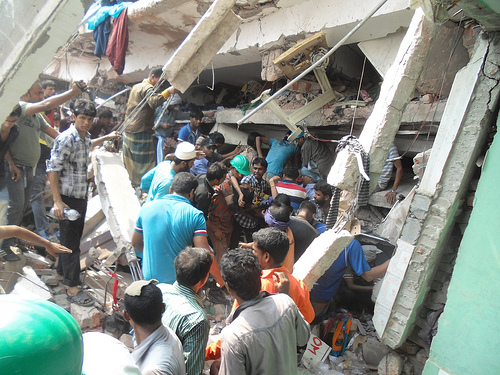
Rescuers search for survivors after the factory collapse in Bangladesh. Photo credit to Bangladesh Federation of Workers Solidarity
Care
1. Evidence of chemical weapons use in Syria is released
Last August, Pres. Obama mentioned in an impromptu news conference that while he has not yet mobilized forces against Bashar al-Assad’s regime, the Syrian leader’s use of chemical weapons would be a “red line” that, if crossed, would force the US to action. With stockpiles of VX, mustard, and sarin gas scattered throughout Syria, there has always been a serious concern for the West that these munitions could be used to attack other nations, such as Israel next door.
According to Sec. of Defense Chuck Hagel last Thursday, there is now evidence that sarin gas has been used against the rebels in Syria. Several blood samples taken from those fighting against Assad’s forces have all proven positive for the chemical, and nations from Qatar to Israel to France have all stated that this new stage of the two-year war has been entered. However, negligible action has yet been taken by the US since this admission. This is understandable, since many analysts have considered the Syrian conflict as one without a sure side to back and where America’s influence could easily create more troubles for the region and the US. With muddled organization among the rebels, the most likely leader to take over after Assad’s possible fall would come from the Nusra Front, a militia labeled by the US as a terrorist group.
Unfortunately for Obama, his frequent statements on the dreaded consequences for Syria if they were to use chemical weapons ought to be acted on. With these horrific actions taken, there are both moral and strategic reasons to counter the Assad regime, but to do so may truly be beyond America’s interests.
2. Corruption between CIA and Afghan government surfaces
Last Sunday, the New York Times revealed that the CIA has discreetly been delivering millions of dollars in cash payments to Afghan President Hamid Karzai over the past decade. Growing out of a program in the early days of the Afghan invasion to pay off warlords, the program eventually morphed into a way for the CIA and US government as a whole to maintain access to Karzai. The Iranian government is known to have been running a similar program, which appears to have been handled more transparently. Whether these programs actually worked is another story; Karzai is famously defiant of the US at times and Iran is unhappy over the strategic partnership between the US and Afghanistan he signed.
While these reports seem shocking, Karzai previously mentioned how he was thankful for US cash in the past. While this seemed to refer to formal aid, in retrospect it appears that Karzai was literally referring to a bunch of cash. President Obama plans on having most US troops home by 2014, yet the fact that under the table payments are still one of the main methods of communicating with the Karzai regime does not inspire hope for Afghanistan's future. Karzai had to rely on the implicit support of the US to overcome election irregularities in 2009, and it seems unlikely he can hold the country together without Western troops, money, and diplomacy. After over a decade of nation building, this news is further evidence that it might have been all for naught.
3. Bangladeshi factory connected with West collapses
Last week, an eight-story garment factory collapsed in Dhaka, Bangladesh, killing at least 437 and injuring 2,500 others, with many still unaccounted for. This marks one of the worst workplace tragedies of the year so far, and has many in Bangladesh and across the world up in arms over the state of labor regulation in the developing nation. The garment industry accounts for 80 percent of Bangladesh’s GDP, and employs nearly four million people—mostly women. Yet, for the 100,000 factories in and around Dhaka, there are only 18 inspectors responsible for enforcing safety standards.
This is not the first major disaster in the garment industry in Dhaka—just five months ago, a factory fire killed 112 people, and prompted the Walt Disney Company to pull out of all production in Bangladesh. Many are comparing these disasters to the Triangle Shirtwaist Factory fire of 1911 in New York, which killed 146 people, but conditions are different in Dhaka. To start, Dhaka currently stands as the densest urbanized area in the world with 115,000 people per square mile living in the city. Because of the extreme density (in comparison, 1911 New York’s density was 30,690 people per square mile) any tragedy will be immediately magnified.
So far, eight people have been arrested in conjunction with the building collapse, including the building’s owner, Mohammed Sohel Rana. But for many around the world, more action will need to be taken, including labor reforms to improve working conditions for the millions of underpaid men and women working in unsafe conditions across the country. The comparison to the Triangle Shirtwaist Factory disaster may be a positive; that disaster prompted swift and far-reaching industrial safety regulation in the US. On May Day, thousands of workers took to the streets of Dhaka to protest for better conditions and for justice to be served to those hurt by this tragedy.
4. Certain pesticides banned in EU to curb bee deaths
The European Commission announced last Monday that it would be enacting a ban on a set of pesticides known as neonicotinoids, which are allegedly causing harm to bees. The ban is intended to reduce the tide of bee deaths in the European Union, where the bee population has been declining rapidly over the last few years. The ban will take effect on December 1st of this year, and will not affect crops which bees have less contact with, such as grain. It will also apply to home garden use. The mysterious decline in bee populations has drastic consequences for agriculture and natural ecology, so conservationists and agribusiness owners alike are desperate for a solution.
The decision marks the world’s first continent-wide ban on this set of insecticides, and is an initial step on the part of the European Union to try and solve the problem of declining bee populations. Links between neonicotinoids and bee health have not been definitively established yet, so it remains to be seen what kind of effect, if any, the ban will have on the bee population. Indeed, for this reason, a vote by the member EU states did not acquire the “qualified majority” (based on the population sizes of the EU members) usually necessary to enact such policy (it did however receive a 15-vote regular majority, and EU rules allow the EU health commissioner to act alone when such a majority occurs). The decision will also be of key interest to the United States, which is in turn dealing with a declining bee population and will be looking to see the effects of this new ban as well. As the divided EU vote shows however, the question of neonicotinoids will most likely remain a contentious and salient one, as solutions to the problem of bee deaths continue to be sought for.
5. Bolivia Kicks Out USAID
May Day is typically used in Bolivia to announce expropriation or nationalization of an industry. This year leftist president Evo Morales utilized the holiday to proclaim the forced termination of USAID (United States Agency for International Development) activities in the landlocked South American nation. Morales previously ejected the American ambassador and US Drug Enforcement Agency agents in 2008 because coca is a legal and common crop, while Morales is a former head of the coca growers union.
The US has protested the ejection of its program, but Morales accuses the US and its aid program of pursuing political aims. As a leftist and a strong ally of the late Chavez (a spout of passionate anti-imperialist rhetoric), Morales has long been taking steps seen as resisting US influence. USAID was accused of agitating political opposition groups, which is possible given America’s distaste for the Morales government and USAID’s explicit dual mission of helping the developing world and pursuing US interests. Even so, this largely political move will no doubt have painful consequences for those benefitting from US economic assistance, which has increased health, education, and environmental protection in the country since the beginning of operations there in 1964.
Don't Care
0. Beatrix Abdicates in the Netherlands
April 30th was the annual, yet final, Queen’s Day, an idiosyncratic holiday celebrating the birth and reign of the monarch of the Netherlands that is observed with day-long parties, widespread flea markets, and open ubiquitous demonstration of the color orange. This Queen’s Day marks the abdication of Queen Beatrix in favor of her oldest son Willem-Alexander. This provides an interesting opportunity for the role of the monarchies in the Netherlands and across Europe to be evaluated, and many have begun to do just that. In general, Dutch monarchs, as well as the distantly-related other royals in Europe, maintain political neutrality.
That being said, monarchs do hold some level of political sway, in that most political figures in the world regard them with very high esteem and these sovereigns are widely utilized to facilitate diplomatic relations. It has even been suggested that such monarchs are good for countries’ economies in improving international economic and diplomatic ties. On the other hand, the financial cost of these families may outweigh these potential benefits. The Dutch royal family itself is the most expensive in Europe, costing taxpayers well over €30 million a year. Such costs are widely protested in Spain, where the monarchy is viewed with some level of disdain, but in other countries, sovereigns are respected. Royals across the continent are cutting back and Willem-Alexander is fully expected to do the same. Further, the very idea of monarchy is distasteful to some, who see the symbolism of royalty as antithetical to modern political ideals. The question remains whether or not monarchies have a place in the 21st century and whether they have overstayed their welcome.