


The Week of March 4, 2026
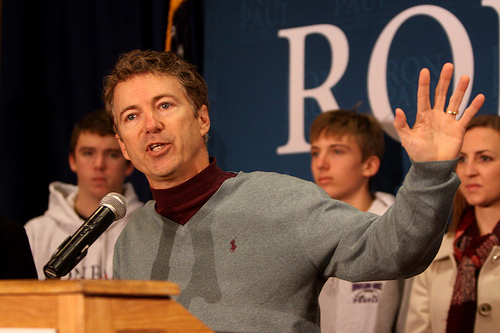
Sen. Rand Paul speaking in Des Moines, Iowa. Photo Credit to Gage Skidmore
1. Syrian Conflict Spreads Across Both Borders
The civil war in Syria, now in its second year, has come no closer to a peaceful conclusion. On the contrary, this past week has seen the conflict expand into neighboring countries in disconcerting ways. Members of the insurgency in southwestern Syria moved into the disputed Golan Heights area, located on the border of Lebanon and Israel, and captured around 20 United Nations peacekeepers and their vehicles. Calling themselves the Martyrs of Yarmouk, the rebels uploaded a video onto YouTube on Wednesday claiming responsibility for the detainment and stating that the captives would be released only when the Syrian government, the rebellion’s adversary, would cease bombing the rebels. Given that this outcome is unlikely anytime soon, the UN is sending a team to investigate the event and to begin negotiations for the release of the peacekeepers. The forces were there to patrol the border and ensure that neither Israel nor Lebanon invade each other. Peacekeepers have been present in this region since 1978.
On the other side of Syria, the hostilities have taken a different, bloodier turn. Government soldiers, seeking a respite from the war, drove into Iraq in a military convoy, only to be gunned down by unidentified assailants likely connected to the Syrian insurgency. At least 48 Syrians were killed, in addition to nine Iraqi soldiers. This attack on Monday has led to an increase in cross-border skirmishes between the revolutionary Free Syrian Army and the Iraqi Army, and the border was officially closed on Thursday. Beyond the direct casualties, this attack has serious implications for the region; there is now increased potential for an extension of the Syrian Civil War and for a greater international response. Iraq’s actions show that it is progressively allying with the Syrian government, and its enduring connections to the US puts both countries in a confused position with regards to regional affairs.. The creeping expansion of the war may soon drag Prime Minister Netanyahu of Israel or President Obama into an intervention that has so far been persistently resisted.
2. Sen. Rand Paul Filibusters Drone-Focused CIA Director
This week, after months of avoiding the question, White House officials acknowledged that they believe the US government has the right under extraordinary circumstances to target and kill American citizens on US soil with drones. The acknowledgment came from Attorney General Eric Holder in a letter to Senator Rand Paul of Kentucky, who had promised to filibuster new CIA Director John Brennan if the policy was not clarified. Though not an apparent change in Administration policy, the statement that attacks may be possible inflamed many liberals and libertarians concerned about the drone program. Despite receiving recognition, Paul commenced a 13 hour filibuster of the nomination anyway. After Paul stopped, the confirmation of Brennan continued and Holder sent a short letter clarifying that President Obama would never use drones to kill Americans in the US who are not “engaged in combat.”
The issue has also created an odd alliance between Republicans and anti-war liberals. This was exemplified when Tea Party favorite Senator Ted Cruz, while asking a “question” during Paul's filibuster, gave a shout out to the left-wing anti-war group Code Pink. Democratic senators were criticized for ostensibly being on the same side of the issue but not participating in the filibuster, most likely being unwilling to cross partisan lines. The event demonstrated how American drone policy, both at home and abroad, is coming under increasing criticism. As America draws down its conventional wars and drones become the face of US warfare, criticism and paranoia about unmanned aircraft will only intensify.
3. Kenyatta and Kenya: An Electoral Quandary
On March 4th, Kenyans went to the polls for the first time since 2007, when a disputed election set off violent ethnic conflicts that claimed the lives of more than 1000 people. In the aftermath of the violence, Kenya’s government carried out a series of reforms, including the passage of a new Constitution and changes to Kenyan elections. One of these measures, a system by which votes are digitally sent directly from the polling place to election headquarters, in an effort to prevent fraud, has caused a major delay in the final tally of the vote this time around. The system was declared to be broken on Wednesday, resulting in a return to manual tabulation. As of Thursday evening, Uhuru Kenyatta, son of Kenya’s first president, was leading in the polls with over 50 percent of the vote, which would enable him to avoid a runoff with the second and third place contenders.
Kenyatta’s present lead troubles many in Kenya and the rest of the world; Uhuru Kenyatta and his running mate, William Ruto, are accused by prosecutors at the International Criminal Court of inciting violence following the 2007 elections. Kenyatta and Ruto shrugged off the ICC’s indictment, arguing that the Kenyan people have a right to select their leaders, and that the international community should respect their choice. As votes, physically delivered in locked suitcases, slowly trickled in throughout Tuesday and Wednesday, election officials announced that results should be finalized by Friday. However, Raila Odinga, Kenya’s current prime minister, and one of Kenyatta’s fellow contenders for the presidency, demanded an end to the vote count on Thursday, crying fraud. Kenyans and international observers alike have reason to worry; accusations of fraud, coupled with a vote split along ethnic lines, is starting to sound like an eerie echo of Kenya’s 2007 post-election nightmare.
4. Key Elections Postponed in Egypt
A top Egyptian court announced this Wednesday that they were suspending the upcoming parliamentary elections—a move that further delays the complete transition to a post-Mubarak government. On the grounds that the Supreme Constitutional Court had not been allowed to review a set of amendments to the elections law before it was passed, the recent decision annulled the decree of Egyptian President Mohamed Morsi that called for elections to start on April 22. The court has not set a date for when it will resume looking at the election law.
This court decision seems to be the latest salvo in part of an ongoing conflict between the judiciary, still staffed by Mubarak holdovers, and Morsi’s administration, the latter seeing the courts as obstructing the resumption of political stability. Opponents, including the National Salvation Front, a coalition of anti-Muslim Brotherhood groups and parties, welcomed the decision, which they see as vindicating their claims that the Muslim Brotherhood is monopolizing power in the country. It is unclear however, whether the recent decision will be enough to convince them to withdraw their threat to boycott the next election, which they announced last month. Morsi has stated that he will respect the court decision, but without a finalized elections law, parliamentary elections for the Egyptian lower house will most likely be delayed for months, leaving the Egyptian political landscape in limbo.
5. European Union Proposes Cap on Executive Bonuses
The endless efforts of UK Minister of Finance George Osborne to stop or limit the EU Parliamentary proposal to cap banker bonuses has failed. Reacting to the rising populism in response to extensive austerity, the European Union has decided to cap banker bonuses to the amount they can earn in a year (unless explicitly stated otherwise by shareholders.)This act follows the recently successful Swiss referendum entitled the “People’s Initiative Against Fat Cat Pay.” Limiting corporate executive bonuses and giving shareholders voting power over executive reimbursement, the act was passed with 68 percent of the vote and wide popular support. Free market advocates on both sides of the Atlantic have criticized the regulation as ineffective, counterproductive, and an overreach of government authority. Most economic analysts have pointed out that the caps will simply result in boosted and more rigid pay structures, eliminating pay variability and resulting in an even greater risk of bank failure. A major purpose of the EU action is to reduce the distorted incentive system which leads to reckless behavior and financial crises. Many economists argue that the problem with the incentive system lies in the implication of security; banks frequently receive bailouts even after committing deleterious and widespread actions.
One major outcome of the new EU regulations may be increased skepticism of the supranational body in the UK. London is the largest financial hub in Europe, and therefore the area most affected by these changes. British bankers have begun to denounce the regulation as impractical in today’s globalized economy, when top executives can easily find a job at a competitor and major banks can seamlessly relocate to New York, Dubai, Hong Kong, or Singapore. This adds another factor to the referendum on EU membership promised by David Cameron, assuming his successful reelection in 2015.
Don't Care
0. Shanks on a Plane: TSA Allows Knives
The Transportation Security Administration recently announced that it will start allowing passengers to board planes with blades that are 2.36 inches or shorter. The knife must also not be able to lock in place, so box cutters and switch blades will still be prohibited. Other items that will now have clearance are up to two golf clubs, ski poles, toy bats, and other sporting equipment. The cause of the TSA’s recent change stems from increased security on planes, as well as more passenger awareness and concern. The agents on the security checkpoints have also insisted they have more time to focus on the passengers now that backscatter scanners have been phased out.
The pilots and flight attendants disagree with this new change in policy, but that objection is unlikely to limit the enforcement of the decision. But any policy change by the TSA to make onerous rules less stringent are likely to be welcomed by most travelers. The matteralso brings back the debate over whether the TSA is effective at all. The agency have never themselves caught a terrorist, and have run into frequent controversies. Allowing golf clubs on planes will also further infuriate passengers who still cannot bring on drinks more than 400mL. It remains to be answered why a passenger would need a golf club (or a short knife for that matter) on board with them, while baby formula is still banned.