


Anonymous, Hacktivism, and Law Enforcement
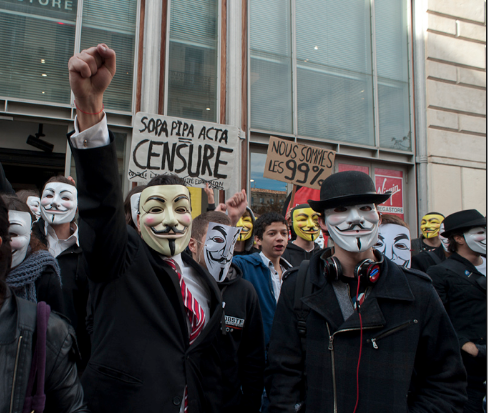
Anonymous members protest SOPA and PIPA in January of 2012. Courtesy of flickr.com/photos/azety
Internet based activist groups such as Anonymous and LulzSec have garnered much media attention over the last few years with takedowns of the FBI, Visa, Mastercard, Paypal, and Department of Justice websites, as well as disruptions to the Sony Playstation network. Law enforcement around the world has had difficulty coping with the decentralized nature of these associations, yet has scored a few recent successes in arresting individual hackers. The Weekly Focus takes a look at the organization and goals of Anonymous, as well as the ways that law enforcement has responded to internet based activists groups and problems law enforcement has faced in dealing with these organizations.
Anonymous was created in 2003 as a coordinated, but anonymous, online community. The group first gained notoriety after it initiated an online campaign against the Church of Scientology, although it wasn’t until 2008 that Anonymous started its devotion to hacktivism—a term the group uses implying that their actions are a form of online activism. The group has attacked what it views as censorship and regulation of the Internet, often through distributed denial of service (DDoS) attacks, or online hacking that temporarily stops users from accessing targeted websites. The organization is not tied to any identifiable individual or group, so it is hard to pin down perpetrators in response to its actions.
One of the most prominent hackings Anonymous participated in was that of Strategic Forecasting Inc. (Stratfor) in December. Over 4 million classified emails were stolen, all of which will be released through Wikileaks. This marked the first time the two groups had worked together. Such a notable attack, besides gaining a large amount of publicity, gave law enforcement agencies around the world a pressing sense of urgency to respond quickly. On February 28th, Interpol reported the arrests of 25 Anonymous members currently planning attacks. The arrests occurred in Europe and South America, and followed previous arrests of Anonymous participants around the world.
Anonymous presents a problem that governments have not been confronted with in the past. The loosely organized group isn’t bound by geography or traditional social distinctions. As an organization that fails to fit the traditional mold, it is tricky to shut it down. As one Brazilian Tweeted, “Interpol, you can’t take Anonymous. It’s an idea.” Although the public perception of the average Anonymous member is a tech-savvy teenager in their parent’s basement, this is not usually the case. One of the few now publicly known members of Anonymous, informant Hector Monsegur or “Sabu,” is a father in his late twenties. For law enforcement agencies, this presents a problem. An action by Anonymous can involve hundreds of individuals in jurisdictions that cross state and national boundaries. The decentralized nature of the group is also a hindrance in attempts to police Anonymous. Since the group rarely has defined leaders, it is difficult to stop them.
The recent arrests of several members of LulzSec, an online hacking group similar to Anonymous, shows both the failures and strengths of this sort of group organization. Unlike most Anonymous members, LulzSec members have defined names and promote themselves separately from Anonymous. Hector Monsegur, then only known publicly as “Sabu,” is perhaps the most well-known of the group. The group garnered a large amount of media attention with attacks and information theft from high profile websites. Their popularity seems to have brought increased attention from law enforcement. On June 7, 2011, in the midst of a period of ‘hactivism’ related arrests around the globe, Monsegur was arrested after a raid on his apartment. Mensegur pleaded guilty to charges related to computer hacking and then proceeded to cooperate with authorities by informing on other members of LulzSec. This operation culminated at the beginning of this month in the arrest of several LulzSec.
Although the members of LulzSec were unique in terms of identity, their actions were similar to the actions of many Anonymous members. Their downfall provides the clearest picture of what law enforcement action against a “hacktivist” group looks like. The FBI cooperated with Irish and UK police forces to collect evidence and carry out arrests. The collaboration between a member of LulzSec and the FBI signals that the strategy of infiltration will likely prove valuable to law enforcement as they pursue Anonymous in the future. A quote from a recent NATO report confirmed this, stating that the longer Anonymous operates, “the more likely countermeasures will be developed, implemented, the groups infiltrated, and perpetrators prosecuted.” It seems that policing the “wild west” of the Internet is indeed feasible. In order to be done successfully though, policing will require innovative infiltration techniques, and a willingness by law enforcement agencies to join forces across international boundaries.
Further Reading:
Timeline of Anonymous Hacks
Court Filings Related to LulzSec
NATO Report on Cyber Security and Internet Information Security
Anonymous Arrests Report