


Crisis in Thailand
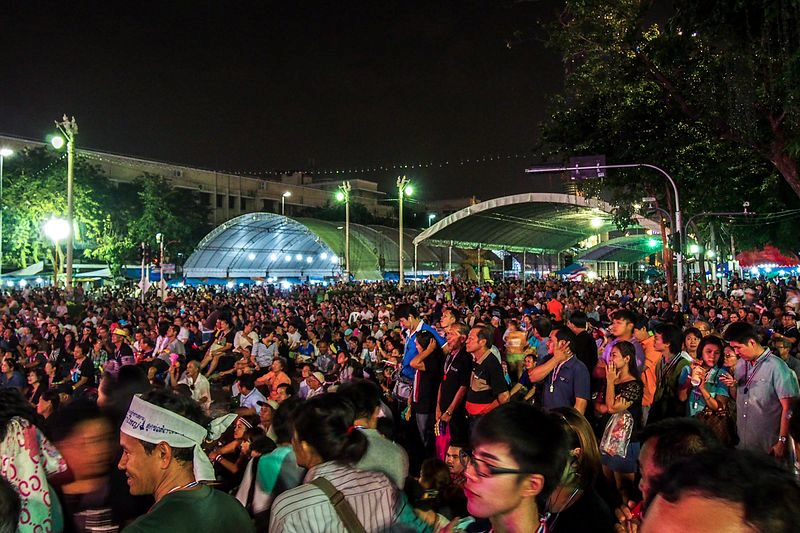
A mass gathering of protesters in Bangkok. Photo courtesy of Maxim B.
January 25, 2026
Up to 200,000 protesters continue to rally in Bangkok in what began as a reaction to a proposed amnesty law that would protect former Prime Minister Thaksin Shinawatra, the older brother of the current Prime Minister Yingluck Shinawatra. The protest has since morphed into an all-out anti-corruption campaign, led by Suthep Thaugsuban of the opposition Democratic Party. Protesters are calling for Yingluck to be replaced by an unelected council, and are threatening to boycott elections on February 2. The protesters, mainly middle-class individuals from Bangkok and Democratic Party supporters from the southern provinces, contrast starkly with Yingluck supporters from the northern provinces and the urban working class. Thaksin’s parties and their supporters have been in power for two decades, having won over the Democrats in the last five elections. Democrats claim that the self-exiled Thaksin still has influence over Thai politics and his sister’s government uses the Thai coffers to buy continued support. Corruption is rampant in Thailand, ranking 102 of 107 in the Transparency International global corruption index, and continues to rise. 25-35 percent of people reported that they had to pay bribes to obtain government contracts, up from five to 10 percent in 1990.
The ongoing protests in Thailand having become increasingly violent with no end to the demonstrations in sight. There has been daily violence related to the demonstrations for the past week. On Sunday January 19th, two explosions timed only minutes apart at a demonstration site near Victory Monument in Bangkok injured at least 28 people. The explosions were caused by fragmentation grenades, the same kind that killed one and injured dozens on Friday at a similar protest march. The explosions on Sunday were meant to target Protest leader Thaworn Senniem, a former deputy prime minister for the opposition Democratic Party. So far, there have been eight deaths and more than 400 injuries related to the political unrest that began in late November 2013, but the violence had been limited to nighttime skirmishes. These explosive attacks represent a worrying spread of violence into daylight hours.
Since then, the Thai government has imposed a 60 day state of emergency within Bangkok and its environs. This gives the government power to ban public gatherings, censor the media, detain subjects without a warrant, and impose a curfew among other powers. However, in practice, it is unclear how much of an effect the declaration will have. Many protesters are already in open defiance to the government, and the police and the military are reluctant to get involved in an already uncertain conflict. Whether or not the decree is effective, it casts an even murkier shadow on upcoming elections, which come before the end of the state of emergency.
The prolonged crisis and increasing violence pose a threat to the government. Since the ousting of Prime Minister Thaksin Shinawatra by the urban elite in 2006, Thailand has a history of political unrest, with several such crises paralyzing Thailand within the past eight years. It is the same upper and middle class Thais who back the current opposition movement, driving to depose Yingluck Shinawatra. A military coup is also a possibility. The Thai military has carried out or attempted a coup 18 times since 1932. Some political analysts say the movement aims to creating enough turmoil in the nation to push the military into seizing power and restoring order. Even without the demonstrations, Yingluck is under pressure to resign. The National Anti-Corruption Commission has found grounds to investigate Yingluck for allegations of handling a deal to export surplus rice to China that would disproportionately benefit her rural farmer supporters. She would be forced out of office if found guilty of these allegations. Whether or not Yingluck chooses to voluntarily step down, order is not likely to return to Thailand for quite some time.
Further Reading:
On the protests
On Corruption
Contributions by Monika Hur, Valerie Zuckerman, and Ben Mandel