


The Week of October 17th, 2016
Care
1. The once and future king
Death of Thailand’s king
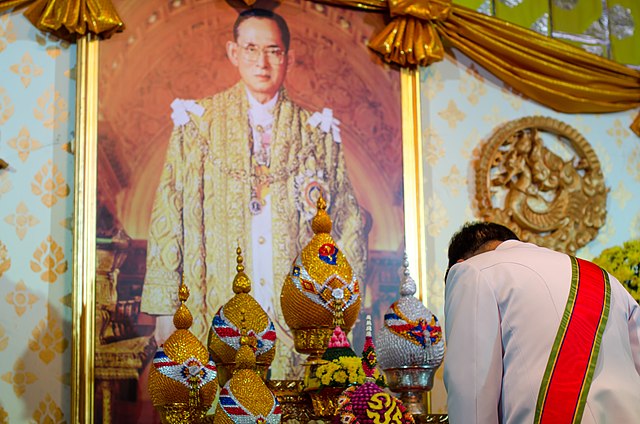
King Bhumibol Adulyadej, Thailand’s monarch, died on October 13th. While the passing of a head of state is normally an important event, King Bhumibol’s passing takes on extra significance due to the veneration his people had for him. In a country marked by deep social and political divides, and rocked by frequent coups, Bhumibol was a rare unifying figure. However, those who did have critical thoughts about the king had a hard time expressing them. Strict lèse-majesté laws mean insults related to the king (including those about his pet dog) can result in 15 years in jail. Such prosecutions have increased in number since a military junta took power in a coup d’état two years ago.
The king’s death is even more important due to his likely successor. In contrast to his adored father, Maha Vajiralongkorn is known for his lavish lifestyle and multiple scandalous romantic relationships. Many Thais question whether he has the dignity necessary to rule a country and unify the people. Although the military has attempted to reshape Prince Vajiralongkorn’s playboy image, his accession may spur support for Thai republicanism. More immediately, Bhumibol’s death may chip away at popular support for the military. The ruling junta came to power after deposing Yingluck Shinawatra, the then-prime minister and sister of Thaksin, a divisive and populist former prime minister who himself was removed through a coup and sent into exile. To combat the influence of the Shinawatras’ parties, the junta often used the king’s blessing to boost their legitimacy. Vajiralongkorn seems unlikely to be able to do the same for the junta. Thailand currently remains in a mood of somber tranquility. But with a pillar of stability gone, it may only be the calm before the storm.
2. Two sides of the same coin
Brazilian speaker expelled
Weeks after the Brazilian Senate voted to impeach President Dilma Rousseff, Brazilian politics has taken another turn for the worse. This week, legislators voted to ban Eduardo Cunha, the speaker of Brazil’s lower legislative body, from politics for the next eight years. Mr. Cunha is currently awaiting charges of corruption after revelations that he did not declare his Swiss bank accounts and took a $2 billion bribe from a company looking to secure a contract with Petrobas, Brazil’s state-owned oil company. Mr. Cunha is part of the center-right Brazilian Democratic Movement Party and was a leading voice behind the effort to impeach Mrs. Rousseff.
Mr. Cunha stood before the chamber and vehemently maintained his innocence, repeatedly asking legislators for proof of any wrongdoing. Watchdog groups accuse Mr. Cunha of using his political position to interfere with investigations and taking billions of dollars’ worth of kickbacks. The police arrested the former speaker, claiming that he is a flight risk, given his dual Italian-Brazilian citizenship and vast financial resources. In the wake of Cunha’s arrest, dozens of politicians have come under scrutiny for shady dealings. In a last-ditch attempt to avoid prosecution, Cunha warned that he would expose other corrupt politicians if his case was sent to trial, something that would severely undermine the already-strained relationship between Brazilian leaders and their people. In a country rife with political corruption and kickbacks, the corruption case against Cunha is par for the course.
3. Laying siege
Retaking Mosul
On Monday, combined Iraqi and Kurdish military forces launched an attack to retake Mosul from ISIS forces. Mosul, Iraq’s second largest city, was taken by ISIS in 2014 and declared the new capital of their “caliphate.” Since taking the city, ISIS has suffered backlash in the form of defections, discontented citizens and internal rivalries. Some residents reported being too scared to leave the town because of the explosive-laden roads and armed troops stationed on the outskirts of the city.
So far, the one-month operation has taken less time than predicted. After warning residents to flee the city, the Iraq troops and Peshmerga forces broke through the enemy’s first line of defense. Then, it proceeded to attempt to liberate 84 villages between their starting point and Mosul. Most recently, ISIS troops were seen fleeing to their base in Raqqa, Syria.
Approximately 100 US advisers are participating in the operation. The US has suffered one casualty from the operation.
Iraq’s triumphs over ISIS are the latest in a string of losses for the terrorist group. In the last year, the Iraqi military has also taken back important cities, such as Ramadi, Fallujah, Sinjar, and Beiji. Earlier this month, US and Turkey-backed Syrian rebels retook the religiously symbolic town of Dabiq. However, the liberated villages have sent thousands of Iraqis flooding to UN-run Syrian refugee camps. The international community is determined not to abandon the city and its citizens after the recapture and has scheduled diplomatic talks in Paris.
4. Catch me if you can
Russian hacker arrested
Russian hacking has had an alarming and almost continuous effect on the United States over this past year, especially with regards to the 2016 election. Vladimir Putin, Russia’s authoritarian president, has been friendly with presidential candidate Donald Trump, and US intelligence believes that Russia has been hacking the Democratic National Convention and the Clinton campaign as a way to support the Republican nominee. This summer, the Russian hacking of DNC communications led to the resignation of DNC Chair Debbie Wasserman Schulz, and recent hackings of Hillary Clinton’s campaign chairman John Podesta’s emails have been an obstacle for Ms. Clinton. Last week, the United States formally accused Russia of hacking to interfere with the election, an accusation that carried significant diplomatic consequences.
The United States, working with the Czech Republic, arrested a high-profile Russian hacker this week operating in Prague. The hacker is suspected of conducting extensive hacking against the US government, although he does not appear to have been directly involved in the high-profile DNC hacks. Capturing this operative is a major win for US intelligence, as it not only deprives Russia of one of their most skilled hackers but also allows the FBI to interrogate him and potentially bolster American cybersecurity infrastructure. Russia, which continues to formally deny responsibility in these cyberattacks, has called for the hacker to be turned into their embassy, which implies this man’s status as an operative of the Russian government. The capture of this hacker provides two key advantages for the United States. First, it demonstrates that the United States is now much more capable of policing former safe-havens for Russian hackers like the Czech Republic due to increased diplomatic power. Second, United States is beginning to strike back against Russia’s attacks on American democracy, an effort that will most likely only strengthen in the coming months.
5. New leader, old problems
UN’s new secretary-general
Last week, the United Nations General Assembly officially appointed a successor for the post of world’s top diplomat. António Guterres, 67, will become the new secretary-general on Jan. 1st. Originally, the six-month campaign was expected to result in the selection of the first-ever woman and Eastern European as secretary-general. Ultimately, Mr. Guterres was chosen, the former Socialist prime minister of Portugal and head of the UN’s refugee agency.
The UN’s three main pillars are helping the world’s poor become less so, ensuring human rights are respected across the globe, and making and keeping the peace. Mr. Guterres seems well-suited to make real progress on these fronts. As prime minister, he oversaw reduced budget deficits and increased welfare spending as well as the creation of a conditional cash transfer program. Having spent a decade leading the the 10,000 staff UN Refugee Agency, he knows the workings of the vast UN bureaucracy.
By all accounts Mr. Guterres is a strong leader and a principled one. He has garnered praise from around the globe for his leadership style of consensus building and communication. Indeed, he will have his work cut out for him. Civil wars in the Middle East and South Sudan require immediate attention. There are more refugees now than at any point since World War II. It is not without reason that the position of secretary-general is referred to as “the most impossible job in the world.” Mr. Guterres will need to draw on his deep experience as a skilled international operator for the UN to confront these and other crises around the globe. That Mr. Guterres won the first-ever open election for the position speaks to his broad appeal. Ban Ki-moon, the outgoing secretary-general, praised the Portuguese for being best known as someone “on the front lines of armed conflict and humanitarian suffering.” He shall have to be ready to do so from day one.
Don’t Care
0. Live and die by the sword
Saudi prince executed
On Tuesday, Saudi Arabian prince Turki bin Saud al-Kabir was put to death by the country's government. The death sentence came as per royal order from the Middle Eastern nation’s king, King Salman, and marks the first execution of a Saudi royal in over 40 years. The last time the Saudi government executed a member of the royal family was in 1975, when another prince assassinated his uncle and was subsequently put to death.
Prince Turki was found guilty of murder in the shooting death fellow Saudi citizen Adel bin Suleiman bin Abdulkareem Al-Muhaimeed three years ago. The death occurred during a street brawl in the outskirts of Riyadh, the Saudi Arabian capital. Prince Turki’s death sentence was handed down by the nation’s General Court, and upheld by the Supreme Court and finally by royal decree.
The execution was mostly lauded by the Saudi citizenry, many of whom felt that the king’s decision illustrated his commitment to treat all members of society equally in the eyes of the law. A video of the king saying “any citizen can sue the royal family and seek justice”, as well as a hashtag which translates to “decisive Salman orders retribution for prince”, have both gone viral in the wake of Prince Turki's execution.
However, it seems that the pride of Saudi citizens in the equity of their legal system may be somewhat misplaced. Many royals accused of heinous crimes have received last-minute clemency from their victim’s families in exchange for huge sums of cash, often called “blood money.” In Prince Turki case, his victim’s family’s desire for justice could not be assuaged by this “blood money,” and Prince Turki was forced to pay the ultimate price. But a system in which the wealthy can buy their way out of a murder conviction hardly seems worthy of praise.
Wooyoung Lee, Avi Dravid, Sophie Chen, Jose Trejos, David Gernon, and Max Rowe contributed